Arkansas Rice Update 8-7-26
Arkansas Rice Update 2026-21
August 7, 2026
Jarrod Hardke, Scott Stiles, Nick Bateman, & Ben Thrash
“I hear the train a-comin’, it’s rollin’ round the bend.”

I Feel My Temperature Rising
The heat continues. We talked about drain timing last week. Gentle reminder that under current conditions, when you pull the water the ground is going to turn to concrete extremely fast. Given how far behind we are in rainfall for the past year, there is little subsoil moisture to support us once we shut the irrigation down. Notice how fast water has disappeared in your rice fields this year? That’s what we’re talking about. When you pull the water you need to be hooked up, greased, and ready to roll.
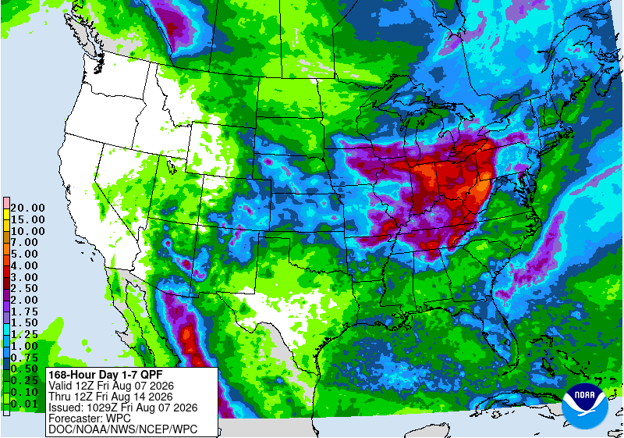
While there does appear to be a chance for some precipitation over the next week, it looks random and sketchy. Even if we do see some pop-up storms, the previous comments about the ground drying quickly won’t change. But do be mindful of rain chances that could give your harvest start fits especially if you intend to use sodium chlorate.
The limited super early harvest reports are of good yields (better than last year) and initial milling also better (not the best but better). Both of these are positive initial signs that we’re on an average or better yield track and provide some hope for milling. But for milling – that story really gets written as harvest progresses. This grain is going to get very dry and very brittle very fast. Review drain timing considerations in last week’s update, and if you like to use sodium chlorate as a harvest aid we’re covering that this week.
With harvest in the southeast and central portions of the state getting going, and more reaching the starting line up and down the state, this may turn into a quick and dirty harvest if conditions stay dry. The first rice fields combines are hitting are seeing grain moisture a little lower than expected, so keep that in mind and try to check a sample early.
Next week we’ll see the first certified acreage report for the year to see where acres have ended up. Should be interesting along with updates to production estimates.
See more below on harvest aids, rice stink bugs, and markets.
Let us know if we can help.
Fig. 1. NOAA 7-day precipitation forecast.
Harvest Aids in Rice
Jarrod Hardke
PDF version of this article for download: Harvest Aids in Rice.
The use of sodium chlorate (salt) as a harvest aid in rice can be an excellent tool when needed, but it can hurt us when used incorrectly. Here are some guidelines we’ve developed to assist with maximizing the benefits of this tool while minimizing the risks if you choose to use sodium chlorate (salt) as a harvest aid. Please read through all of the guidelines as some of the comments overlap in attempting to logically answer all of the questions we usually receive.
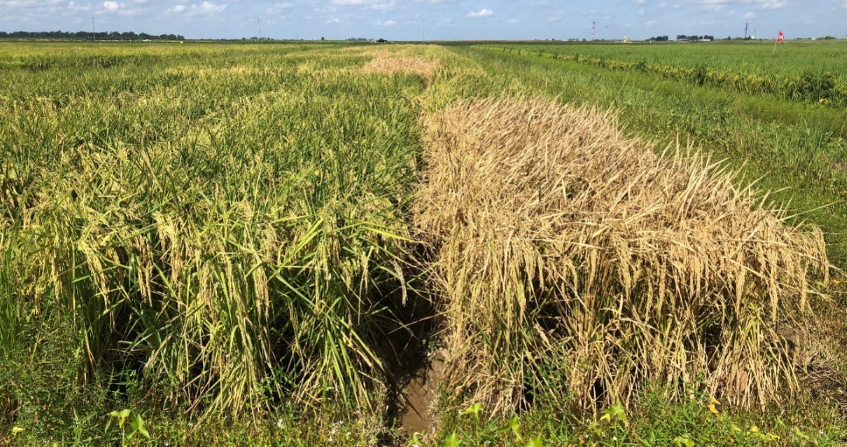
Fig. 2. Research plots receiving sodium chlorate (right) versus untreated check.
Determining initial grain moisture
Often at higher moisture levels we’re more interested in collecting a hand sample rather than put a combine in the field just to see where our starting point is. A hand sample is fine, but it has limitations. Add AT LEAST 2% to the moisture level you get from a hand sample, and often adding 3% is needed. We pull a lot of hand samples preparing for plot harvest and frequently find that the difference between a hand sample and a combine sample is 2-3% (a hand sample is always lower moisture – higher moisture grains are difficult to remove by hand).
What moisture is safe to begin applying sodium chlorate to rice?
Varieties should be below 25% grain moisture before applying sodium chlorate (e.g., Ozark, DG263L, CLL18, etc.).
Hybrids should be below 23% grain moisture before applying sodium chlorate (e.g., RT 7302, RT 7521 FP, etc.).
While these moisture levels are safe, we need to be smart about how we proceed to achieve the outcomes we want. Depending on your target harvest moisture, we may need to wait longer. Some want moisture below 20% for harvest while others may need rice to be below 18%.
Salted rice can drop in moisture approximately 1% per day depending on conditions compared to 0.5% per day for rice that hasn’t been salted. A simpler way to put it is that salt initially takes out ~2% of grain moisture and after that grain moisture trends down similarly regardless of whether rice is salted or not. So, if salting at 23% and wanting to start harvest at 18%, you’ll need to wait 5 days before starting harvest (which is too long – more on that below).
What rates of sodium chlorate should I use?
Sodium chlorate is mostly available as a 5 lb a.i. per gallon product (1 gallon of product contains 5 lbs of active ingredient). We’ve most commonly evaluated rates ranging from 3 lb a.i. to 6 lb a.i. (0.6 to 1.2 gal product per acre) but for simplicity you can think of ½ gallon to 1 gallon as comparable rates. When comparing 3 lb to 6 lb applications, we haven’t seen much difference – but higher rates can give more uniformity and more consistent drydown of the overall plant. The grain moisture response was very similar as was upper canopy desiccation.
When should I start harvest?
Start in 2-3 days and complete harvest in 5 days or less after application of sodium chlorate. Waiting longer can allow heavy dew and/or rain events to cause milling issues. Also, the entire panicle can get drier, becoming more susceptible to shattering. Risks for milling and yield loss increase the longer harvest takes beyond 5 days after application. Avoid salting too far ahead of the combine.
When should I stop applying sodium chlorate?
Once moisture falls below 18%, exercise caution when using sodium chlorate. Long-grains don’t seem to have as much risk below 18%, but medium grains should NOT be salted once they fall below 18%.
If salting long-grains at lower moistures, consider using a lower rate of sodium chlorate – 2.5 to 3 lb a.i. (0.5 to 0.6 gallons) and begin harvest the following day after application – complete harvest within 3 days of application.
Lodged rice
Don’t salt rice that has lodging. The salt will only work on the plants contacted by the application, meaning severely dried plants on top and still green plants underneath. It becomes a blended mix of wetter and drier grains. Fields with only small areas of lodging are not of great concern.
Additional thoughts
Don’t salt rice solely on the basis of rapidly lowering grain moisture and expect a major moisture reduction. In research trials, whether harvested 3 or 7 days after application, salted plots were typically only 2% lower grain moisture than plots that weren’t salted.
In 2019 when we looked at multiple cultivars starting at 20-22% moisture, it turned very hot and moisture fell 1% per day (without applying salt). So, in 7 days we observed a fall from 20-22% moisture to 13-15% moisture (the average high those 7 days was 95). Use caution under these conditions. Moisture dropping to very low levels in long grains is not necessarily going to cause excessive milling issues as long as it’s harvested immediately so that no re-wetting and drying can occur. Medium grains allowed to drop to these low moisture levels will generally see greater penalties in milling yields.
Quick Take-Homes for Sodium Chlorate (salt) as Harvest Aid in Rice
- Only salt once rice is below 25% for varieties or 23% for hybrids.
- Expect only 3-5% moisture drop by 5 days after application.
- Complete harvest in 5 days after application.
- Do not salt medium-grains below 18% moisture.
- If salting long-grains below 18% moisture, begin harvest the following day and complete harvest by 3 days after application.
- DO NOT get too far ahead of the combine with salt applications.
- Avoid salting rice with lodging issues.
- Use rates ranging from 2.5 to 6.0 lb a.i. (0.5 to 1.2 gallons per acre of 5 lb a.i. products). Use lower rates if rice is lower moisture.
Rice Stink Bug Termination and Rice Delphacid Update
Nick Bateman and Ben Thrash
Rice stink bug numbers have been all over the board this year. However, in the past week or so, our phones have been ringing pretty consistently on rice being at “drain timing” and stink bug numbers have hit threshold and in some cases well above threshold. The question has been, “should I treat?”
We have done a lot of work over the years to determine when the proper termination timing is for rice stink bug. All of this work suggests that rice is pretty safe from “peck” damage once panicles are 50-60% straw colored. Damage after 60% is not common, however if we get into a rainy pattern, kernels can soften and make it easier for stink bugs to damage it. With the current weather outlook of hot and dry, stink bugs will struggle to cause much damage to rice that is past the 60% mark. With that being said, if a field is just getting to 50-60% and running numbers over 15 bugs per 10 sweeps, I would consider treating with a reduced rate of Tenchu (5-6 oz/a). These reduced rates won’t provide a long residual but will provide adequate knockdown.
Lastly, while rice delphacid has not been documented in Arkansas yet this year, Dr. Dawson Kerns at LSU did find a lone female in Winnsboro on Wednesday. We will be doubling our efforts on surveys this upcoming week to determine if they are in the state. Unless something changes drastically in the next few weeks, I think it’s safe to say we will outrun this pest this year. Call us if you have any questions.
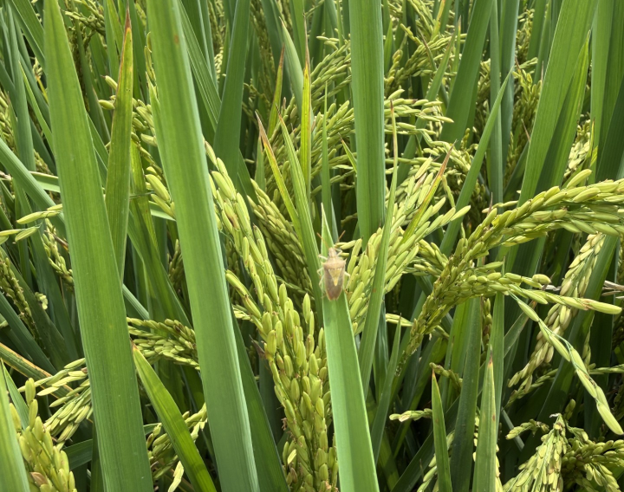
Fig. 3. Rice stink bug adult surveying his dining options.
Market Update
Scott Stiles
Get Ready. Next week, all eyes will be on the USDA’s first survey-based production estimates of the 2026 crop. In the May, June, and July new crop balance sheets, production estimates were based on simple trend-line yield assumptions and NASS’ acreage surveys. The large reduction in rice acres and early planting this year would generally point to better-than-trendline yields.
Yield information across a good swath of acres is available in Louisiana and Texas. In last Monday’s Crop Progress, USDA estimated Louisiana’s rice harvest was 51% complete v. 26% last year and the 5-year average of 22 percent. Texas was 13% harvested compared to 14% last year and the 5-year average of 13 percent. Of note, the LSU AgCenter reported this week that rice losses in Louisiana from Tropical Storm Arthur were close to $16 million. In addition to crop losses, farm machinery and grain storage were impacted by flooding as well. Economic impact of Tropical Storm Arthur on Louisiana agriculture exceeds $112 million
Next Wednesday’s USDA reports will also include the year’s first release of FSA certified acreage. This adds a layer of uncertainty as NASS will refine their June Acreage survey with current information from FSA and RMA data. In other words, we may see some acreage revisions in the August Crop Production and WASDE.
Given the early planting this year and the advanced maturity of the crop, USDA may handle its August rice yield estimates differently from past years. Normally, in-field yield assessments by NASS are not done until the September report. August yield estimates are typically based on farmer survey data, as well as crop condition and satellite/crop density analysis. Information on yield estimates and procedures will be available in next week’s Crop Production.
Links to the USDA’s Crop Production, WASDE, and FSA acreage reports are listed below. These will be released on Wednesday, August 12th at 11:00 AM CT.
WASDE (World Supply and Demand Estimates)
Crop Acreage Data | Farm Service Agency
Fig. 4. CME September 2026 Rough Rice Futures, Daily Chart.
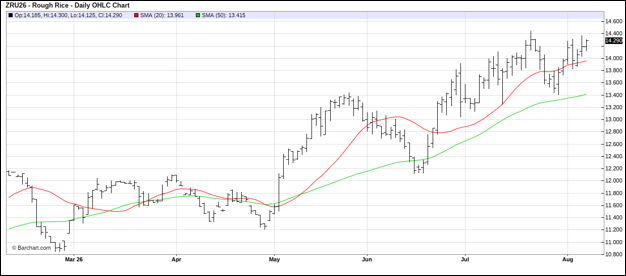
Last week we talked about resistance at the 20-day moving average (red line). The September contract did close above the 20-day in last Friday's session. That was a key technical hurdle to clear in getting back to $14. The next layer of resistance will be the July 22nd high at $14.44. Support is now at $14 and the 20-day moving average at $13.96. Ahead of next Wednesday’s USDA reports, expect low-key, narrow-range trading. On Wednesday, the market will be hyper-focused on the prospect of rice acres being reduced a bit more and the 2026/27 balance sheet tightening further.
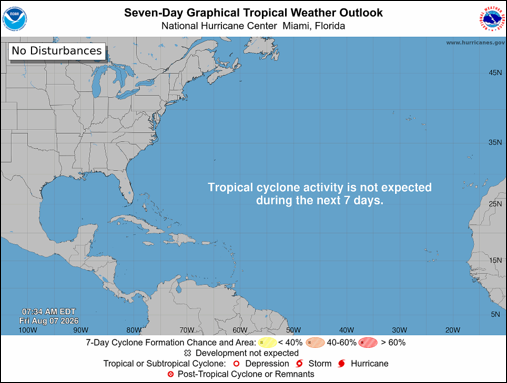
Cash rice bids for August to October delivery at dryers averaged $5.90/bu. on Friday. Mill bids were $6.00/bu for fall delivery. Mill bids for early 2027 delivery were $6.22 per bushel. We continue watching the Mississippi River gauge. It was -.82’ Friday morning and almost 10 feet below last year. Also worth a mention, the Atlantic Hurricane map is bone-dry. There’s more news this week on barge lines implementing “Low Water Protocols”, reducing drafts and tow sizes. Friday’s forecast had river levels rising marginally next week to +1’ before turning lower. Barge freight in the Cairo-Memphis territory increased for the 6th consecutive week—up 7% from last week. With harvest getting underway, expect some downward pressure on grain basis very soon.
Fig. 5. Mississippi River at Memphis, TN.
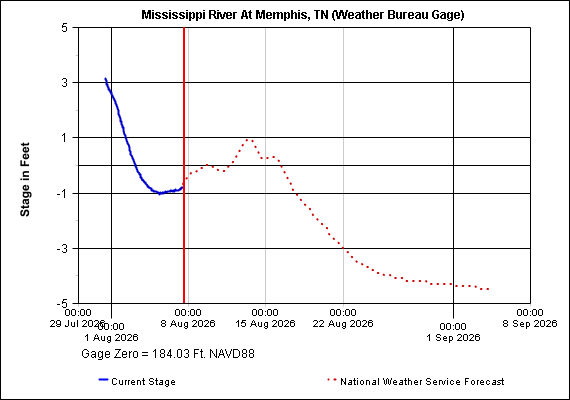
Fig. 6. Seven-Day Graphical Tropical Weather Outlook.
DD50 Rice Management Program is Live
The DD50 Rice Management Program is live and ready for fields to be enrolled for the 2026 season. All log-in and producer information has been retained from the 2025 season, so if you used the program last year you can log in just as you did last year. Log in and enroll fields here: https://dd50.uada.edu.
Use the Arkansas Rice Advisor Internet App!
The Arkansas Rice Advisor site https://riceadvisor.uada.edu functions like an app on your mobile device. There you can readily access the DD50 program, rice seeding rate calculator, drill calibration, fertilizer and N rate calculators, publications, and more.
Additional Information
Arkansas Rice Updates are published periodically to provide timely information and recommendations for rice production in Arkansas. If you would like to be added to this email list, please send your request to rice@uada.edu.
This information will also be posted to the Arkansas Row Crops blog (http://www.arkansas-crops.com/) where additional information from Extension specialists can be found.
More information on rice production, including access to all publications and reports, can be found at http://www.uaex.uada.edu/rice.
Acknowledgements
We sincerely appreciate the support for this publication provided by the rice farmers of Arkansas and administered by the Arkansas Rice Research and Promotion Board.
The authors greatly appreciate the feedback and contributions of all growers, county agents, consultants, and rice industry stakeholders.
Specialist |
Area |
Phone Number |
|
|---|---|---|---|
|
Jarrod Hardke |
Rice Extension Agronomist |
501-772-1714 |
|
|
Tom Barber |
Extension Weed Scientist |
501-944-0549 |
|
|
Nick Bateman |
Extension Entomologist |
870-456-8486 |
|
|
Ralph Mazzanti |
Rice Verification Coordinator |
870-659-5507 |
|
|
Trent Roberts |
Extension Soil Fertility |
479-935-6546 |
|
|
Bob Scott |
Extension Weed Scientist |
501-837-0273 |
|
|
Scott Stiles |
Extension Ag Economics |
501-258-8455 |