Arkansas Rice Update 5-29-26
Arkansas Rice Update 2026-12
May 29, 2026
Jarrod Hardke, Scott Stiles, Nick Bateman, & Ben Thrash
“Most gamblers know that they’ll never break even.”

A Little Cooperation Please
A second rainy week in a row wasn’t exactly on the list of requests. Naturally the weather has decided to work on catching up on missing rainfall from earlier in the year at just the wrong time. Depending on where you stand in the state, somewhere around 7-9 days of the past two weeks have had measurable rainfall – some days that might be 0.1 inches and some days that might be over 2 inches, but it’s just staying damp. Over just the last 7 days some areas have received over 6 inches of rain.
Plenty of rice that has already been put to flood looks really good at this point. Unfortunately, there is a sizable amount of rice that has finally reached a point we’re comfortable going to flood, but we’re running out of opportunity to fertilize the right way and on time. We need to be prepared to pivot. “Spoon feeding” is not a preferred recommendation – it takes more nitrogen and is more difficult to manage, but it does work, and needs to be considered on fields that have run out of time or are about to. More on this in the update.
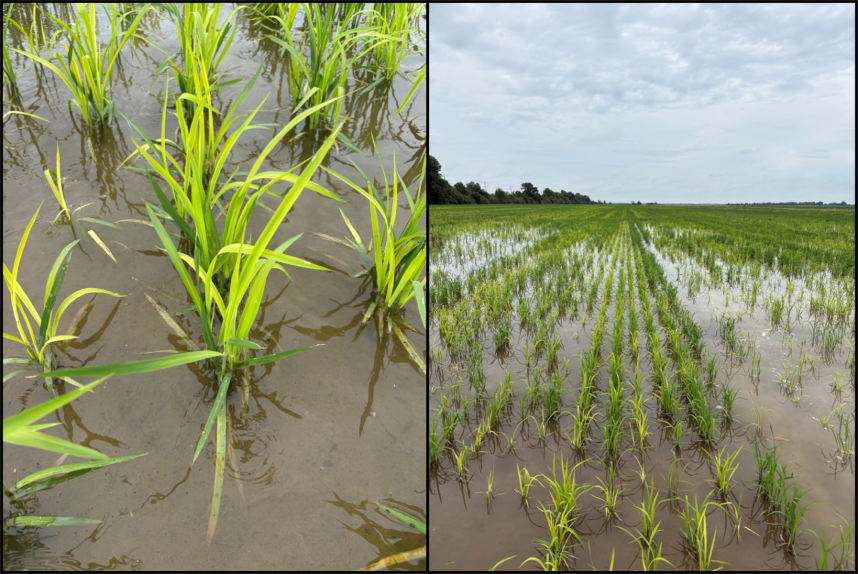
We seem to be on the road to warmer days, but a steadily unsettled pattern of rain chances. Most calls this week have revolved around herbicide injury from ACCase products (e.g., Highcard, Ricestar) from the continued cloudy wet weather. The ALS products like Permit have also been causing the post-flood bright yellow erratic pattern flashing we regularly see under these similar weather conditions. And of course a heavy turn toward managing nitrogen with wet, muddy, and/or drying fields (covered in the 5-22 Rice Update).
In this update is info on crop progress and preflood N management, herbicide cut-off timings, rice water weevil management, and rice markets.
Let us know if we can help.
Additional article: Preflood Nitrogen in Rice: Core Principles for Nitrogen Efficiency and Yield Protection – Ana Smith, Justin Chlapecka, and Trent Roberts.
Fig. 1. NOAA 7-day precipitation forecast.
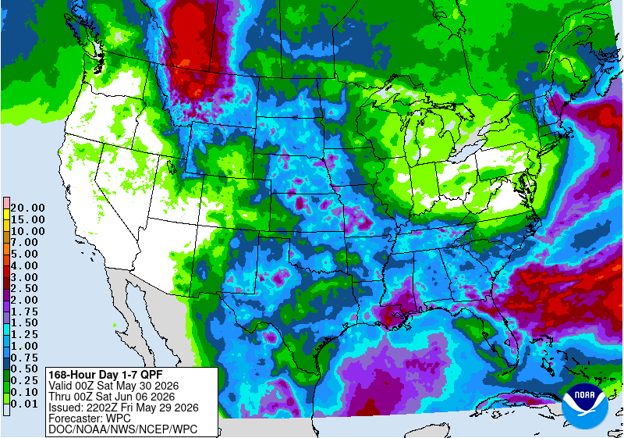
Fig. 2. ALS injury (flashing) post-flood.
Running on Empty – Behind on Preflood N
Jarrod Hardke
The time is now to get some nitrogen (N) out in some kind of way. The wet ground troubles have found us once again like in 2024 and 2025. In 2024, we seemed willing to go to alternative plans like spoon-feeding when conditions stayed too wet to put preflood N on dry ground. That served us well with high yields. Unfortunately, in 2025 there was a general reluctance to pivot while we waited too long for ground to dry and we saw yield reductions as a result. We’re on a similar path now with some fields already reported at green ring with no N applied yet and no flood. Oy…
So, let’s use RT 7521 FP as an example cultivar. Have a look at Table 1 for key dates at our Stuttgart and Harrisburg planting date studies according to the DD50 Rice Management Program. Rice that emerged mid-April or earlier has reached or is past the final N date and in some cases should already be at panicle initiation (green ring) by now. Remember all cultivars are different in their time from emergence to green ring – this is where the DD50 program and it’s final N date recommendation are a huge help – it tells you when you are or aren’t running out of time on N. Some cultivars have more time than this to reach final N date and green ring, but some others have less time.
Rice will try to wait when it doesn’t have enough N, but you can only ask it to wait for so long. If you have reached green ring and still no N has been applied, be prepared for noticeable yield losses come harvest. A lot of variables can fluctuate the outcome, but 20-30 bu/acre yield losses aren’t abnormal.
Table 1. Agronomic and nitrogen management dates from the DD50 Rice Management Program for RT 7521 FP in planting date studies at Stuttgart (RREC) and Harrisburg (NERREC) in 2026.
|
Location |
Planting Date |
Emergence Date |
End of Early N |
Final N Date |
Green Ring |
|---|---|---|---|---|---|
|
Stuttgart |
3/20 |
4/2 |
5/10 |
5/21 |
6/3 |
|
Stuttgart |
3/31 |
4/14 |
5/19 |
5/29 |
6/10 |
|
Stuttgart |
4/15 |
4/27 |
5/27 |
6/5 |
6/17 |
|
Stuttgart |
5/4 |
5/13 |
6/6 |
6/15 |
6/25 |
|
Stuttgart |
5/18 |
5/25 |
6/16 |
6/24 |
7/5 |
|
|
|
|
|
|
|
|
Harrisburg |
3/19 |
4/3 |
5/3 |
5/16 |
5/28 |
|
Harrisburg |
3/31 |
4/16 |
5/16 |
5/25 |
6/6 |
|
Harrisburg |
4/14 |
4/25 |
5/22 |
5/31 |
6/11 |
|
Harrisburg |
5/4 |
5/15 |
6/6 |
6/14 |
6/24 |
|
Harrisburg |
5/19 |
5/27 |
6/17 |
6/24 |
7/4 |
Beware Herbicide Cut-Off Timings
Jarrod Hardke
Green Ring is here or rapidly approaching for many acres in the state. Considering the situation described above where we’re getting really late putting rice to flood – beware that some of your intended “preflood” applications may be knocking on the door of green ring.
Notice in Table 2 that a lot of herbicides have a green ring cut-off or have a recommendation for even earlier. Use caution when deciding what to use preflood and know your growth stage! A number of discussions this past week have mentioned Highcard / Provisia / Ricestar / Regiment and you’ve got major risk applying those when reaching green ring.
For more info on herbicide cut-off timings for additional herbicides and other crops, check out MP566 Application Cut-Off Timings for Common Herbicides.
Table 2. Rice herbicide cut-off timings and season max use rates.
|
Herbicide |
Rice Growth Stage Cut-Off |
Season Max Use Rates |
|---|---|---|
|
Aim |
60-day PHI; ½” IE recommended |
8.8 fl oz/ac |
|
Basagran |
No cut-off on label |
4 pt/ac |
|
Beyond/Postscript |
BIE/green ring plus 14 days |
10 fl oz/ac – Beyond 15 fl oz/ac – Postscript |
|
Clincher |
60-day PHI; green ring recommended |
25 fl oz/ac |
|
Facet |
40-day PHI; 7 days prior to green ring recommended |
43 fl oz/ac |
|
Gambit |
48-day PHI |
2 oz/ac |
|
Grandstand |
½” IE; green ring recommended |
32 fl oz/ac |
|
Grasp |
60-day PHI ½” IE recommended |
5.6 fl oz/ac |
|
Londax |
60-day PHI ½” IE recommended |
1.67 oz/ac |
|
Loyant |
60-day PHI; 7 days prior to green ring recommended |
32 fl oz/ac |
|
Newpath/Preface |
5-leaf rice |
12 fl oz/ac |
|
Permit |
48-day PHI |
1.33 oz/ac |
|
Permit Plus |
48-day PHI |
1.5 oz/ac |
|
Phenoxy (2,4-D) |
Green ring |
3.2 pt/ac |
|
Propanil |
60-day PHI; green ring recommended |
8 qt/ac |
|
Provisia/Highcard |
Green ring |
31 fl oz/ac |
|
Regiment |
Green ring |
1.06 oz/ac |
|
Ricestar HT |
Green ring |
30 fl oz/ac |
|
Rogue |
2-tiller rice |
12.6 fl oz/ac |
|
Sharpen |
½” IE |
6 fl oz/ac |
|
Ultra Blazer |
50-day PHI |
1 pt/ac |
Rice Water Weevil Management
Nick Bateman & Ben Thrash
We have had several reports of rice water weevil (RWW) activity in rice that has gone to flood in the past 7-10 days. Most of these reports have not been overly alarming with most of the activity being relegated to the traditional areas where we would expect to find higher populations (near tree lines and low lying/swampy areas). However, in some of the more severe cases, folks have been asking about foliar treatments or is the seed treatment that came on the seed good enough, and if they should drain the field. Right now, we should focus on adult control. It will take a few weeks to determine what level of larvae are present in the field, and whether draining is needed.
Almost all of the rice planted in Arkansas is either treated with CruiserMaxx Rice or NipsIt Inside seed treatment, which are excellent on grape colaspis. However, efficacy of these products on RWW decreases 28-35 days after planting in the best conditions. Although RWW pressure is higher for later planted rice, these plantings typically experience rapid growth allowing us to flood within 3 weeks of planting. In these situations, we still get sufficient control of RWW with NipsIt or CruiserMaxx. If rice has been treated with Dermacor or Fortenza, it will still have protection from RWW at least 60 days after planting. Also, it is important to note that NipsIt and Cruiser within the 28-35 days after planting will reduce scarring observed. However, Dermacor and Fortenza will not affect scarring but will maintain better control of larvae.
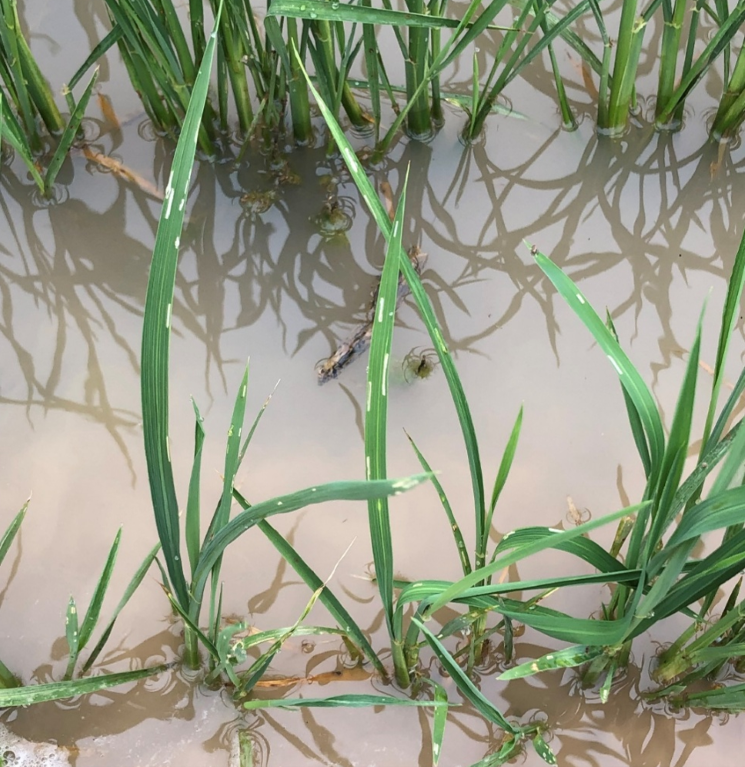
For rice that is going to flood past the 28-35 day window with CruiserMaxx Rice or NipsIt, a foliar application of a pyrethroid like Lambda-cy or Mustang Max might be called for. However, Dermacor and Fortenza will NOT need a foliar application. While scarring from adult weevil feeding is usually superficial and doesn’t cause yield loss, this is a sign that adults are present and active in the field. Scarring can be used to determine if a foliar application is warranted. In general, an application is warranted if over 50% of new leaves have scarring present and adults are present. Using a sweepnet is a good way to determine if adults are still present. One of our students has been working on a threshold using a sweep net for several years and it seems like if you are catching 15 RWW adults per 10 sweeps, there is high likelihood that over threshold numbers of larvae will be present.
Timing is critical on foliar applications for rice water weevil. Applications must be made within 5-7 days of permanent flood establishment, as long as adults are present. If it is later than that, our studies indicate you may as well keep the insecticide in the jug. We have done a lot of work comparing preflood applications versus postflood for RWW control, and in general preflood has done better. There is a major caveat with how we do this work versus the real world. This has to do with the time to flood establishment. Generally, our test is flooded to a 4-inch depth within 12-24 hours after application. This is not realistic on any grower field. If we are using Lambda-Cy we only have about 24 hours of residual. If Lambda-Cy is applied to soil and then a flood is applied it can trap the insecticide on the soil. If it takes 7-10 days to get a field covered in water we have essentially wasted a $1 an acre.
Let us know if you have any questions.
Fig. 3. Rice water weevil adult feeding on rice.
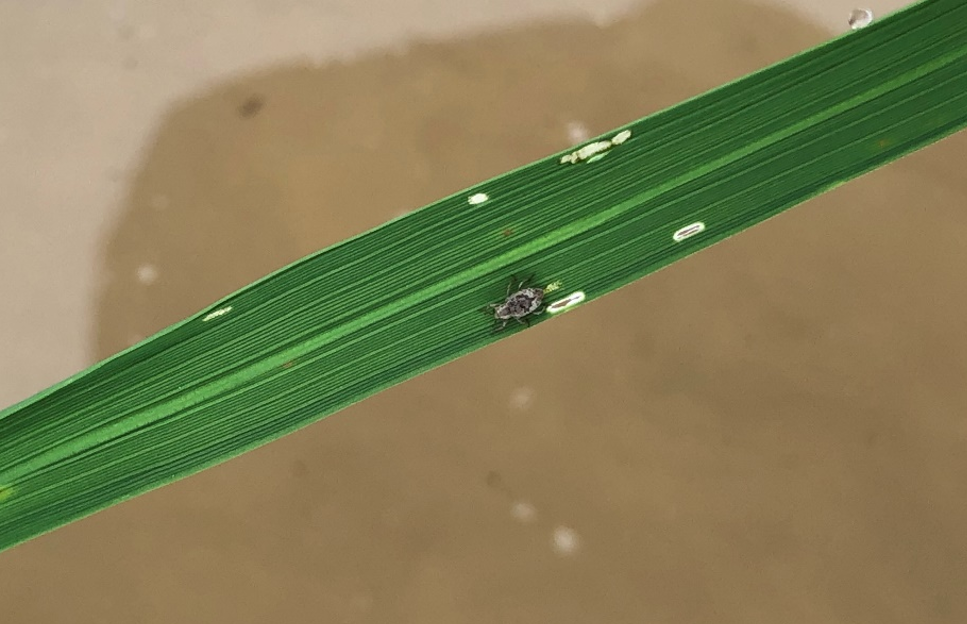
Fig. 4. Leaf scarring from rice water weevil adult feeding.
Market Update
Scott Stiles
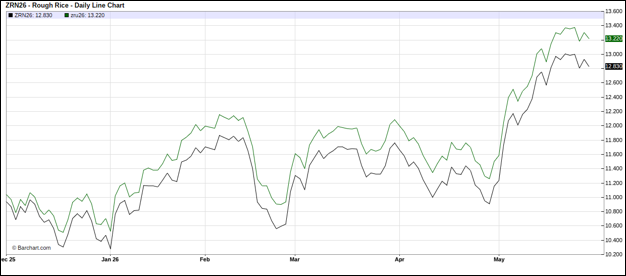
This week has been characterized by back-and-forth trading. The old crop July contract has run into resistance at $13.00/cwt. while the new crop September contract stalled in the $13.40 area. The July contract currently trades near $12.85 (black line in chart below), reflecting heavy ending stocks and slow exports of the 2025/26 marketing year. The September contract, trading near $13.20 (green line in chart below) and a roughly 40-cent premium to July, foretells of lower production and tighter stocks in 2026/27.
Figure 5. CME July and September 2026 Rough Rice Futures, Daily Chart.
Recapping some of this week’s USDA reporting, the latest Crop Progress had long-grain planting essentially wrapped up. As of May 24th, Arkansas was at 98% planted as well as Mississippi and Missouri. Planting was complete in Louisiana and Texas. Of note, the crop insurance final planting date for Arkansas was May 25th, with the late planting date ending June 9.
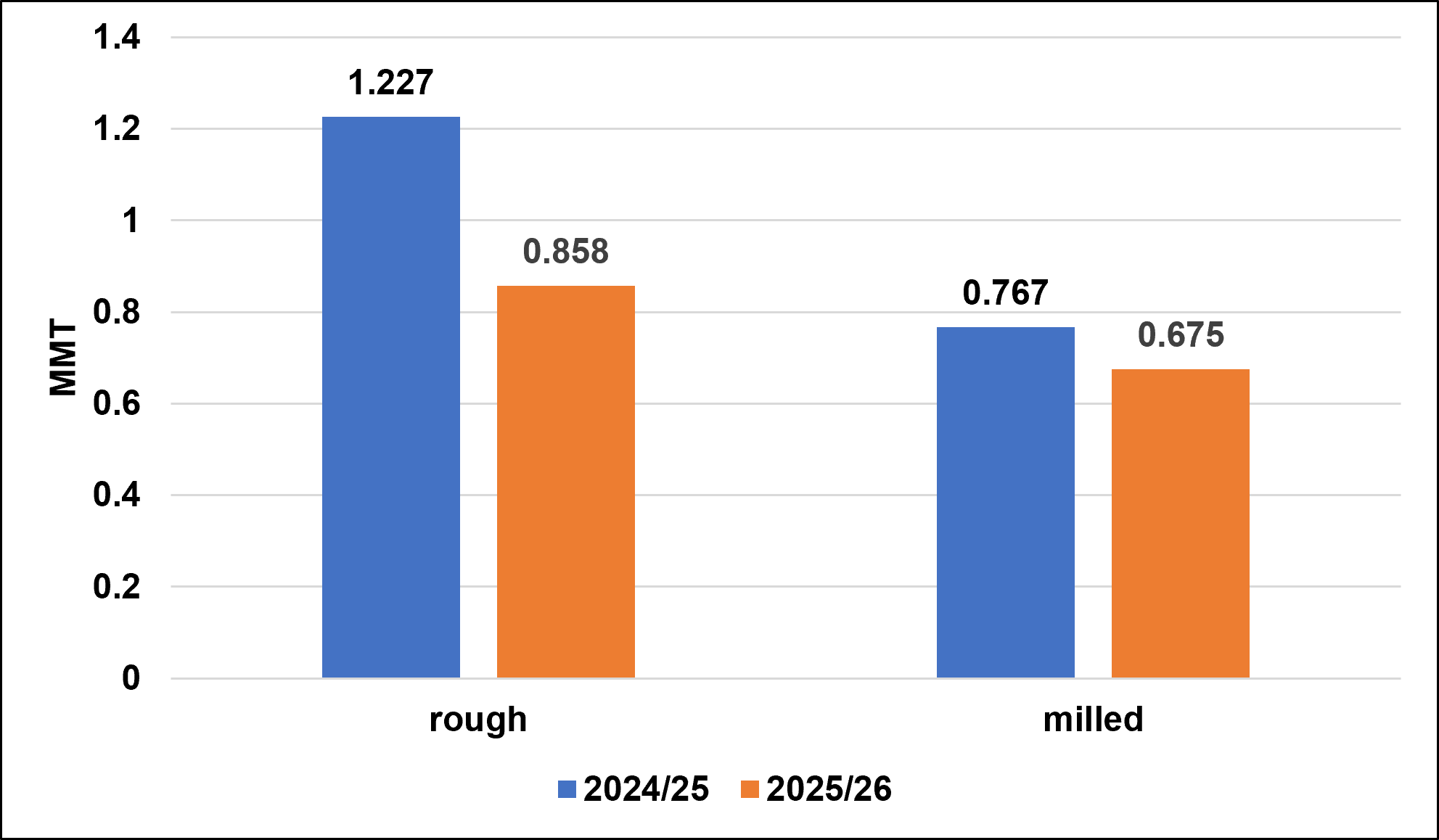
Export sales last week were lackluster for both rough rice and milled rice. Long-grain rough rice sales totaled 5,129 MT for the week ending May 21st. Honduras (5,000 MT) and Mexico were the only buyers. Milled rice sales totaled 2,146 MT with Canada, Mexico, and Saudi Arabia accounting for most of the business. There were two new crop sales last week: 1,000 MT of long-grain brown and 9,000 MT of long-grain milled, both to the United Kingdom.
Year-to-date, total long-grain sales are 23% behind last year. Rough rice sales are down 30% on large reductions in sales to Mexico (-46%), Guatemala (-61%) and Honduras (-22%). Milled rice sales are down 12% from a year ago. The decline is largely attributed to a 40% reduction in sales to Iraq. An agreement between the United States and Iran to reopen shipping through the Strait of Hormuz would be constructive and possibly encourage some additional milled rice business for the U.S.
Figure 6. U.S. Long-Grain Export Sales, week ending May 21.
source: USDA Foreign Agricultural Service
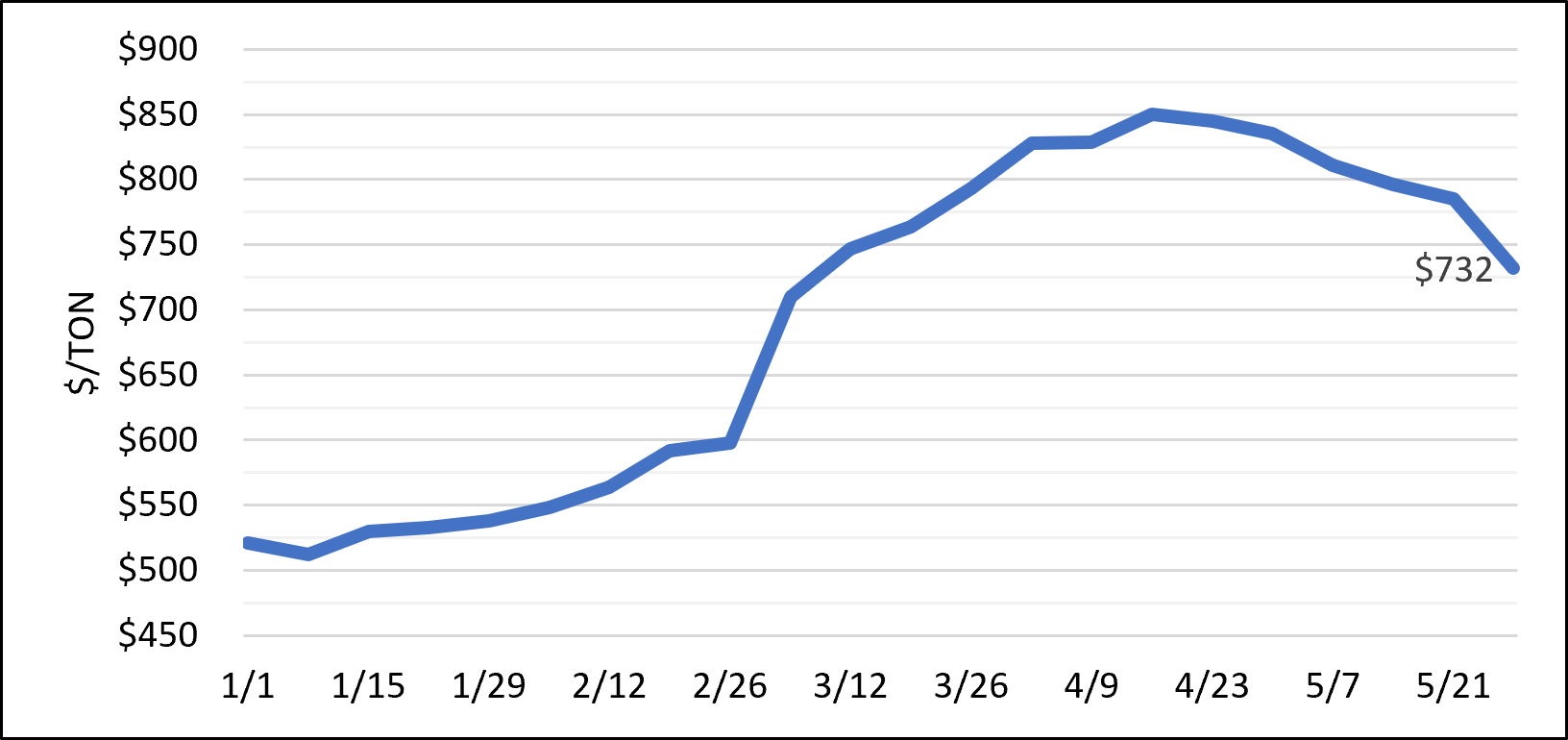
On a more positive note, energy markets are lower this week as well as Urea prices. The oil market is sensing the U.S. and Iran are getting closer to a deal. WTI (NYMEX crude oil) traded over $109/bbl on May 18th. This week, WTI has slipped into the mid $80s. Regarding Urea, average prices in Arkansas have dropped over $100/ton in the past month. From our weekly survey, the average Urea price this week was $732 per ton. Prices will vary around the state. Contact your local supplier.
Figure 7. Arkansas Weekly Average Urea Price ($/ton), 2026.
DD50 Rice Management Program is Live
The DD50 Rice Management Program is live and ready for fields to be enrolled for the 2026 season. All log-in and producer information has been retained from the 2025 season, so if you used the program last year you can log in just as you did last year. Log in and enroll fields here: https://dd50.uada.edu.
Use the Arkansas Rice Advisor Internet App!
The Arkansas Rice Advisor site https://riceadvisor.uada.edu functions like an app on your mobile device. There you can readily access the DD50 program, rice seeding rate calculator, drill calibration, fertilizer and N rate calculators, publications, and more.
Additional Information
Arkansas Rice Updates are published periodically to provide timely information and recommendations for rice production in Arkansas. If you would like to be added to this email list, please send your request to rice@uada.edu.
This information will also be posted to the Arkansas Row Crops blog (http://www.arkansas-crops.com/) where additional information from Extension specialists can be found.
More information on rice production, including access to all publications and reports, can be found at http://www.uaex.uada.edu/rice.
Acknowledgements
We sincerely appreciate the support for this publication provided by the rice farmers of Arkansas and administered by the Arkansas Rice Research and Promotion Board.
The authors greatly appreciate the feedback and contributions of all growers, county agents, consultants, and rice industry stakeholders.
Specialist |
Area |
Phone Number |
|
|---|---|---|---|
|
Jarrod Hardke |
Rice Extension Agronomist |
501-772-1714 |
|
|
Tom Barber |
Extension Weed Scientist |
501-944-0549 |
|
|
Nick Bateman |
Extension Entomologist |
870-456-8486 |
|
|
Ralph Mazzanti |
Rice Verification Coordinator |
870-659-5507 |
|
|
Trent Roberts |
Extension Soil Fertility |
479-935-6546 |
|
|
Bob Scott |
Extension Weed Scientist |
501-837-0273 |
|
|
Scott Stiles |
Extension Ag Economics |
501-258-8455 |