Arkansas Rice Update 5-22-26
Arkansas Rice Update 2026-11
May 22, 2026
Jarrod Hardke, Scott Stiles, & Bob Scott
“Oh, baby, baby, it’s a wild world…”

Rainy Day People
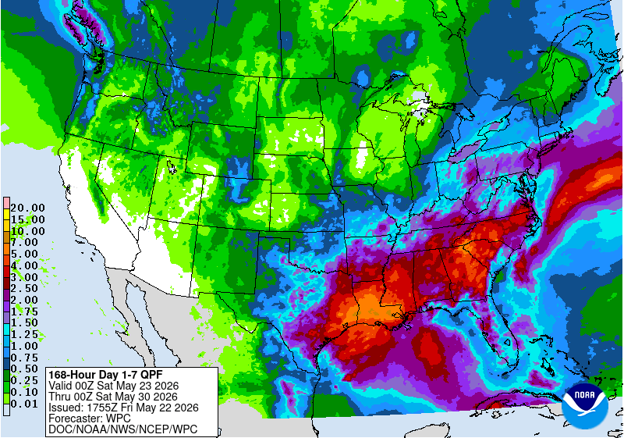
The rainfall received this week was welcome for many, believe it or not. After the cool, wet conditions to start May, we were enjoying a week + of warmer temperatures and sunnier days. But of course that warming came with windy days, rapidly drying the soil and causing plant stress. This led to salt accumulation at the soil surface (even in areas without traditional salt problems) and caused exaggerated herbicide sensitivity and general plant health issues. So rains this week were welcome to alleviate that stress. But we’re trading one problem for another by setting into a multi-day (week-long?) rainy and cloudy period. The only thing consistent about 2026 is our inconsistency.
This time of year has become a ‘rinse and repeat’ for the last several years. Many rice acres have reached the stage where we’re looking for dry ground to fertilize and flood, only to be met with persistent rainfall events. If the current forecast holds for the next week, things will start to get very interesting from a management standpoint.
It was nice to see a general recovery to rice condition over the past week though, and some additional rain will help rice continue to improve. It is notable though, that cooler days are slowing down the accumulation of DD50 units which should buy us a little time on the need to push for early nitrogen applications.
We still can’t say rice planting is completely finished, but between seeing a little more planted this past week, and a wet outlook until almost June, prospects of any more planting are slim. These rains should finish bringing the last planted rice to a solid stand – something a lack of moisture wouldn’t let happen through most of our planting window.
In this update is info on crop progress, N management in suboptimal conditions, rice herbicide injury to soybean, and rice markets.
Let us know if we can help.
Fig. 1. Arkansas rice weekly planting progress, 2013-2026.
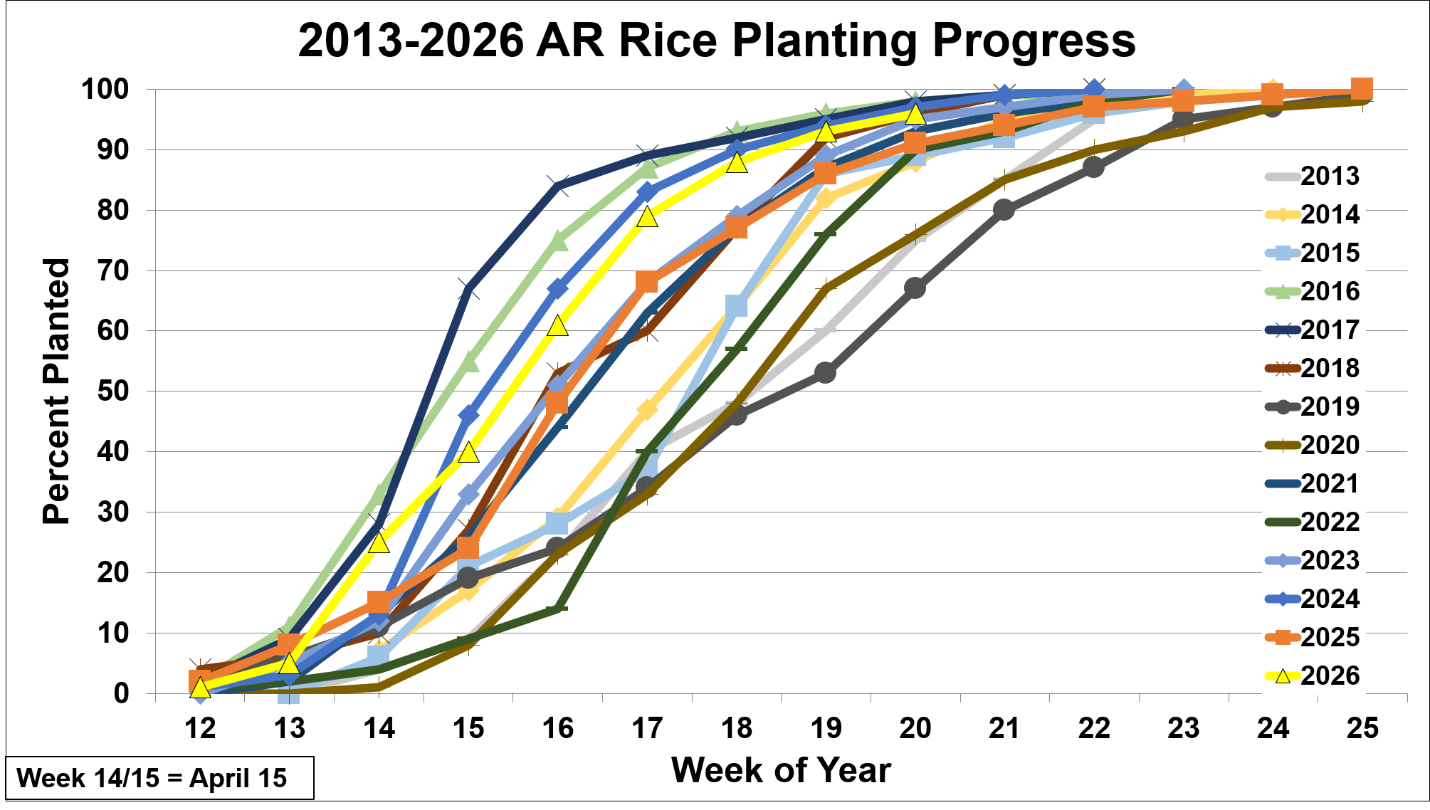
Fig. 2. NOAA 7-day precipitation forecast.
Managing Nitrogen in Rice in Suboptimal Conditions
Jarrod Hardke
Repeating this article for yet another year…
First things first – use the DD50 Rice Management Program to know where you stand on preflood nitrogen timing! If you only use the program for one thing, this is the most important. It’s nice when we can start rice in the optimal window, but the most critical timing is the “final recommended time to apply preflood nitrogen.” This is the date we need to focus on, not on general growth stage or height of plants – DD50 unit accumulation really tells us where we are, especially when we’re riding temperature roller coasters and plant growth is seesawing.
So, the goal is to get preflood N out no later than the final recommended time, but earlier if possible so we can get it incorporated where the plant can use it. However, there is some time built into the program after this date to account for flood-up, but not much. Furrow-irrigated rice is easier since we can get water through the field very quickly. The recommendations below refer to flooded rice.
Scenarios:
Field is dry: Minimum expectations – 1) silt loams – shoes leave little to no impression and soils are at “whitecapping”; 2) clays – surface soil is not tacky and starting to crack. Use urea treated with a recommended NBPT product (e.g. Agrotain) to minimize ammonia volatilization losses which occur when urea is left on the soil surface unincorporated by irrigation or rainfall. Potential N shortfalls can be caught and corrected with no yield penalty 6-8 weeks postflood.
Field is muddy: Wait until the field is free of standing water, and use urea treated with NBPT. After application, attempt to let the soil dry beneath the urea, if possible, but if rain occurs on the applied urea, flood the field. Letting the soil dry prior to flooding allows the urea to incorporate into the soil and will perform similar to that if optimal conditions were present at the time of flooding. **Prior to NBPT, we needed to flood immediately if urea went on damp ground but now we can wait.** When urea is applied to mud and flooding commences before the soil dries, the urea does not incorporate well into the soil, but rather dissolves into the water and is lost from the floodwater before the plant can take it up. If muddy conditions are present and unlikely to dry before another rain, increase preflood rate by 10-20 lb N/acre (20-40 lb urea/acre) and begin flooding. Under very poor conditions, consider a 20-30 lb N/acre (40-60 lb urea) rate increase. **Still strongly suggest attempting to let soil dry as much as possible prior to flooding.**
Field is flooded: If conditions have created standing water through the final recommended time to apply N, set the spills and begin applying N in a “spoon-feed” manner – 100 lb urea/acre once a week for 3-4 weeks. For hybrids, a minimum of 3 and possibly 4 applications of 100 lb urea/acre are needed to maximize yield. For varieties, a minimum of 4 and possibly 5 applications of 100 lb urea/acre are needed to maximize yield. Some varieties may have lower N requirements (e.g. DG263L) and may fall somewhere in between the hybrid/variety spoon-feed recommendations. **For urea applications going into standing water, do not treat urea with NBPT, it only has value when urea is going on the soil.**
***DO NOT, for any reason, ever drop the entire large preflood N application into standing water!!***
Levee field with no way to manage flood (levees not up, or no spills or levee butts): Apply 100 lb urea/acre treated with NBPT prior to rain to start a weekly spoon-feeding program as described above and continue weekly if the field stays wet from rainfall events and flood management isn’t possible. BUT, if at any time in the middle of the spoon-feed program you’re able to get the field in shape to flood, then you can apply whatever remaining amount of N is to be applied to the dry soil and flood up. For example, if you’re normal preflood N rate is 260 lb urea and instead you make a first spoon-feed application of 100 lb urea, if the next week you are ready to flood, you can apply the remaining 160 lb urea and flood.
Call if you have questions or want to talk through scenarios.
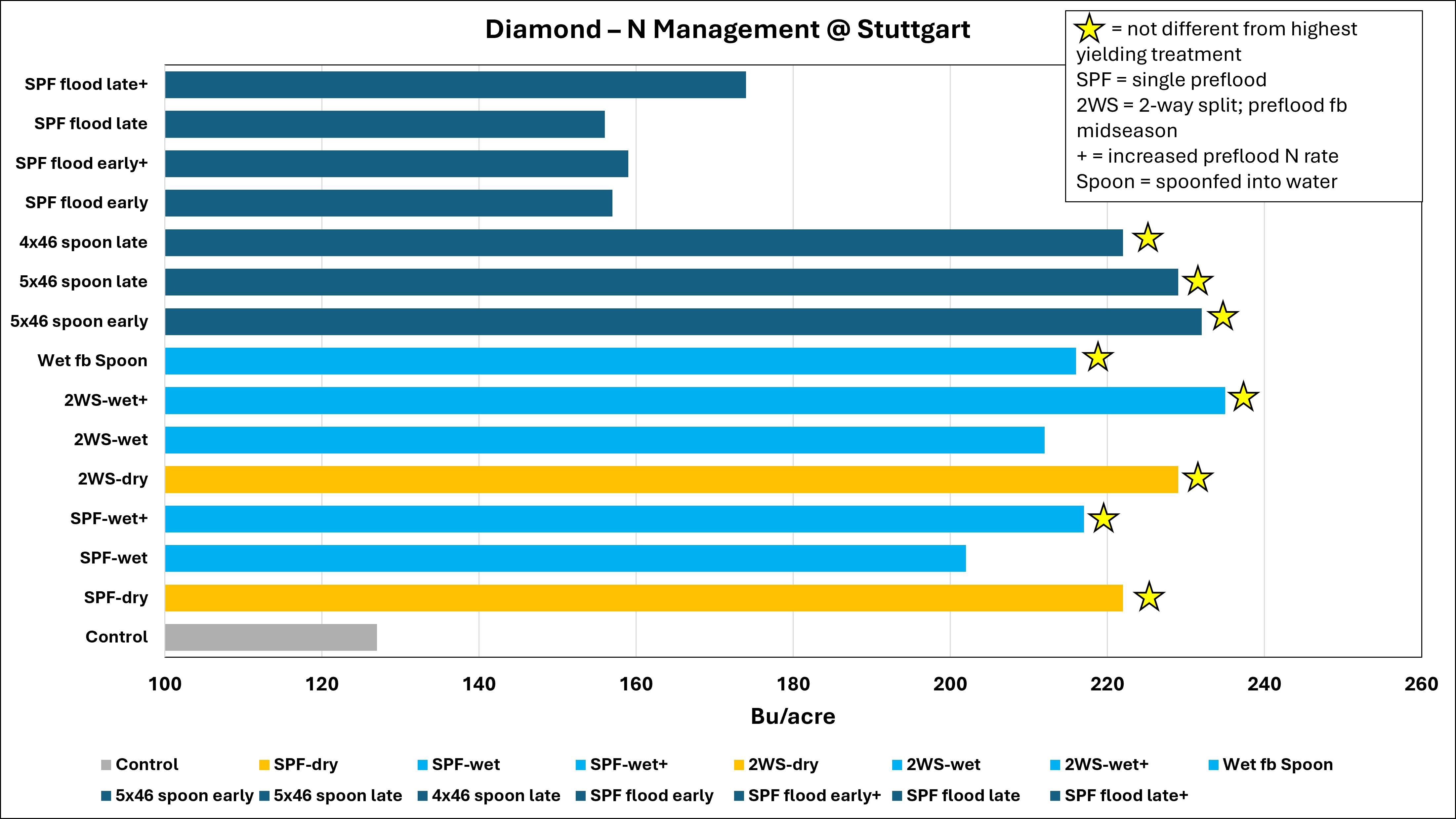
Let’s add a figure this year from a study on Diamond some years ago where we compared dry, wet, and flooded soil conditions for nitrogen applications (Fig. 3). Note that to create “wet” soil conditions, we simulated a 1-inch rainfall immediately prior to N application (we just let the standing water soak in before we applied N then began flooding).
I realize the figure is a little busy and there is a lot of nuance to different treatments. Some notes have been added to the figure to help sort out the shorthand treatment descriptions. Basically, a single preflood (SPF) applied to dry soil, a SPF applied to wet soil with 30 lb N added, a 2-way split (2WS) applied to dry soil, a 2WS applied to wet soil with 30 lb N added to preflood, and three different versions of a spoonfeed approach all yielded similarly. The spoonfeed approaches of ‘early’ and ‘late’ refer to the first application going out immediately after flood established (early) or about 7-10 days later (late).
Fig. 3. Comparison of rice nitrogen management to dry, wet, and flooded soil conditions.
While that may keep yield on par across those different options, keep in mind the differences in fertilizer + application cost for different strategies. For the N strategies used in this study (and using $800/ton for today’s urea price and $0.105 per lb urea application cost) here is a breakdown of costs you might incur on a silt loam soil:
SPF-dry: $143/acre – 130 lb N
SPF-wet+: $176/acre – 160 lb N
2WS-dry: $167/acre – 105 lb N fb 45 lb N
2WS-wet+: $200/acre – 135 lb N fb 45 lb N
Wet fb Spoon: $202/acre – 184 lb N (4x46)
5x46 spoon early: $253/acre – 230 lb N (5x46)
5x46 spoon late: $253/acre – 230 lb N (5x46)
4x46 spoon late: $202/acre – 184 lb N (4x46)
Bobbing and Weeding
Bob Scott
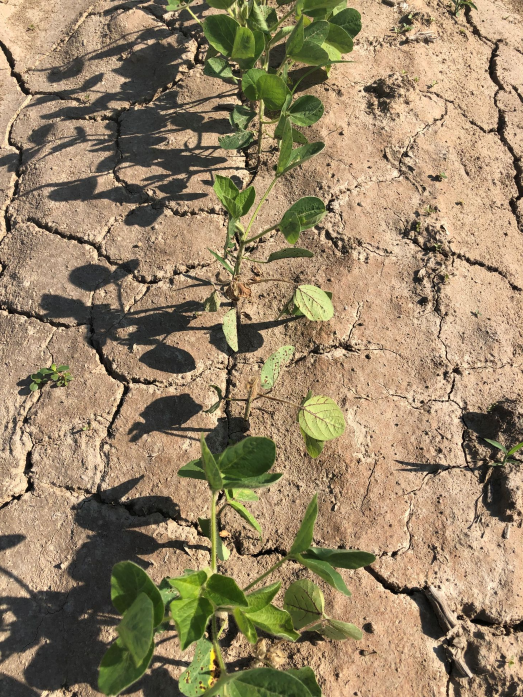
Various drift calls continued to roll in this week. One concern has been off-target movement of ALS-inhibiting herbicides (Permit, Gambit, Regiment, Grasp) from rice onto soybean fields. Injury can range from severe yellowing, stunting and death to yellow terminals and purple veins on the backs of soybean leaves (Fig. 4). Of these herbicides, Regiment is the most injurious to soybean followed closely by Grasp. STS and Bolt traited beans have enhanced tolerance to these products, with Bolt beans being the most tolerant. However, Regiment still significantly injures Bolt soybeans. See page 29 of the MP44.
In addition, there is an error on the Gambit recommendation in the rice section of the MP44, page 99, it should read “Avoid drift to non-STS/Bolt soybeans”. Newpath/Preface and Beyond/Postscript are in a similar class of chemistry but will not injure soybean.
Fig. 4. ALS herbicide injury to soybean.
Market Update
Scott Stiles
As a reminder, grain markets will not open at their normal time this Sunday evening due to the Memorial Day holiday. They will be closed Sunday and Monday and will open Monday evening.
Remember our Fallen. All gave some. Some gave all.
Memorial Day Trading Schedule:
- Friday, 5/22, regular hours
- Sunday, 5/24, closed
- Monday, 5/25, closed AM, open 7:00 PM CST
- Tuesday, 5/26, regular hours
The September contract is working on its 4th week of gains and trading at the highest point since last August. As of Friday morning (5/22) trading was at $13.38/cwt or $6.02 per bushel (no basis). The life of contract high is $13.94/cwt. The rice market continues to trade the same news and themes that have been discussed all month: U.S. acreage, El Nino, and the potential for a tighter U.S. and World balance sheet in 2026/27.
Fig. 5. CME September 2026 Rough Rice Futures, Weekly Chart.
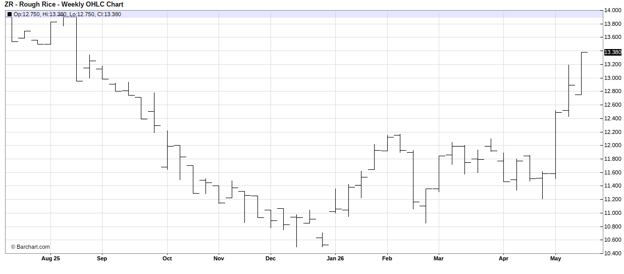
Monday’s trading saw a strong recovery that negated last Friday’s “key reversal down” on the daily chart. Fresh highs were made Tuesday and again Thursday and Friday. Daily trading ranges have tightened to less than 20 cents in the last few sessions this week. With a three-day weekend ahead, oftentimes Friday trading is about position squaring. Few traders have the desire to hold a position for the next three days with the possibility of anything and everything taking place in the Middle East.
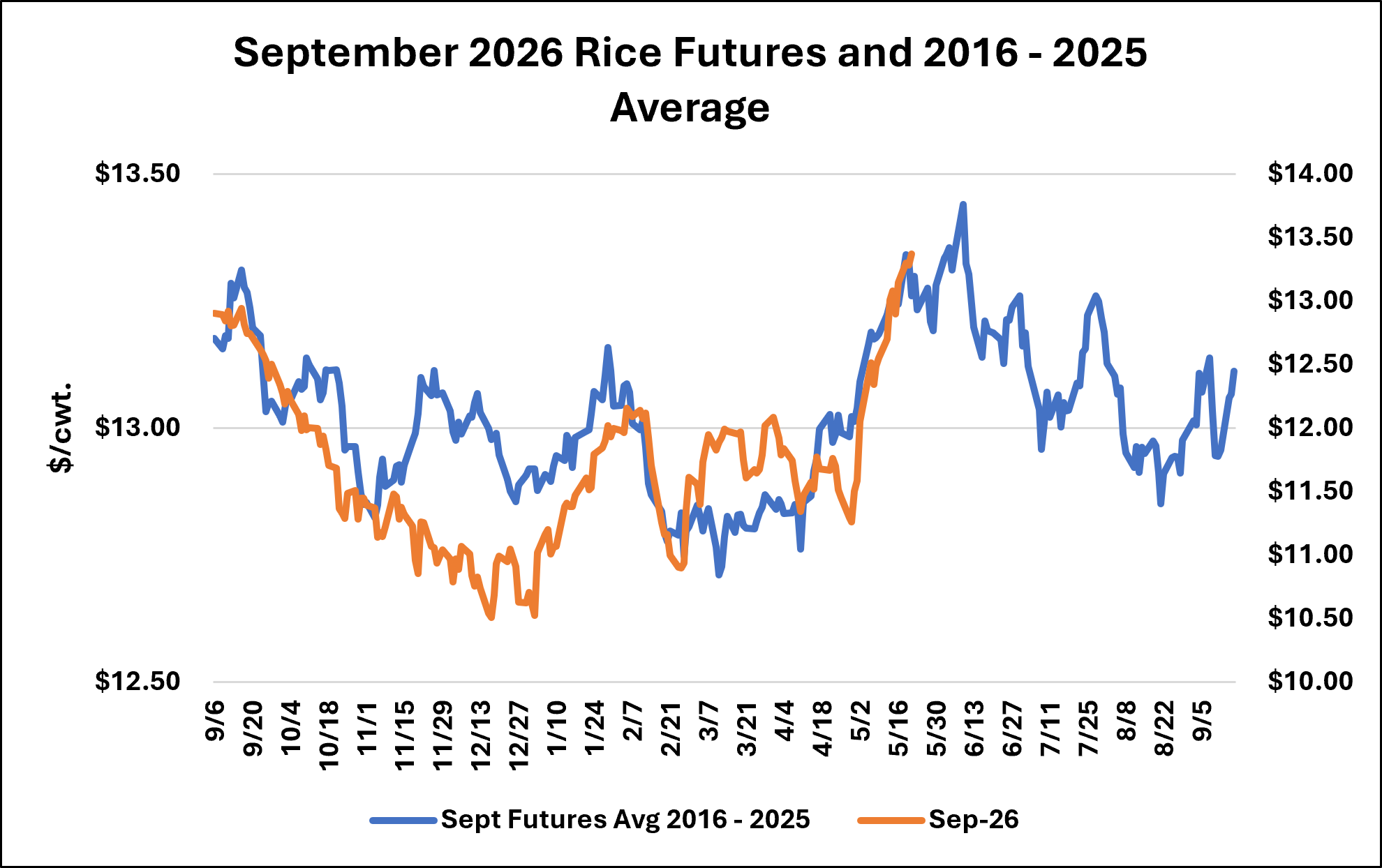
For what it’s worth, the September contract is following the 10-year seasonal tendency reasonably well (shown below). If so, we may also see a “correction” or a pullback in the market next week. Keep in mind, the September contract has gained almost 17% this month and the technical indicators are overbought with the Relative Strength Index (RSI) sitting at 75. Following a market correction in the final week of May, we could see a push to new highs in the first 10 days of June.
Figure 6. CME September Rough Rice Futures, 10-Year Seasonal.
Long-Grain Exports:
For the week ending May 14th, rough rice sales were 36,499 metric tons (MT), marking a 7-week high. Buyers for the week were Mexico (31,000 MT) and Honduras (5,499 MT). Shipments totaled 7,076 MT with all going to Honduras (5,499 MT) and Mexico (1,577 MT).
Year-to-date, old crop rough rice sales remain 30% below last year. Except for Colombia, export sales to all major markets are down. Sales to Mexico are off 46% compared to a year ago. The first new crop (2026/27) rough rice sale was made last week. This was 11,000 MT to unknown destinations.
Milled rice sales totaled 13,756 MT with 13,355 of the total going to Haiti. Shipments totaled 25,643 MT which were mostly to Haiti (22,255 MT) and Canada (1,067 MT). Smaller amounts moved into Saudi Arabia, Panama, and Mexico. Old crop milled rice sales are running 10% behind last year. No new crop sales of milled rice have been reported thus far.
There has been little change regarding the situation in Iran. At present, shipping traffic through the Strait of Hormuz is operating at 4% to 10% of its normal volume. This is 2 to 14 ships passing per day, compared to a pre-war average of roughly 60 to 100. There are approximately 1,550 commercial ships currently stranded within or near the Persian Gulf.
DD50 Rice Management Program is Live
The DD50 Rice Management Program is live and ready for fields to be enrolled for the 2026 season. All log-in and producer information has been retained from the 2025 season, so if you used the program last year you can log in just as you did last year. Log in and enroll fields here: https://dd50.uada.edu.
Use the Arkansas Rice Advisor Internet App!
The Arkansas Rice Advisor site https://riceadvisor.uada.edu functions like an app on your mobile device. There you can readily access the DD50 program, rice seeding rate calculator, drill calibration, fertilizer and N rate calculators, publications, and more.
Additional Information
Arkansas Rice Updates are published periodically to provide timely information and recommendations for rice production in Arkansas. If you would like to be added to this email list, please send your request to rice@uada.edu.
This information will also be posted to the Arkansas Row Crops blog (http://www.arkansas-crops.com/) where additional information from Extension specialists can be found.
More information on rice production, including access to all publications and reports, can be found at http://www.uaex.uada.edu/rice.
Acknowledgements
We sincerely appreciate the support for this publication provided by the rice farmers of Arkansas and administered by the Arkansas Rice Research and Promotion Board.
The authors greatly appreciate the feedback and contributions of all growers, county agents, consultants, and rice industry stakeholders.
Specialist |
Area |
Phone Number |
|
|---|---|---|---|
|
Jarrod Hardke |
Rice Extension Agronomist |
501-772-1714 |
|
|
Tom Barber |
Extension Weed Scientist |
501-944-0549 |
|
|
Nick Bateman |
Extension Entomologist |
870-456-8486 |
|
|
Ralph Mazzanti |
Rice Verification Coordinator |
870-659-5507 |
|
|
Trent Roberts |
Extension Soil Fertility |
479-935-6546 |
|
|
Bob Scott |
Extension Weed Scientist |
501-837-0273 |
|
|
Scott Stiles |
Extension Ag Economics |
501-258-8455 |