Harvest Aids in Rice

Harvest Aids in Rice
Jarrod Hardke
The use of sodium chlorate (salt) as a harvest aid in rice can be an excellent tool when needed, but it can hurt us when used incorrectly. Here are some guidelines we’ve developed to assist with maximizing the benefits of this tool while minimizing the risks if you choose to use sodium chlorate (salt) as a harvest aid. Please read through all of the guidelines as some of the comments overlap in attempting to logically answer all of the questions we usually receive.
Here is a link to a pdf of this posting in case that is an easier format to reference or print and retain: 2025 Harvest Aids in Rice
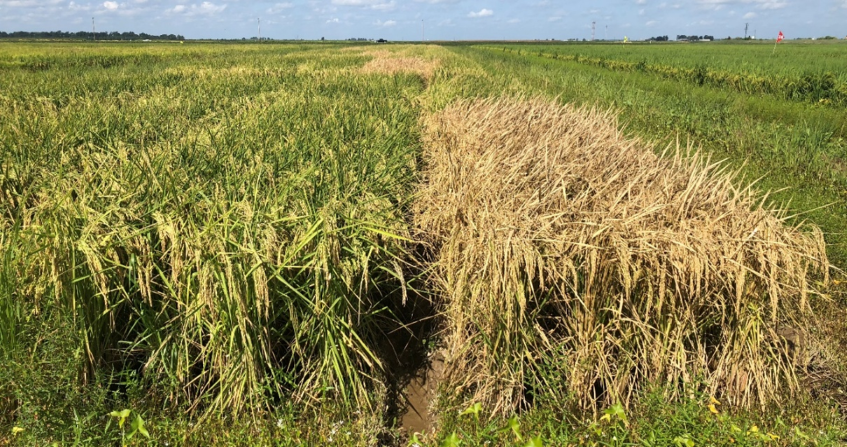
Fig. 1. Research plots receiving sodium chlorate (right) versus untreated check.
- Determining initial grain moisture
Often at higher moisture levels we’re more interested in collecting a hand sample rather than put a combine in the field just to see where our starting point is. A hand sample is fine, but it has limitations. Add AT LEAST 2% to the moisture level you get from a hand sample, and often adding 3% is needed. We pull a lot of hand samples preparing for plot harvest and frequently find that the difference between a hand sample and a combine sample is 2-3% (a hand sample is always lower moisture – higher moisture grains are difficult to remove by hand).
- What moisture is safe to begin applying sodium chlorate to rice?
Varieties should be below 25% grain moisture before applying sodium chlorate (e.g., Ozark, DG263L, CLL18, etc.).
Hybrids should be below 23% grain moisture before applying sodium chlorate (e.g., RT 7302, RT 7521 FP, etc.).
While these moisture levels are safe, we need to be smart about how we proceed to achieve the outcomes we want. Depending on your target harvest moisture, we may need to wait longer. Some want moisture below 20% for harvest while others may need rice to be below 18%.
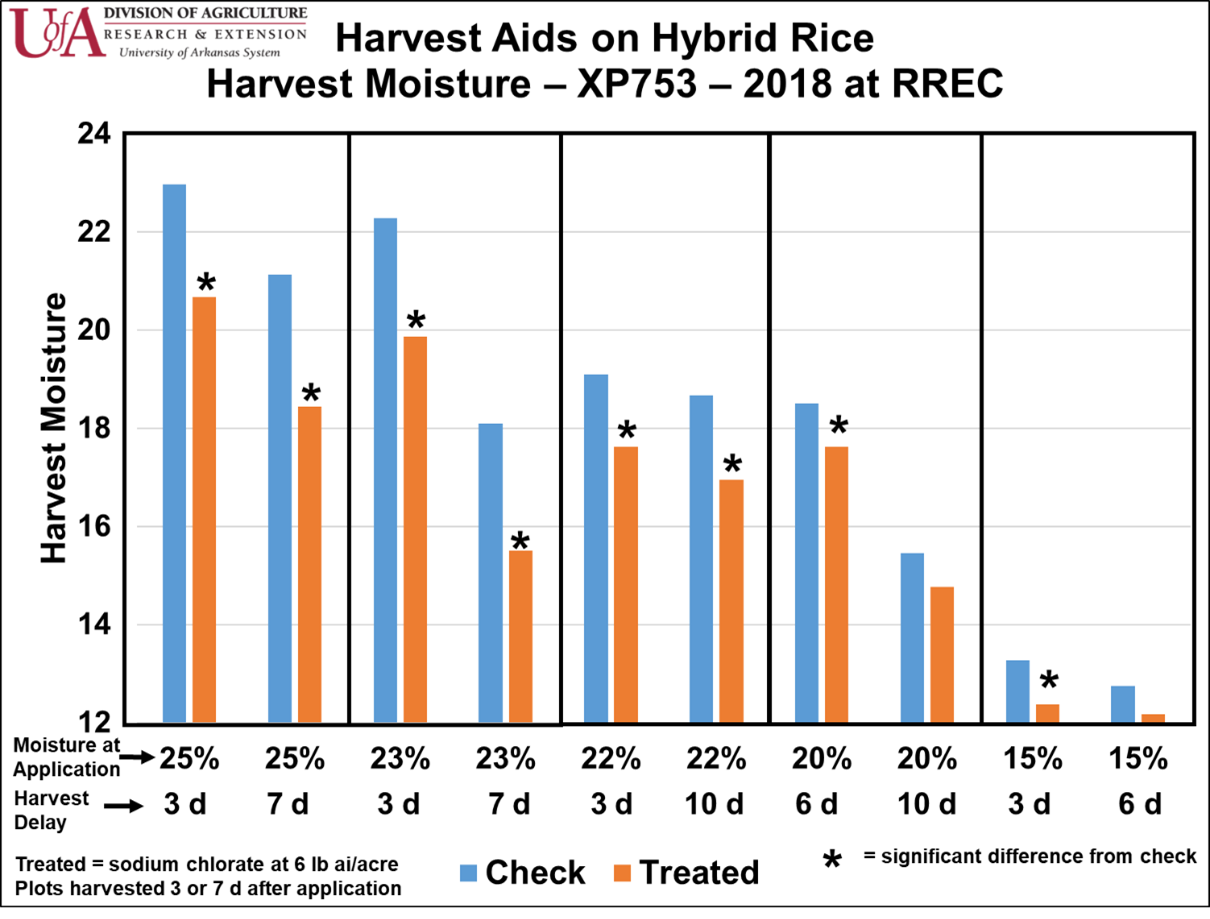
Salted rice can drop in moisture approximately 1% per day depending on conditions compared to 0.5% per day for rice that hasn’t been salted. A simpler way to put it is that salt initially takes out ~2% of grain moisture and after that grain moisture trends down similarly regardless of whether rice is salted or not. So, if salting at 23% and wanting to start harvest at 18%, you’ll need to wait 5 days before starting harvest (which is too long – more on that below).
Fig. 2. Use of sodium chlorate and effect on grain moisture of RT XP753 hybrid rice in trials in 2018. Sodium chlorate applied at different grain moisture levels and harvested at 3 or 7 days after application (weather dependent).
- What rates of sodium chlorate should I use?
Sodium chlorate is mostly available as a 5 lb a.i. per gallon product (1 gallon of product contains 5 lbs of active ingredient). We’ve most commonly evaluated rates ranging from 3 lb a.i. to 6 lb a.i. (0.6 to 1.2 gal product per acre) but for simplicity you can think of ½ gallon to 1 gallon as comparable rates. When comparing 3 lb to 6 lb applications, we haven’t seen much difference – but higher rates can give more uniformity and more consistent drydown of the overall plant. The grain moisture response was very similar as was upper canopy desiccation.
- When should I start harvest?
Start in 2-3 days and complete harvest in 5 days or less after application of sodium chlorate. Waiting longer can allow heavy dew and/or rain events to cause milling issues. Also, the entire panicle can get drier, becoming more susceptible to shattering. Risks for milling and yield loss increase the longer harvest takes beyond 5 days after application. Avoid salting too far ahead of the combine.
- When should I stop applying sodium chlorate?
Once moisture falls below 18%, exercise caution when using sodium chlorate. Long-grains don’t seem to have as much risk below 18%, but medium grains should NOT be salted once they fall below 18%.
If salting long-grains at lower moistures, consider using a lower rate of sodium chlorate – 2.5 to 3 lb a.i. (0.5 to 0.6 gallons) and begin harvest the following day after application – complete harvest within 3 days of application.
- Lodged rice
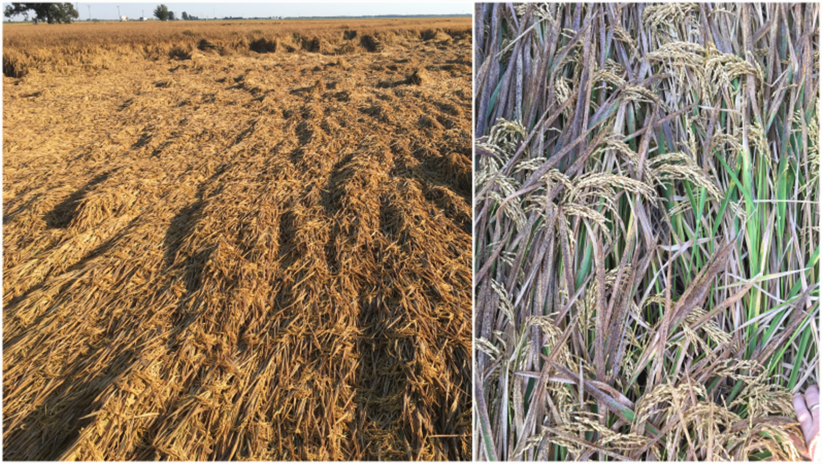
Don’t salt rice that has lodging. The salt will only work on the plants contacted by the application, meaning severely dried plants on top and still green plants underneath. It becomes a blended mix of wetter and drier grains. Fields with only small areas of lodging are not of great concern.
Fig. 3. Lodged rice (left); top layer of rice versus underneath layer after salting (right).
- Additional thoughts
Don’t salt rice solely on the basis of rapidly lowering grain moisture and expect a major moisture reduction. In research trials, whether harvested 3 or 7 days after application, salted plots were typically only 2% lower grain moisture than plots that weren’t salted.
In 2019 when we looked at multiple cultivars starting at 20-22% moisture, it turned very hot and moisture fell 1% per day (without applying salt). So, in 7 days we observed a fall from 20-22% moisture to 13-15% moisture (the average high those 7 days was 95). Use caution under these conditions. Moisture dropping to very low levels in long grains is not necessarily going to cause excessive milling issues as long as it’s harvested immediately so that no re-wetting and drying can occur. Medium grains allowed to drop to these low moisture levels will generally see greater penalties in milling yields.
- Quick Take-Homes for Sodium Chlorate (salt) as Harvest Aid in Rice
- Only salt once rice is below 25% for varieties or 23% for hybrids.
- Expect only 3-5% moisture drop by 5 days after application.
- Complete harvest in 5 days after application.
- Do not salt medium-grains below 18% moisture.
- If salting long-grains below 18% moisture, begin harvest the following day and complete harvest by 3 days after application.
- DO NOT get too far ahead of the combine with salt applications.
- Avoid salting rice with lodging issues.
- Use rates ranging from 2.5 to 6.0 lb a.i. (0.5 to 1.2 gallons per acre of 5 lb a.i. products). Use lower rates if rice is lower moisture.
DD50 Rice Management Program is Live
The DD50 Rice Management Program is live and ready for fields to be enrolled for the 2025 season. All log-in and producer information has been retained from the 2024 season, so if you used the program last year you can log in just as you did last year. Log in and enroll fields here: https://dd50.uada.edu.
Use the Arkansas Rice Advisor Internet App!
The Arkansas Rice Advisor site https://riceadvisor.uada.edu functions like an app on your mobile device. There you can readily access the DD50 program, rice seeding rate calculator, drill calibration, fertilizer and N rate calculators, publications, and more.
Additional Information
Arkansas Rice Updates are published periodically to provide timely information and recommendations for rice production in Arkansas. If you would like to be added to this email list, please send your request to rice@uada.edu.
This information will also be posted to the Arkansas Row Crops blog (http://www.arkansas-crops.com/) where additional information from Extension specialists can be found.
More information on rice production, including access to all publications and reports, can be found at http://www.uaex.uada.edu/rice.
Acknowledgements
We sincerely appreciate the support for this publication provided by the rice farmers of Arkansas and administered by the Arkansas Rice Research and Promotion Board.
The authors greatly appreciate the feedback and contributions of all growers, county agents, consultants, and rice industry stakeholders.
Specialist |
Area |
Phone Number |
|
|---|---|---|---|
|
Jarrod Hardke |
Rice Extension Agronomist |
501-772-1714 |
|
|
Tom Barber |
Extension Weed Scientist |
501-944-0549 |
|
|
Nick Bateman |
Extension Entomologist |
870-456-8486 |
|
|
Ralph Mazzanti |
Rice Verification Coordinator |
870-659-5507 |
|
|
Camila Nicolli |
Extension Pathologist |
608-622-2734 |
|
|
Trent Roberts |
Extension Soil Fertility |
479-935-6546 |
|
|
Bob Scott |
Extension Weed Scientist |
501-837-0273 |