How Can Dry Soil Conditions Affect Soil Sampling and Soil-Test Results?
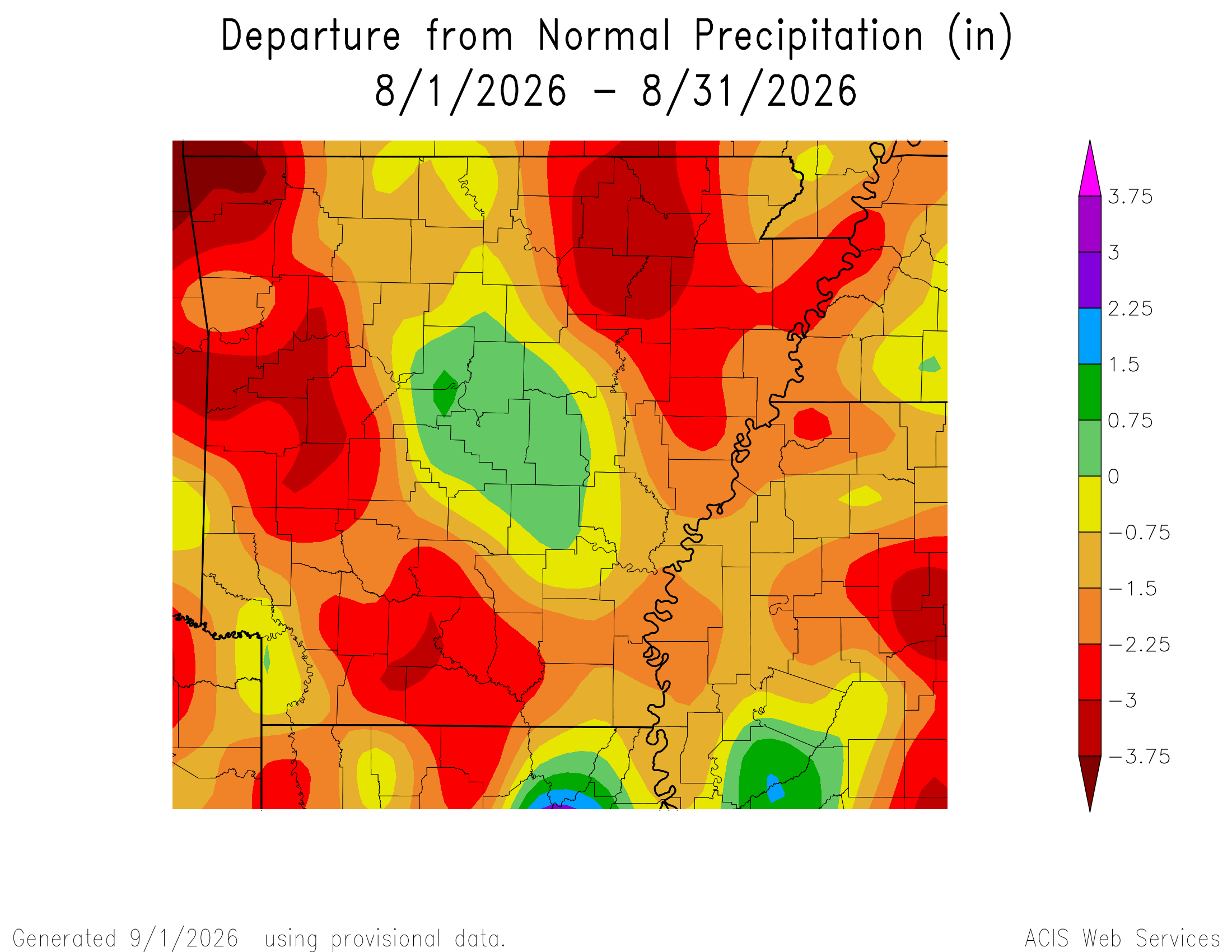
Figure 1. Departure from normal precipitation (inches) in Arkansas from August 1 to August 31, 2026. Source: High Plains Regional Climate Center.
Much of Arkansas received below-normal precipitation during August (Figure 1). As the time for soil sampling approaches, dry conditions may affect sample collection and soil-test results. This article discusses how dry soil conditions can affect sampling depth and soil-test results, along with considerations when collecting soil samples and interpreting the results under these conditions.
Dry conditions can make consistent sampling difficult
In Arkansas, the recommended sampling depth is 4 inches for fields going into rice and soybean and 6 inches for corn and cotton.
- Dry soil can prevent sampling to the recommended depth. When soils are too dry (moisture is below 20 percent), inserting a soil probe to the standard 6-inch depth becomes difficult due to the presence of a hardpan common to Arkansas alluvial soils. Under these conditions, soil cores may be shallower than intended (Figure 2).
- Shallow cores can overestimate nutrient concentrations. Sampling depth matters because nutrients such as phosphorus and potassium can be concentrated near the soil surface. Collecting cores shallower than the recommended depth can result in higher soil-test values.
- A 1-inch difference can affect fertilizer recommendations. In silt loam soils low in potassium, research conducted by the University of Arkansas Division of Agriculture found that soil-test potassium was 15 to 20 percent higher when cores reached only 5 inches instead of the target 6 inches. This difference could be enough to change fertilizer rate recommendations.
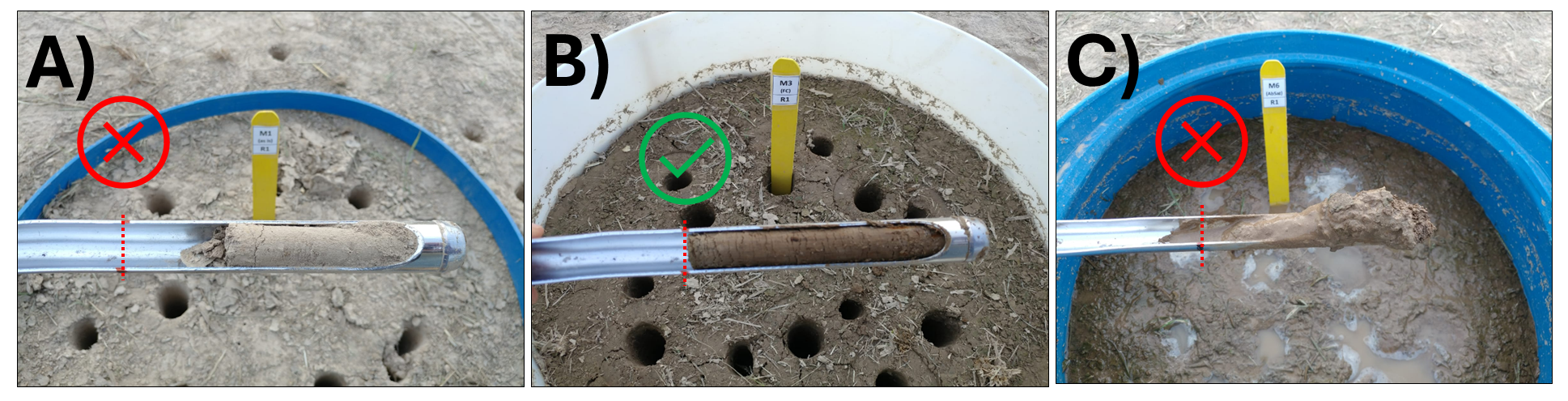
Figure 2. Moisture at the time of sampling can compromise soil core integrity and the target sampling depth. Panel A) shows shallow sampling due to very dry soil conditions, panel B) shows correct soil sampling with adequate moisture conditions, and panel C) shows compromised soil core associated with excessive soil moisture on a Dewitt silt loam near Stuttgart, AR. The dashed red line indicates the target 6-inch sampling depth.
Soil pH fluctuations in dry conditions
Soil pH is used to make liming decisions, so even a relatively small change in measured pH can matter when a field is near the threshold for a lime recommendation.
- Soil pH naturally changes throughout the year. In Arkansas, soil pH commonly varies by approximately 0.5 pH units. Lower readings are often observed during dry summer and post-harvest fall conditions, while higher values typically occur during the winter and early spring.
- Dry soils can concentrate soluble salts. Soluble salts (ions such as K⁺, Ca²⁺, Mg²⁺, NH₄⁺, NO₃⁻, Cl⁻, and SO₄²⁻ dissolved in soil water) can become more concentrated as soil moisture moves toward the surface and evaporates, leaving the salts behind. The positively charged ions (cations) can exchange with acidic cations (H⁺ and Al3⁺) held by the soil, temporarily reducing soil pH by 0.1 to 0.5 pH units.
Soil-test potassium (K) can also fluctuate with dry conditions and sampling timing. An upcoming blog will discuss these seasonal changes in more detail.
Considerations when sampling dry soils
When soil sampling needs to be completed during dry conditions, a few considerations can help when collecting samples and interpreting the results.
- Maintain the recommended sampling depth consistently. Dry conditions can make reaching the target depth more difficult, so sampling depth should be monitored and kept consistent throughout the field.
- Be consistent with sampling time. When possible, sample a field within the same 1–2 month period each sampling cycle. Soil test values from samples collected in September may differ from those collected from the same area in January, particularly for soil pH and K. However, rainfall can also vary from year to year, so soil moisture conditions should be considered when comparing results even when samples are collected during the same time of year.
- Unexpectedly low pH readings should be interpreted carefully. Dry conditions can temporarily lower measured soil pH and potentially trigger a lime recommendation. Compare the result with previous soil tests and field history before making major changes to the liming plan.
- Follow-up sampling can help confirm an unexpected result. If soil test results do not align with previous results or field history, another sample collected later under adequate soil moisture can help determine whether the initial results were influenced by sampling conditions.
Acknowledgment: This Extension material was developed as part of ongoing work on soil-test variability supported by Fertilizer Tonnage Fees administered by the Arkansas Soil Test Review Board.
Authors:
- Ana Morales-Ona Smith – Assistant Professor and Extension Soil Fertility Specialist for Row Crops
- Trent Roberts – Professor and Extension Soil Fertility Specialist
- Gerson Drescher – Assistant Professor of Soil Fertility
- Nathan Slaton – Professor and Associate Vice President for Agriculture and Assistant Director of the Arkansas Agricultural Experiment Station
References:
- Drescher, G. L., Slaton, N. A., Ahmad, U., Smartt, A. D., Roberts, T. L., & Gbur, E. E. (2024). Soil moisture and probe characteristics affect core integrity and soil test results. Soil Science Society of America Journal, 88, 1216–1233. https://doi.org/10.1002/saj2.20696
- Slaton, N. A., Fryer, M., Roberts, T. L., Norman, R. J., Hardke, J. T., Hedge, J., & Frizzell, D. (2016). Soil-test phosphorus and potassium fluctuations following rice and soybean harvest yield through early spring. Wayne E. Sabbe Arkansas Soil Fertility Studies 2015. https://scholarworks.uark.edu/cgi/viewcontent.cgi?article=1020&context=aaesser#page=45