Using Chicken Litter as Part of a Fertility Program
The high price of fertilizers has increased the use of chicken litter as part of a farmer’s fertility program. Details on this program can be found in this Extension publication, The Use of Poultry Litter in Row Crops. Perhaps the most important recommendation is to obtain an analysis of the litter as close to the time of application as possible. Table 1, below, identifies the common nutrient contents of 100 samples of broiler litter analyzed by the University of Arkansas Agricultural Diagnostic Laboratory during 2008.
Table 1. Typical nutrient content of 100 samples received by the Diagnostic Lab during 2008 and classified as “broiler” litter. Nutrient levels are reported on an “as is” basis and measured in pounds per ton (lb/t).
|
|
Moisture % |
N lb/t |
P2O5 lb/t |
K2O lb/t |
|---|---|---|---|---|
|
Average |
34 |
55 |
60 |
63 |
|
Median |
31 |
57 |
60 |
63 |
|
Mode* |
25 |
60 |
61 |
58 |
|
Range |
15-64 |
24-88 |
30-115 |
25-91 |
(*Mode = the most common value observed.)
The wide range of litter moisture and nutrient contents listed in Table 1 underscores the importance of having the litter analyzed prior to application. Some of the samples analyzed consisted of 64% water. This significantly lowers the “as-is” nutrient contents in the litter, as more of the litter weight is made up of water. In this group of data, nitrogen (N), phosphorus (P), and potassium (K) levels can vary greatly with the difference in lowest and highest nutrient contents reported being between 3 to 4 times. Although there can be a wide range in nutrient content, amongst litter sources the relative values of the average, median, and mode nutrient contents indicate that there is some consistency across a wide range of sources. The number of flocks and types of poultry raised can be good indicators of potential litter nutrient contents with greater than 4-5 flocks of pullets, hens, and broilers and greater than 2 flocks of turkeys providing good quality litter.
Moisture content in chicken litter
The moisture content can vary significantly, affecting the nutrient level/content in chicken litter (Figure 1). This is very important as the amounts of N, P, and K shown in the report as 'lb/ton' (i.e., 60 lb K2O/ton) are calculated based on the "as is" moisture content measured at the lab. Therefore, it is important to take a sample as close to the application time as possible. If poultry litter is stockpiled and loses moisture, its nutrient content when measured on a moist or "as is" basis will become more concentrated (higher content of nutrients/ton litter). If, on the other hand, the moisture level increases, then the nutrients will get diluted (lower content of nutrients/ton litter). Also, the nutrient concentration (provided as a percent) is reported in both, "dry" and "as is" basis for reference.
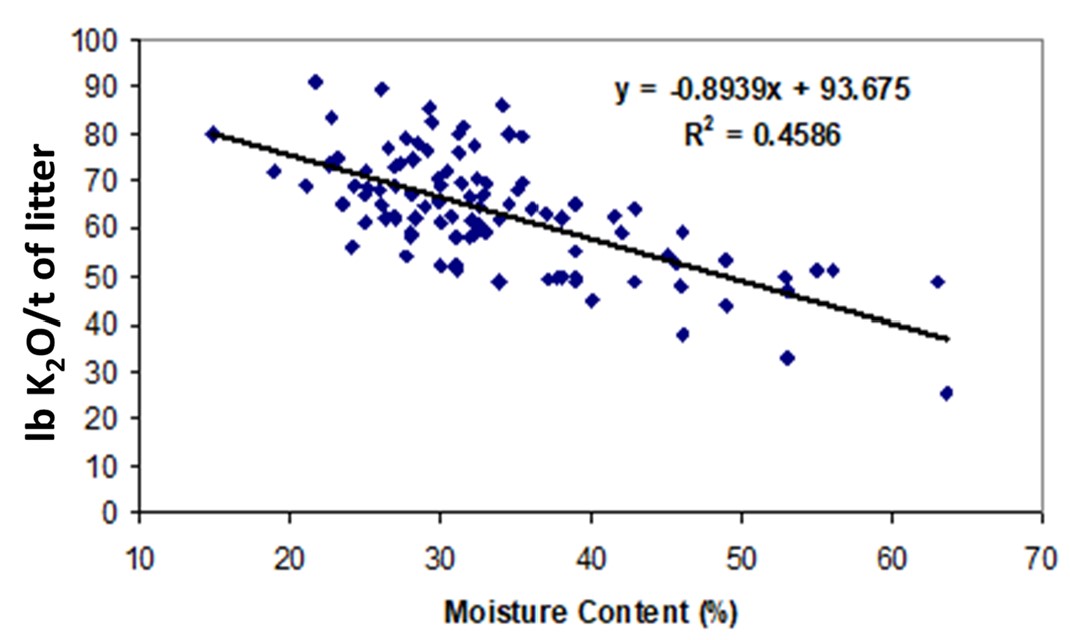
Figure 1. Relationship between moisture and potassium concentration in 100 samples of chicken litter received during 2008.
(Linear equation, y = -0.8939x + 93.675 and slope, R2 = 0.4586)
The concentration reported on a dry basis should be higher as the weight of the water is not included in the calculation.
Is there much variability in samples received from the same farm?
One may assume that samples coming from the same farm should test similar nutrient values. The analyses of five samples, coming from the same supplier, are presented in the table below (Table 2). Samples coming from the same farm varied significantly in moisture content, and N, P, and K content.
Table 2. Nutrient content of 5 samples received by the Altheimer lab, received from the same farm. Nutrient contents are reported on an “as is” basis.
|
|
Moisture % |
N lb/t |
P2O5 lb/t |
K2O lb/t |
|---|---|---|---|---|
|
Average |
36 |
51 |
48 |
62 |
|
Range |
32-46 |
39-60 |
32-63 |
48-78 |
The information provided in Table 2 is not the result of a rigorous study but shows the magnitude of the variability possible within a farm and the importance of analyzing chicken litter. It also shows the importance of collecting a representative sample. Instructions on collecting a sample can be found in this Extension factsheet, Sampling Poultry Litter for Nutrient Content, FSA 9519.
Nitrogen in Chicken Litter
The amount of N shown in the report represents the amount of N that can potentially become plant available. The N in the chicken litter is mostly in the organic form that needs to be mineralized. Published studies report varying degrees of mineralization (conversion to a form that plants can use). For practical purposes assume that 50 to 60% of the N will become plant available during the first year, and no additional benefit should be expected in the following years, especially if the litter is applied at rates of 1-2 tons per acre (t/a).
The rate at which the N becomes plant available is particularly affected by temperature and moisture. The optimum temperature for mineralization to proceed is reported to be around 75 °F and higher. This is important, as wheat farmers may consider applying litter in February and March to meet the N requirements of the crop and the N availability from the litter may be limited if temperatures are low.
Researchers in Georgia concluded that the mineralization rate was significantly slower in clayey soils than on sandy soils, as clayey soils tend to remain wetter for longer periods. They also noted higher denitrification rates for the same reasons, as compared to chemical fertilizer. Studies in Arkansas concluded that poultry litter is not a good alternative to urea-N in rice produced with delayed flood irrigation, as the potential for denitrification is higher than in other cropping systems such as corn and cotton.
The typical rule of thumb is that 50% of the N in poultry litter can be counted for upland crops such as corn, cotton, and grain sorghum, and 25% of the N can be counted towards the season total N rate for delayed-flood rice.
Other researchers have reported that when temperature and moisture conditions are near optimum levels, a large portion of the N is mineralized (becomes plant-available) in 4 to 6 weeks.
It appears that there is no difference between fresh and pelletized chicken litter in the supply of major nutrients. However, the pelletized formulation is significantly higher in price than fresh litter. Also, this formulation typically has a lower moisture content. There are some sources of pelletized litter that may show higher N analysis resulting from supplementation with chemical fertilizer, typically ammonium sulfate.
Potassium in chicken litter
The line in the graph below (Figure 2) represents the average K2O content of the 100 samples analyzed (63 lb K2O /t). The graph shows that using the average K2O content value could result in over-or under-estimating the actual amount of potassium fertilizer equivalent per ton of litter. All of the K in chicken litter exists in an inorganic form that is readily plant available. The K is highly water-soluble (similar to muriate of potash fertilizer) and can leach and move through or out of stockpiled litter depending on the time of exposure and rainfall.
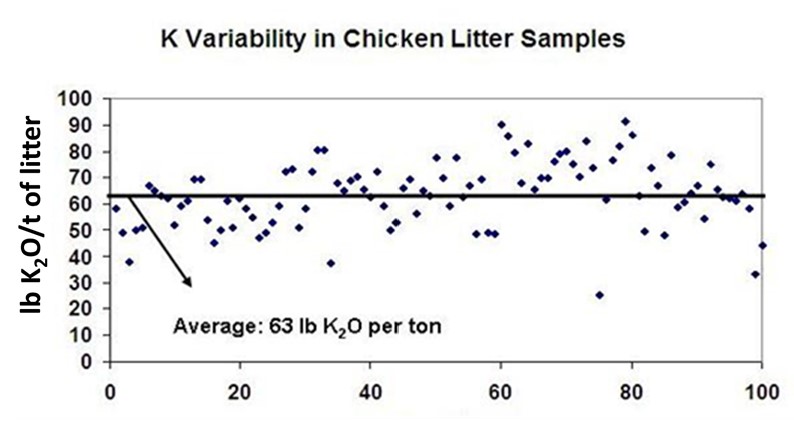
Figure 2. Potassium fertilizer equivalent (K2O) analyses of 100 samples received during 2008.
Phosphorus in Chicken Litter
Many farmers find chicken litter as a good commercial fertilizer alternative to supply P and K, particularly in soils with low levels of such nutrients and the current fertilizer prices. It has been reported that two-thirds of the P in chicken litter exists in the inorganic form, particularly as orthophosphate which is the form plant roots take up. The remaining one-third exists as organic-P that, as in the case with N, needs to be converted into a form plants can use. For fertility purposes, assume that at least 90% of the P will become plant available during the first year. Once the P has been released from the chicken litter, it is subject to all the transformations and potential losses that commercial fertilizers undergo.
The position of the Division of Agriculture is to recommend chicken litter based on P requirements. Applying chicken litter to meet the N requirements of a crop may result in P application rates that exceed the amount a crop may need for optimum growth.
Other Benefits
The beneficial effects of chicken litter applications to restore the productivity of recently leveled fields is well known. In addition to supplying major nutrients, chicken litter can also provide less than 0.1 lb boron/ton and 0.5 to 1.0 lb zinc/ton. The majority of litter is organic carbon. When added to the soil it can provide many of the same benefits that soil organic matter would, and it also helps to promote microbial activity.
Application of Chicken Litter
If chicken litter is going to be used as a source of nutrients, the application equipment must be properly calibrated. The two factors to consider when applying chicken litter are application uniformity and application rate. Failing to properly calibrate application equipment can result in areas over-or under fertilized, resulting in streaking. Results from a study in Colorado showed that seven out of ten spreaders had patterns that were off-center. Another one of the spreaders had one side with 7.5 times the amount of manure on it than the other side. Some of the trucks did not seem to be loaded evenly (trucks were loaded according to common procedure). They also reported swath widths ranging from 7.5 ft to 16.1 ft, with an average of 11.1 ft. Taking the time to make sure the spreader trucks are calibrated and have even spread patterns will reduce the likelihood of streaking and increase nutrient variability across fields.
Summary
Chicken litter is a great source of plant essential nutrients, but the concentration of such nutrients can be highly variable. A representative sample collected and analyzed before an application is recommended to calculate actual nutrient input.
As a rule of thumb, 50-60% of the N and at least 90% of the P and K in the litter will become plant available during the year it was spread.
Spreading trucks need to be properly calibrated to achieve the highest spreading uniformity possible.
The University of Arkansas recommends applying chicken litter based on the P requirements of the intended crop.