A process for choosing wheat varieties to manage disease in the 2024/2025 growing season
KEY POINTS
- Commonly occurring diseases of wheat can be managed with an integrated approach.
- Choosing wheat varieties that demonstrate genetic resistance to diseases of concern should be the primary focus of an integrated approach.
- Between flag leaf emergence and full flowering, the weather in Arkansas is often conducive for disease development.
- Using the data from variety testing program trials, this article demonstrates a strategy for choosing varieties that will likely aid in management of economically important wheat diseases.
ECONOMICALLY IMPORTANT WHEAT DISEASES IN ARKANSAS
Wheat disease management in Arkansas typically deals with several different foliar diseases. In 2024, we observed multiple foliar diseases in official variety trials located around the state. Fusarium head blight (Figure 1), stripe rust and leaf rust (Figure 2), Septoria tritici blotch (Figure 3), and bacterial streak (Figure 4) were all present at each variety trial location but were more or less severe depending on location. This past year was much different than 2022 and 2023 when disease pressure was lower, which was due to the environment. When severe, any of these diseases can cause significant yield loss. Severe disease will most often occur on wheat varieties that are susceptible to the disease. Those with resistance will have lower levels of disease even when weather favors disease development. Because we can’t predict weather (or disease pressure) months in advance, choosing varieties with good resistance to commonly occurring diseases helps to ensure a successful crop in the coming season.
METHODS
Each year the University of Arkansas Division of Agriculture Variety Testing Program places official variety trials on research stations in Arkansas (Rohwer Research Station in Kelso, Pine Tree Research Station, Lon Mann Cotton Research Station in Marianna, Vegetable Research Station near Kibler, and Northeast Research and Extension Center in Keiser). In 2023, sixty different wheat varieties were planted at each location and each location had the same varieties. Plots were established at a planting rate of 26 seed per ft2 and plot dimensions were 20 feet long and 5 feet wide. Varieties were arranged in a randomized complete block design with four replications. Foliar disease data were collected prior to maturity where each disease present was rated on a 0-9 scale with a rating of 9 indicating the most severe disease. Means from each location and diseases that occurred at each location are presented. Yield data was averaged by variety, subjected to ANOVA and means were separated using Fisher’s least significant difference (LSD) test at P=0.05.
VARIETY SELECTION PROCESS
For a variety selection process, we should use at least the last two years of data from the five trials planted. Each one of these locations had all the same varieties planted each year but not both years. Some varieties were planted in 2024 but not 2023, and some in 2023 but not 2024. Ideally, we would like to look at three or four years of variety testing data that includes multiple disease evaluations and recorded yields, which may reduce our variety options in some years with a high turnover of varieties. However, more good data is always better, with two years data considered the minimum. No decisions on variety selection should be made with only a single year’s yield data. Many factors determine a variety’s yield performance. With respect to disease, a single severe disease, or the cumulative impact of many diseases, can be significant.
For the selection process, let’s consider what would be important and how those characteristics might be prioritized in the list below.
- Included in the last two years of the variety testing program.
- In the ‘higher yielding’ group across all locations for both years.
- Low Fusarium head blight.
- Low stripe rust and leaf rust.
- Lower levels of other foliar diseases like bacterial streak and Septoria tritici blotch.
If we explicitly follow the listed criteria, then we’ve got some issues to negotiate before we can be comfortable with a list of variety options. As an example, an arbitrarily selected list of varieties with yield data from 2024, 2023, and 2022 is provided in Table 1. The variety list is sorted high to low using 2024 yield averages across all locations. As we can see, Delta Grow 1200 was the top yielding variety in 2022 and 2023 but not 2024. However, it was near the top in 2024 and Progeny Buster, USG 3352, Delta Grow 1000, Dyna-Gro 9701, P26R45, AgriMAXX 514, and Dyna-Gro 9120 were not significantly different using the LSD value of 3.4. Although just outside the group, we might also add Progeny Bingo to the list. Using Delta Grow 1200 as the standard, this gives us a nice group of varieties to begin with as they have been relatively high yielding over the last three years of variety testing. Progeny Chad, Progeny Turbo, Delta Grow 3500, and Delta Grow 1800 are included in the table for purposes of comparison.
Table 1. A group of varieties selected and their yields from official variety trials in 2022, 2023, and 2024. An arbitrarily selected subset of the full variety list has been included in the table for comparisons.
|
VARIETY |
PINE TREE |
ROHWER |
KEISER |
ALL LOCATIONS 2024 |
ALL LOCATIONS 2023 |
ALL LOCATIONS 2022 |
|---|---|---|---|---|---|---|
|
Delta Grow 1200 |
100.7* |
68.5 |
63.1 |
75.5 |
92.9 |
93.8 |
|
Delta Grow 1000 |
103.1 |
70.4 |
54.2 |
74.4 |
86.3 |
86.3 |
|
Dyna-Gro 9701 |
105.9 |
64.6 |
54.7 |
73.0 |
85.6 |
83 |
|
P26R45 |
98.3 |
61.9 |
64.3 |
72.6 |
84.6 |
78.3 |
|
AgriMAXX 514 |
94.6 |
65.5 |
62.2 |
72.0 |
87.4 |
89 |
|
Dyna-Gro 9120 |
100.3 |
61.6 |
61.6 |
72.0 |
78.9 |
89.9 |
|
PROGENY #BINGO |
95.8 |
58.8 |
63.6 |
71.1 |
90.4 |
89.5 |
|
PROGENY #CHAD |
90.4 |
50.4 |
64.9 |
69.3 |
76.2 |
83.4 |
|
PROGENY #TURBO |
93 |
58.2 |
54.8 |
67.7 |
84.1 |
89.9 |
|
Delta Grow 3500 |
98.4 |
56.5 |
53.5 |
67.6 |
66 |
78.3 |
|
Delta Grow 1800 |
92.6 |
64.8 |
51.7 |
65.3 |
77.3 |
85.1 |
|
LSD (5%) |
7.8 |
8.9 |
4.5 |
3.4 |
- |
5.0 |
|
C.V. |
7.0 |
12.6 |
7.0 |
8.5 |
- |
11.9 |
|
AVERAGE |
96.1 |
60.7 |
57.5 |
69.7 |
81.7 |
81.6 |
|
HIGH |
114.4 |
78.2 |
66.5 |
81.2 |
92.9 |
93.8 |
|
LOW |
68.8 |
43.0 |
30.8 |
57.2 |
58.8 |
65.2 |
*Yield presented in bushels per acre. Yield means were separated using Fisher’s least significant difference (LSD) test at P=0.05. The LSD critical value is given as is the coefficient of variation (C.V.), average yield, high yield, and low yield of each data set.
Because disease pressure was much higher in 2024 than 2023 or 2022, we may give 2024 disease ratings a higher priority than 2023 or 2022. Disease ratings from 2024 are listed in Table 2 and the ratings are for diseases that most influenced yield at each of three locations: stripe rust at Keiser, bacterial streak at Rohwer, and stripe rust at Pine tree. Due to its general importance, scab data is also included. Since yield data was not available for Kibler in 2024 and only Fusarium head blight ratings were collected from Marianna, data from these locations are incomplete and have been excluded from the example. Disease ratings from 2023 and 2022 are not included in Table 2 but can be found in the 2023 Arkansas Wheat Update.
Table 2. A group of varieties selected and their disease ratings of the most influential diseases at each location in 2024. An arbitrarily selected subset of the full variety list has been selected for the table and is the same as the list in Table 1. This list includes Progeny Buster, USG 3352, Delta Grow 1000, Dyna-Gro 9701, P26R45, AgriMAXX 514, Dyna-Gro 9120, and Progeny Bingo. Progeny Chad, Progeny Turbo, Delta Grow 3500, and Delta Grow 1800 are included in the table for comparison of disease levels.
|
VARIETY |
PINE TREE 2024 |
ROHWER 2024 |
KEISER 2024 |
|||
|---|---|---|---|---|---|---|
|
Stripe rust* |
Scab |
Bacterial streak |
Scab |
Stripe rust |
Scab |
|
|
PROGENY #BUSTER |
1.8 |
3.0 |
3.3 |
2.3 |
1.0 |
1.7 |
|
USG 3352 |
2.5 |
6.0 |
3.8 |
2.0 |
1.3 |
2.3 |
|
Delta Grow 1200 |
1.8 |
2.5 |
4.8 |
2.5 |
1.3 |
1.3 |
|
Delta Grow 1000 |
0.8 |
4.0 |
4.0 |
2.8 |
0.0 |
1.0 |
|
Dyna-Gro 9701 |
3.5 |
2.8 |
4.6 |
2.3 |
2.0 |
1.0 |
|
P26R45 |
1.5 |
3.0 |
4.8 |
1.3 |
0.0 |
1.0 |
|
AgriMAXX 514 |
1.0 |
1.3 |
5.0 |
2.0 |
0.3 |
1.0 |
|
Dyna-Gro 9120 |
2.5 |
1.8 |
6.3 |
1.8 |
0.3 |
2.0 |
|
PROGENY #BINGO |
1.0 |
2.0 |
4.8 |
1.5 |
0.0 |
1.0 |
|
PROGENY #CHAD |
2.3 |
5.8 |
4.0 |
2.5 |
2.0 |
4.7 |
|
PROGENY #TURBO |
2.3 |
3.0 |
6.0 |
2.0 |
2.3 |
1.0 |
|
Delta Grow 3500 |
7.3 |
4.8 |
4.5 |
2.3 |
5.0 |
2.3 |
|
Delta Grow 1800 |
2.5 |
1.5 |
4.5 |
1.5 |
2.5 |
1.0 |
|
C.V. |
86.8 |
57.4 |
31.9 |
42.3 |
119.3 |
69.5 |
|
AVERAGE |
2.3 |
2.9 |
4.8 |
2.2 |
1.6 |
1.5 |
|
HIGH |
7.3 |
6.0 |
7.0 |
4.3 |
7.3 |
4.7 |
|
LOW |
0.3 |
1.0 |
2.5 |
1.3 |
0.0 |
0.7 |
*Foliar disease data were collected prior to maturity where each disease present was rated on a 0-9 scale with a rating of 9 indicating the most severe disease.
The predominant diseases rated in 2024 were stripe rust and leaf rust. However, we should consider scab first. There was some scab at all locations, but it was not severe enough to drive yield differences among varieties. Still, we must always consider that scab can affect grain quality due to deoxynivalenol (a toxin) accumulation in the grain. For this reason, planting varieties with resistance to scab is important. While we do not have varieties available that are completely resistant to scab, there are many that can be considered moderately resistant. The scab rating at Pine Tree for USG 3352, indicates that if planted, it might be necessary for a preventative fungicide application to be applied. The same logic should be applied to other varieties that have demonstrated high yields over multiple years.
In all locations rated for diseases, the leaf rust tended to arrive much later than stripe rust. While severe in some varieties, its impact may have been minimized due to timing. Some varieties also had severe stripe rust and leaf rust, which made getting an accurate rating of the later arriving leaf rust more difficult. However, there was enough stripe rust at Pine Tree and Keiser to make informed decisions on varieties. Most of the varieties listed in our higher yielding group did not have significant stripe rust. However, some did, which may explain yield differences by location. In a year where stripe rust was severe in some varieties, many varieties demonstrated reliable resistance which was correlated to their yield performance relative to other more susceptible varieties in these trials. Other varieties that had more stripe rust, might require a fungicide application in years when it is moderate to severe to help maintain their yield potential.
Lastly, we consider our bacterial streak evaluations from Rohwer. This location received well above average rainfall in the spring, so it was not surprising to see elevated bacterial streak. The varieties listed in our group didn’t have much difference in bacterial streak disease between them so there isn’t much to consider. Overall, this group of varieties reacted similarly to this disease but yields at Rohwer for some in the higher group were a little lower at this location (P26R45, Dyna-Gro 9120, and Progeny Bingo) However, it is difficult to say that this was only due to bacterial streak based on our ratings.
Conservatively, our process has allowed us to choose nine varieties to plant in Fall of 2025 that offer high yield potential and a reduced likelihood of severe scab and stripe rust. Some of them may be more impacted by bacterial streak, if it is severe where they are planted. It is also worth noting that bacterial streak cannot be managed with a foliar fungicide application (because it’s caused by a bacterium and not a fungus like scab and stripe rust). Overall, in a year like 2024 when foliar disease pressure was severe, or any other year, it is important to look at yield and disease data for that year and others, to make the most informed decisions on wheat varieties to plant.
For more information on wheat variety performance and disease management options consider the publications at the links below.
For fungicide treatment options see either the current MP154 https://www.uaex.uada.edu/publications/mp-154.aspx
2024 Arkansas Wheat Quick Facts https://www.uaex.uada.edu/farm-ranch/crops-commercial-horticulture/wheat/2024%20Wheatquickfactsheet-%20Final.pdf
The complete variety testing data for 2024 can be found in the 2024-2025 Arkansas Wheat Update. https://www.uaex.uada.edu/farm-ranch/crops-commercial-horticulture/wheat/docs/2024-25-wheat-update.pdf
2023 Arkansas Wheat Update
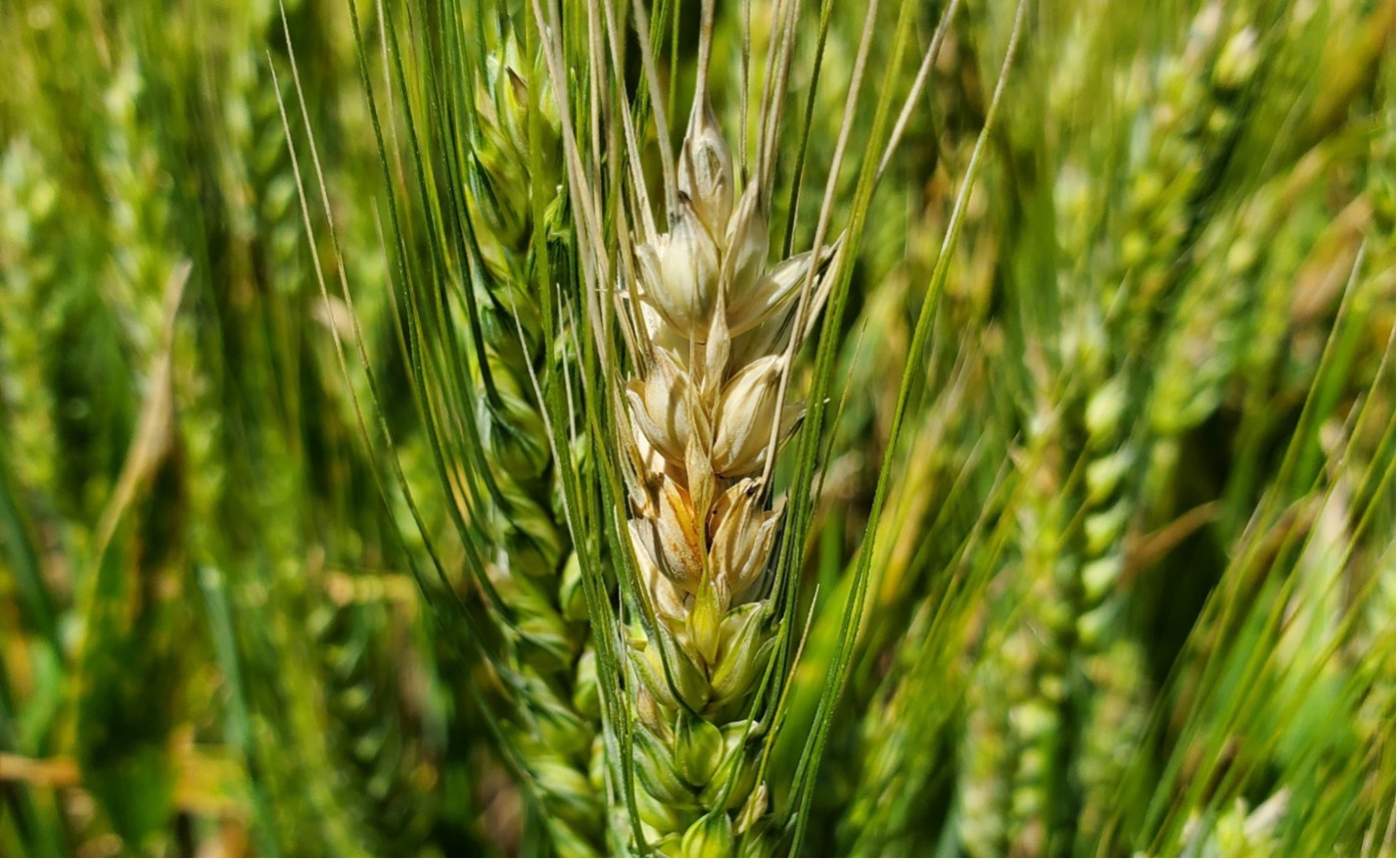
Figure 1. Fusarium head blight (scab) on wheat. The bleached wheat head and orange-colored sporulation are common symptoms and signs of the disease.
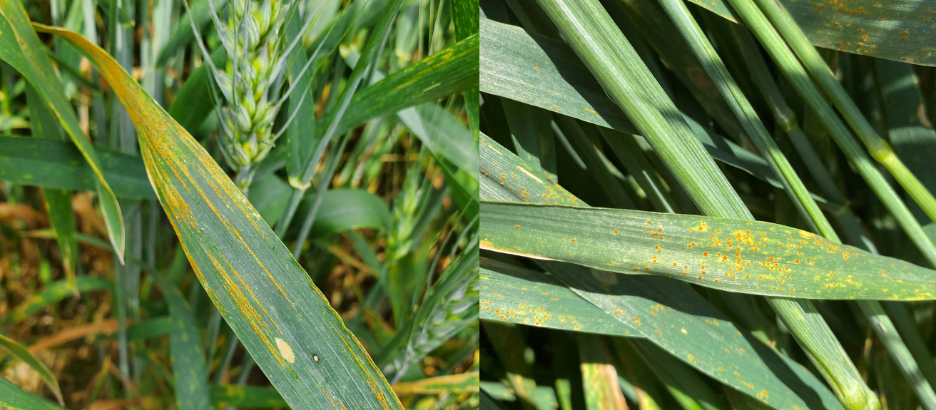
Figure 2. Stripe rust pustules on a susceptible wheat variety oriented in a linear or ‘striped’ fashion (left) and leaf rust pustules (right).

Figure 3. Foliar symptoms of Septoria tritici blotch on wheat with pycnidia in the lesions. The pycnidia contain spores. These pycnidia can be seen under magnification with a handheld lens and help to confirm the presence of the disease.
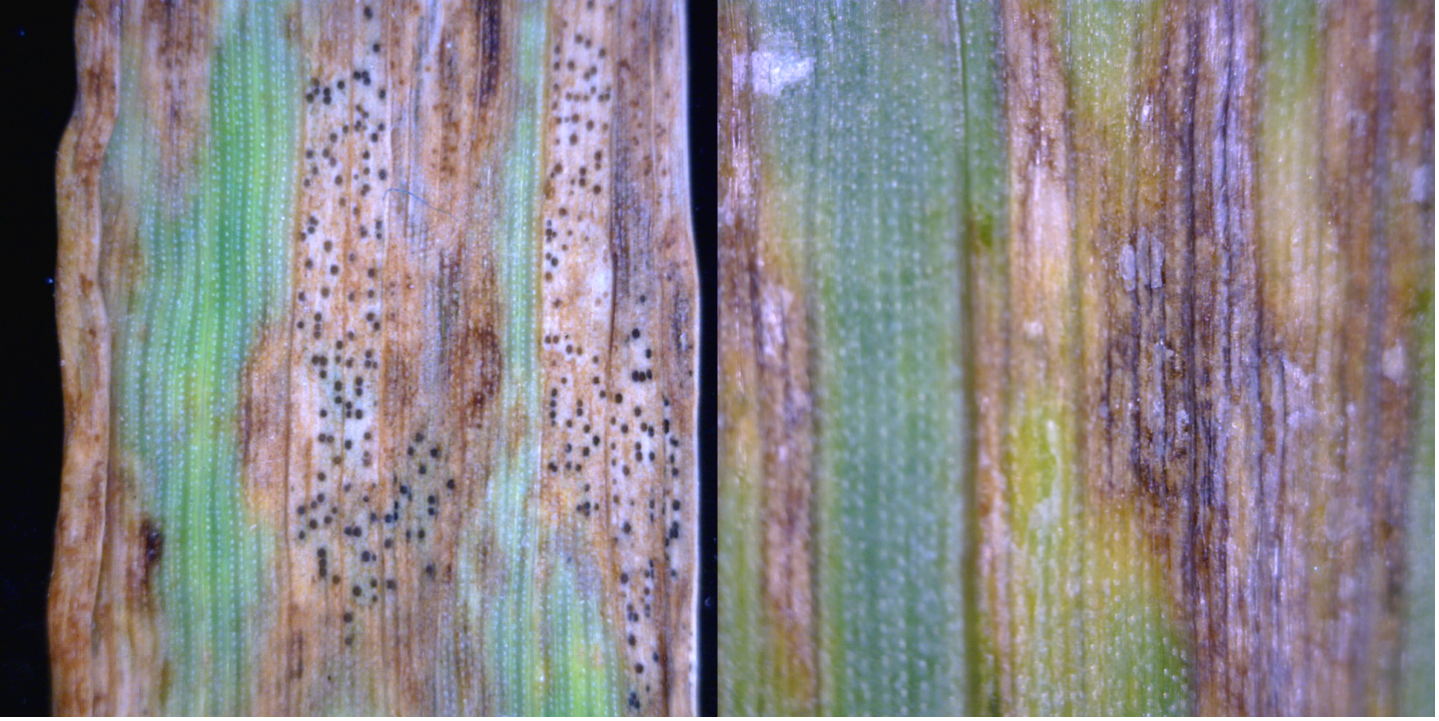
Figure 4. Side by side view of Septoria tritici blotch (left) and bacterial streak (right). Under the magnification of a hand lens, the pycnidia of Septoria are easily seen and much different than the white flaky exudate produced by the bacterial pathogen that causes bacterial streak. Use of a hand lens to identify these signs can help to differentiate between these two diseases.