Impact of Early-Season Flooding Rains on Rice
Impact of Early-Season Flooding Rains on Rice
Rice is certainly the most flood-tolerant of our major crops, but even it has its limits. Early-season flood events that submerge rice for extended periods of time are fairly rare, and typically not widespread. Unfortunately, 2025 has something to say about that.
Many factors play into the survivability of rice in these scenarios, including length of time submerged; depth of submergence; temperature, clarity, and movement of the floodwater; and stage of the rice.
Let’s start at the beginning. As a general rule, rice will emerge through soil or it will emerge through water, but not both. So, drill-seeded rice that has standing water on top of it will not emerge until that standing water is removed. There is a window of time that rice will wait below the soil surface for standing water to dissipate. A week or so of submergence is a safe expectation for rice to survive in this scenario. It can certainly be longer when temperatures are cooler as they are now.
As the floods get off the field, it will be important for warm, sunny conditions to get rapid emergence and good early rice growth. Cooler, still damp conditions that lead to slow rice growth will keep vigor suppressed and plants that may have survived can be taken out by seedling diseases.
For rice that may have just emerged when floods arrived, the length of time they can survive under cooler current conditions can be quite long. In past years we have had observations on seedling rice submerged for weeks that once the flood left, the rice was still sitting there like the day it went under. The key was that the water was cool and had some movement keeping things oxygenated. When the water gets stagnant and muddy, the length of survival can get short fast.
So, the expectation is that much of our impacted rice acres will survive with acceptable stands we’ll want to keep. Some of the early vigor can be lost but also typically recovers as conditions and temperatures improve. Levee fields still have their work cut out for them, as many of these levees will now need to be patched, re-pulled, or in the worst cases knocked down and started over. As noted by Stewart Runsick in Clay Co., fields without levees may have soil piled up in places, meaning seed is deeper and may take longer to emerge.
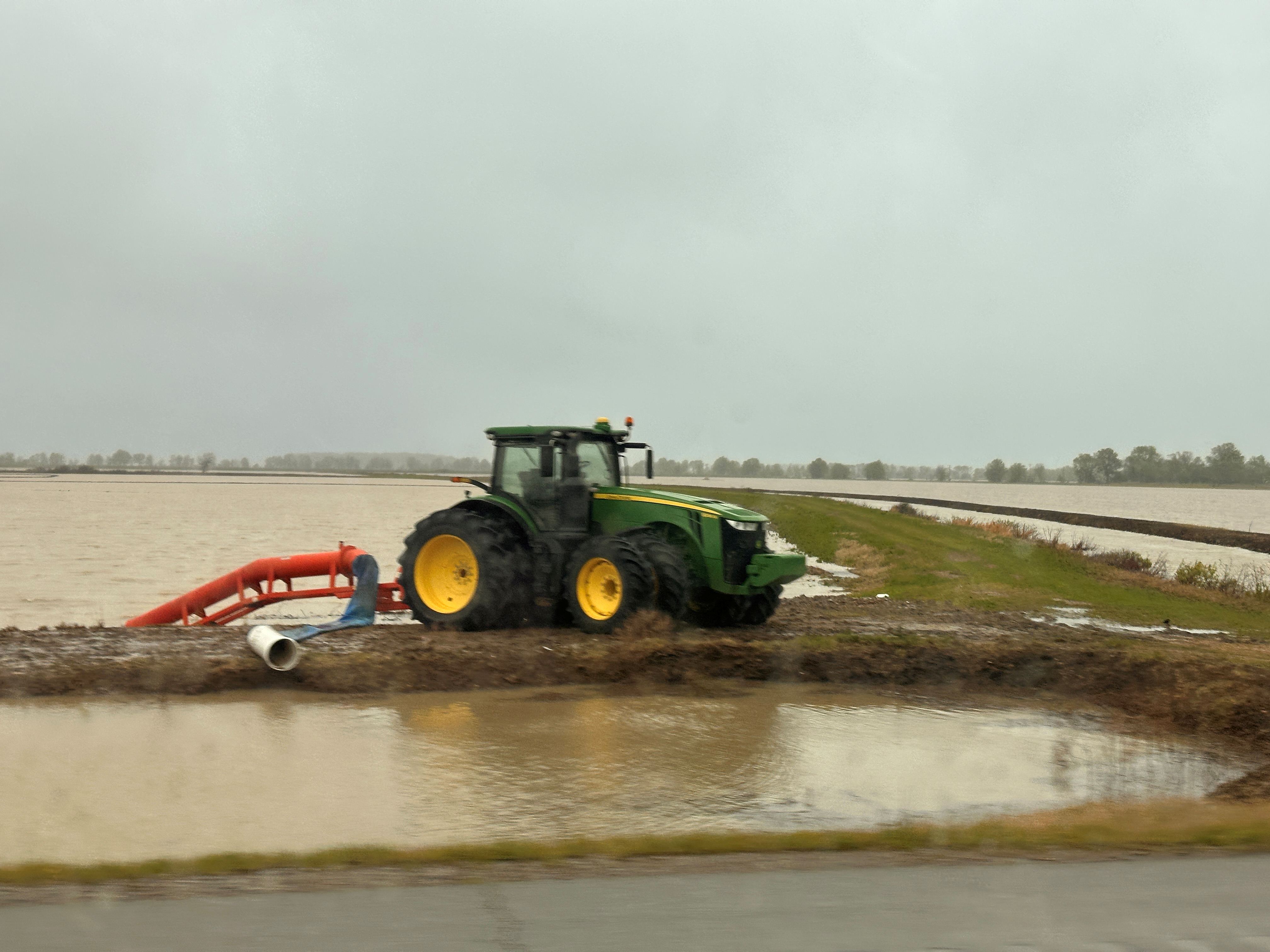
An increasing concern is that water is beginning to back up in places – putting more acres under and for an increasing length of time. The whole situation is “in progress” and will be sometime before we know the full outcome on affected acres.
As a reminder, we continue to look at “starter” type fertilizer applications on both sick and healthy rice, and we continually DO NOT see a benefit to these applications. Getting rice dried out and growing well is the key, which means being careful with herbicide applications that could set them back while they’re recovering. Rice is very resilient if we allow it time to recover.
Fig. 1. Water with nowhere to go (h/t Jenna Martin, Cross Co.).