Arkansas Rice Update 9-25-26
Arkansas Rice Update 2026-28
September 25, 2026
Jarrod Hardke, Scott Stiles, & Kate Turner
“Tumble out of bed and I stumble to the kitchen, pour myself a cup of ambition and yawn and stretch and try to come to life.”

End of a Fast Harvest in a Long Year
National Dolly Parton Day – 9-25.
This will be the last weekly update for the year, though there will be others to follow as we share some results of research trials and any other relevant news should it occur. Thanks for the following this year, and we look forward to providing the weekly Rice Update again in 2027 under hopefully brighter prospects.
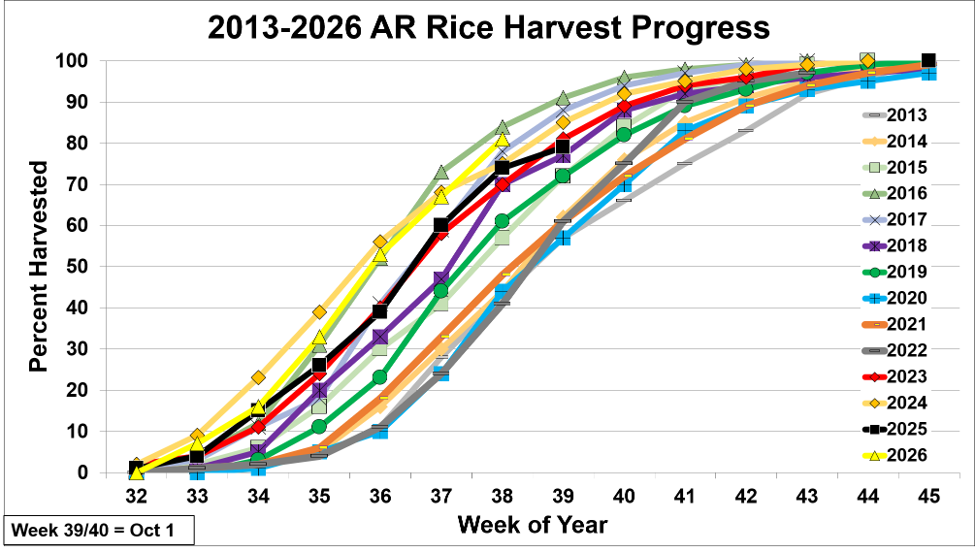
For now, the upside is that harvest is reaching the bitter end – 81% complete as of Monday (9/21) and likely 90% or greater in the upcoming report. Yields have remained largely good to solid, but a little underwhelming for many. A few had record or near-record personal rice harvests, but those were rare. “Just a little off” is how most have described their average yields.
Milling yields are still a no fun topic. Possibly the lowest overall head rice average we’ve seen? Day after day of extreme heat, both day and night, during the heart of harvest clearly took its toll. Early harvest way back in August produced some pretty good milling yields, but they didn’t last. Even when harvested at good moisture levels, the window of the last week of August through the first two weeks of September produced rapidly declining grain moistures and rapidly declining head rice yields.
With some variation depending on cultivar, if you harvested at 16-18% moisture you may have still achieved head rice yields in the 50s at least for some lots. But it refused to last and harvest at lower moisture levels got ugly quick with too many lots falling into the low 40s and the 30s. While rare, numbers in the 20s and below have happened.
Until next time, have a rice day!
See more below on the new rice pathologist, bacterial panicle blight, futures, harvest progress, 2027 decisions, and ARC/PLC sign-ups.
Let us know if we can help.
Fig. 1. NOAA 7-day precipitation forecast.
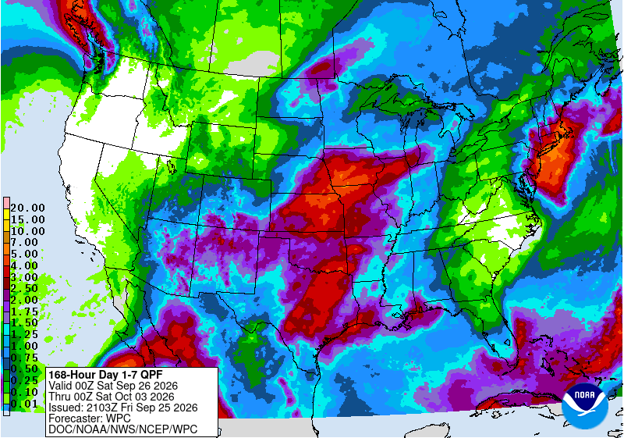
Fig. 2. Arkansas rice 2026 harvest progress.
A New Face in Arkansas Rice
Kate Turner
Hello, Arkansas rice growers!
I’m excited to introduce myself as the new Rice Extension Plant Pathologist with the University of Arkansas Division of Agriculture. I’ve now been in the position for about three weeks, and I’ve already had the opportunity to start getting familiar with Arkansas rice production and the disease challenges growers face each season.
As I settle into the role, I’m looking forward to spending more time in the field, meeting growers, consultants, and extension agents, and learning firsthand about the disease issues that are most important to Arkansas rice production.
And what better way to get started than with a little Arkansas heat?
This Heat Has Been Something Else
There is no question that temperatures this year have been a major talking point. For rice, that heat is more than just uncomfortable—it can have a major impact on disease development. One disease that deserves some attention following these hot conditions is bacterial panicle blight.
Bacterial panicle blight tends to get our attention when rice flowers during periods of high temperatures, particularly when nighttime temperatures remain high. And this year, we certainly had plenty of those conditions. The combination of hot days and warm nights during flowering can create an environment that favors bacterial panicle blight development.
What Are We Looking For?
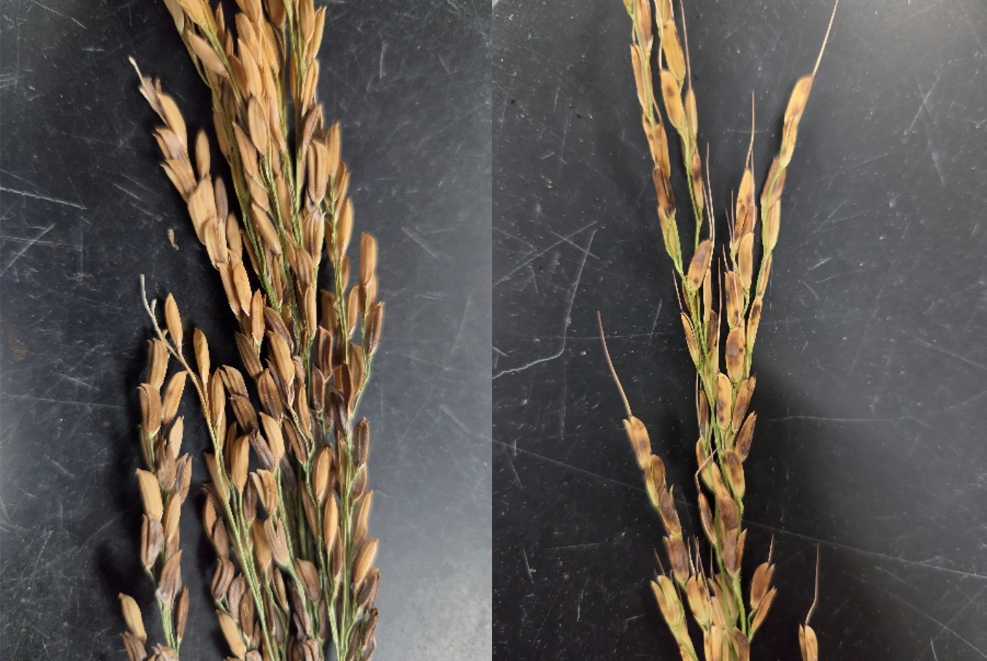
So, what should you be looking for in the field? Bacterial panicle blight can be difficult to spot early, but symptoms are generally associated with the panicle and developing grains. Infected florets may turn brown, fail to develop properly, or produce poorly filled grains.
The disease can occur sporadically within a field, which can make it easy to overlook. However, when conditions are favorable, disease can become more noticeable as the crop moves through grain development. If you are seeing unusual discoloration or poor grain development on panicles—especially in rice that flowered during the hottest part of the season—it is worth taking a closer look.
Why Was This Year Different?
The biggest factor to keep in mind is when the rice flowered relative to the heat. Not every field will have the same level of risk. Variety, planting date, crop management, and weather conditions during flowering can all influence disease development.
That is one reason field observations are so important. Two fields sitting only a few miles apart can sometimes look very different when it comes to disease.
What Can We Do About It?
Unfortunately, bacterial panicle blight is not a disease where we have a simple “spray this and fix it” solution. Management is largely focused on reducing conditions that favor disease and selecting varieties with improved resistance or tolerance. Appropriate nitrogen management, variety selection, and cultural practices all have a role. That also means that what we learn from this year’s crop can help us make better decisions in future seasons.
Looking Ahead
As I continue getting started in my new role, one of my goals is to spend as much time as possible in the field and working with growers, consultants, and extension agents.
Rice diseases don’t always follow the textbook, and Arkansas conditions can present us with some unique challenges. The best way for us to stay ahead of those challenges is to combine what we know from research with what growers, consultants, and extension agents are seeing in the field.
This year’s heat has provided a good reminder of how closely weather and disease are connected.
If you think you are seeing bacterial panicle blight—or another rice disease you aren’t sure about—I’d love to hear from you. Send me a photo, bring me a sample, or stop me when you see me in the field.
Fig. 3. New Rice Extension Plant Pathologist – Dr. Kate Turner.
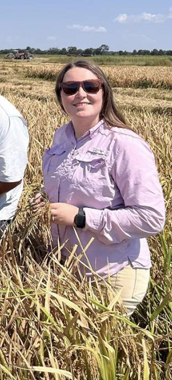
Fig. 4. Bacterial panicle blight on rice.
Market Update
Scott Stiles
“Think big, think positive… Buy low, sell high.” — Louis Winthorpe III Trading Places
The November contract came out of the gate Monday and closed 42 ½ cents higher to settle at $16.06 ½. The key feature here was the market's ability to move through the psychologically important $16.00 level. Trading was weaker Tuesday but closed above $16. Strong buying returned Wednesday that pushed the November contract above its recent high at $16.22. Strong gains in Wednesday and Thursday’s sessions were supported by increasing volume and open interest. This is an indication the breakout above $16 and the recent high at $16.22 has attracted new “longs” or buying. As of September 15th, the managed funds had increased their net long position in rice futures for four (4) consecutive weeks. As of last week, funds held the largest net long position in rice since March 2024 at 1,992 contracts. It’s likely additional fund buying has supported this week’s rally.
Fig. 5. CME November 2026 Rough Rice, Daily Chart.
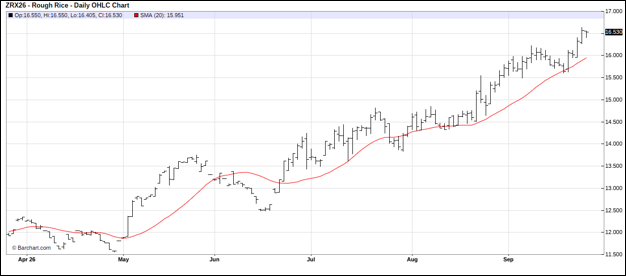
Where to next you might ask? This week’s breakout on the November 2026 daily chart has a strong resemblance to a “bullish flag” formation. The technical trader might say the $17.50 area is a possible objective. Who can say with any certainty? The November 2026 contract is making new highs and in uncharted waters.
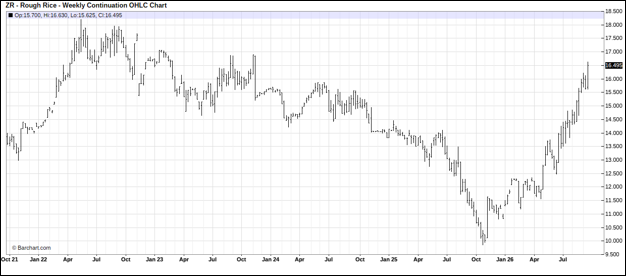
To guesstimate where the next upside objective(s) might reside, we need to review the November weekly continuation chart. The weekly chart clearly shows the uptrend that started last November is still solidly in place. As long as that trend holds, it appears the November 2026 contract is headed for the 2023 highs in the range of $16.85 to $16.90. Above there, $17 would offer some psychological resistance. A solid close above $17 to $17.06 opens the door to refilling a weekly chart gap at $17.31 to $17.42. The 5-year high for November contracts is $18.20, which occurred back in May 2022. Rough Rice Nov '26 Futures Chart - Barchart.com
Fig. 6. CME November Rough Rice, Weekly Continuation Chart.
Harvest Progress:
For the week ending September 20th, the Deep South (Louisiana 97%, Texas 95%) rice harvest was practically finished. The Midsouth is not far behind (Arkansas 81%, Mississippi 75%, Missouri 66%). Monday’s USDA Crop Progress put the national rice harvest at 73% complete, compared with the five-year average of 60%.
Table 1. U.S. Rice Harvest - Selected States (% harvested).
|
State |
week ending |
2021 – 2025 Average |
||
|---|---|---|---|---|
|
Last Year |
Last Week |
Sept.20, 2026 |
||
|
Arkansas |
72 |
67 |
81 |
61 |
|
California |
24 |
10 |
15 |
16 |
|
Louisiana |
96 |
95 |
97 |
93 |
|
Mississippi |
71 |
65 |
75 |
73 |
|
Missouri |
58 |
39 |
66 |
40 |
|
Texas |
95 |
90 |
95 |
93 |
|
|
|
|
|
|
|
U.S. |
70 |
62 |
73 |
60 |
Source: USDA NASS.
Several growers mentioned over the past week they had finished rice harvest and were turning attention to soybeans. For many of the long-tenured rice growers, 2026 was the fastest rice harvest in their career.
Besides the record temperatures and dry conditions in August and September, the other footnote is the Atlantic hurricane season has been historically quiet and record-breaking. This year there have been six named storms but zero hurricanes. Reaching late September without a single storm achieving hurricane strength has not occurred in the Atlantic in 112 years.
With the bulk of the long-grain harvest out of the way, attention now centers on yields, milling, basis, and demand. Something else to watch is India. There were reports this week that India’s rainfall was 18% below normal so far in September and 16% below normal in August. Something to watch. It appears today their production could be down as well as other parts of southeast Asia.
2027 Decisions:
Many have asked us if rice acres will increase in 2027. Good question. Fuel and fertilizer continue to be the leading input concerns. We need to see farm diesel prices soften quite a bit from the $4.95 to $5.00 that growers have reported this week. Urea has turned higher this month with some quotes this week around $650/ton. Phosphates remain firm and potash is creeping higher. Plus, rice will be competing with lower cost $12.75 soybeans and $5.25 corn as fall 2027 futures stand today. Fall 2027 rice bids at mills are currently in the $6.60/bu. area. We will begin work on the 2027 crop budgets very soon. Without a doubt, commodity and input prices will evolve a lot between now and spring 2027. We look forward to working with you and seeing you this winter at county and industry meetings.
Upcoming USDA Reports:
The remaining 2026 release dates for the USDA World Agricultural Supply and Demand Estimates (WASDE Report), NASS Crop Production and FSA Crop Acreage reports are:
- October 9, 2026 (Friday)
- November 10, 2026 (Tuesday)
- December 10, 2026 (Thursday)
WASDE and Crop Production reports are scheduled for release at 11:00 AM Central Time. FSA Acreage reports are generally released after 2:00 PM Central Time.
2026 and 2027 ARC/PLC Sign-up:
The USDA Farm Service Agency (FSA) announced a dual sign-up window for the Agriculture Risk Coverage (ARC) and Price Loss Coverage (PLC) programs.
The official election and enrollment dates are:
- 2026 Crop Year: September 16, 2026, through December 11, 2026.
- 2027 Crop Year: November 2, 2026, through March 15, 2027.
If you prefer to handle paperwork in your local FSA office, note the 2026 and 2027 signup periods overlap. You can wait until after November 2, 2026, to complete paperwork for both crop years during a single visit.
DD50 Rice Management Program is Live
The DD50 Rice Management Program is live and ready for fields to be enrolled for the 2026 season. All log-in and producer information has been retained from the 2025 season, so if you used the program last year you can log in just as you did last year. Log in and enroll fields here: https://dd50.uada.edu.
Use the Arkansas Rice Advisor Internet App!
The Arkansas Rice Advisor site https://riceadvisor.uada.edu functions like an app on your mobile device. There you can readily access the DD50 program, rice seeding rate calculator, drill calibration, fertilizer and N rate calculators, publications, and more.
Additional Information
Arkansas Rice Updates are published periodically to provide timely information and recommendations for rice production in Arkansas. If you would like to be added to this email list, please send your request to rice@uada.edu.
This information will also be posted to the Arkansas Row Crops blog (http://www.arkansas-crops.com/) where additional information from Extension specialists can be found.
More information on rice production, including access to all publications and reports, can be found at http://www.uaex.uada.edu/rice.
Acknowledgements
We sincerely appreciate the support for this publication provided by the rice farmers of Arkansas and administered by the Arkansas Rice Research and Promotion Board.
The authors greatly appreciate the feedback and contributions of all growers, county agents, consultants, and rice industry stakeholders.
Specialist |
Area |
Phone Number |
|
|---|---|---|---|
|
Jarrod Hardke |
Rice Extension Agronomist |
501-772-1714 |
|
|
Tom Barber |
Extension Weed Scientist |
501-944-0549 |
|
|
Nick Bateman |
Extension Entomologist |
870-456-8486 |
|
|
Ralph Mazzanti |
Rice Verification Coordinator |
870-659-5507 |
|
|
Trent Roberts |
Extension Soil Fertility |
479-935-6546 |
|
|
Bob Scott |
Extension Weed Scientist |
501-837-0273 |
|
|
Scott Stiles |
Extension Ag Economics |
501-258-8455 |
|
|
Kate Turner |
Extension Plant Pathologist |
901-517-0109 |