Arkansas Rice Update 9-18-26
Arkansas Rice Update 2026-27
September 18, 2026
Jarrod Hardke & Scott Stiles
“Some people call me the space cowboy…”

Say Uncle
Milling isn’t getting better… Can I just leave it at that? More on the weather and milling below.
Continued clear weather for the next week, but with a possible break in the temperature? It’s seemed like we’ve been teased with this possibility for a couple of weeks now, and maybe it will really happen this time. While it will be welcome, the mild temperatures look to show up about the time rice harvest is down toward the end. We desperately needed the break weeks ago – then when might not be talking about milling again.
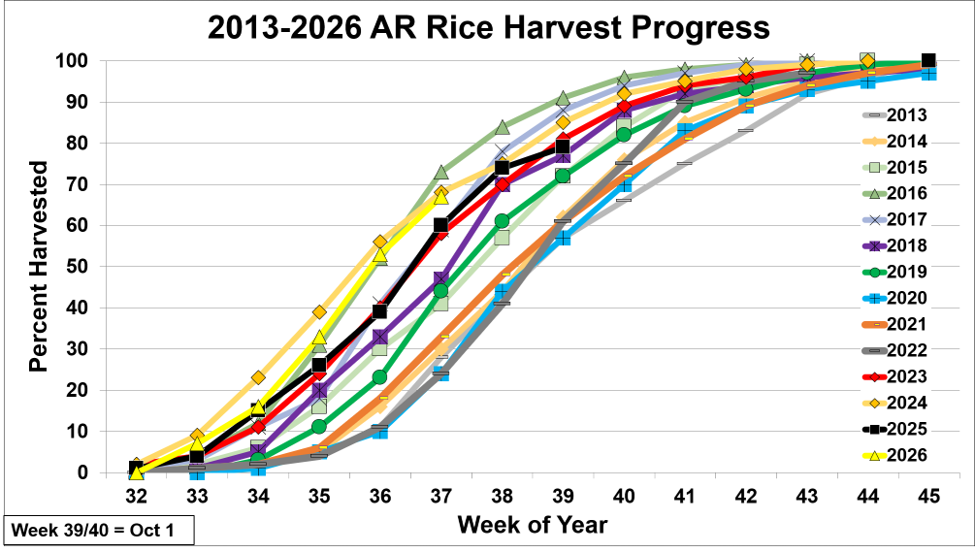
Harvest progress should top 80% by Monday’s report. So, the bulk of harvest will have occurred during record heat – generally not a recipe for good things. Yield reports remain relatively quiet. Most of the conversations that have occurred have focused on some variability but yields coming in near expectation to a little off. Not the situation of major issues we faced on the yield front last fall.
Next week will likely be our last regularly scheduled weekly Rice Update. Additional updates will only be sent out when or if they’re needed. Good luck through the remainder of harvest.
Read on below for more information on milling and weather, preliminary results of Arkansas Rice Performance Trials, futures, ARC/PLC, and crop insurance.
Let us know if we can help.
Fig. 1. NOAA 7-day precipitation forecast.
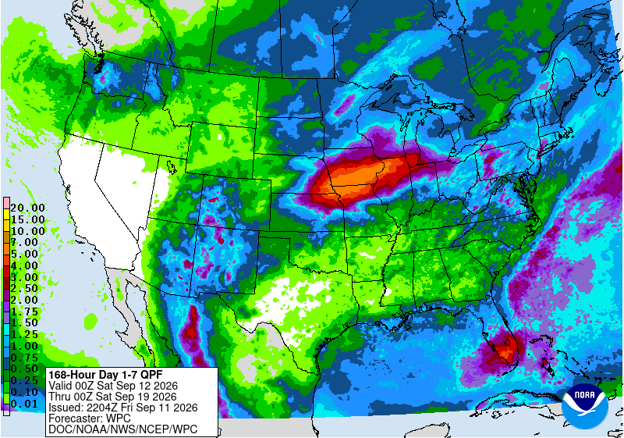
Fig. 2. Arkansas rice 2026 harvest progress.
Milling and the Weather
Jarrod Hardke
I’m as tired of writing about it as you are of reading about it the last few years. We’re all definitely most tired of dealing with it. But it is the reality we’re in.
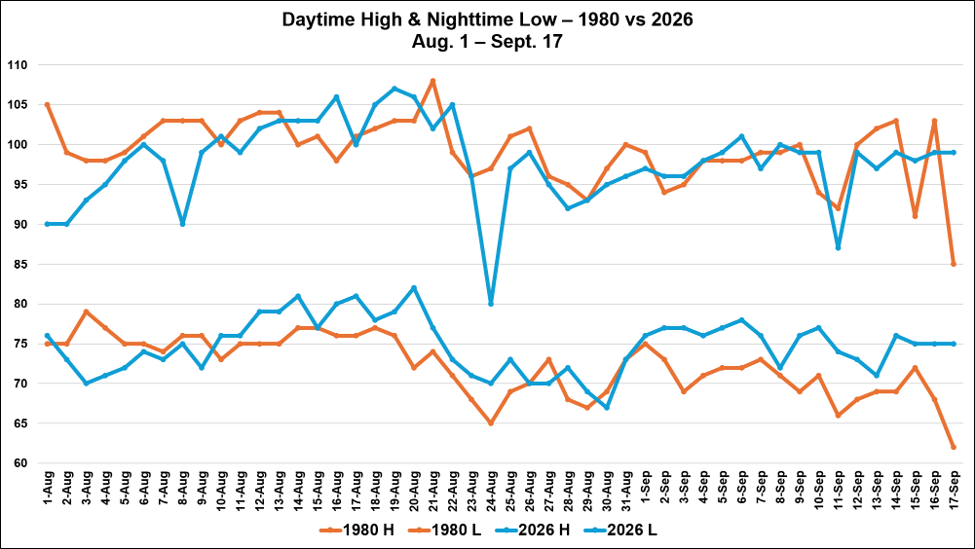
It’s not an illusion – harvest weather has changed, and it doesn’t like us. Yes it’s hot, and yes it’s been hot before. But that doesn’t make things equal. Let’s have a look at Fig. 3. A comparison of the daily highs and lows from 1980 and 2026 from Aug. 1 to Sept. 17. Talk about a lot of similarities.
One thing this chart shows that stands out to me is the nighttime temps – they’re worse in 2026. There’s another thing the figure doesn’t show – in 2026 we surpassed 50% harvest on Sept. 6. While those records weren’t available in 1980, in the three following years 1981-1983, we never reached 50% harvest until October. The game has changed and so have the conditions the crop is going through. I don’t have the answers, but we must accept that we’re working with a different deck of cards today than we were the last time we played a game like this, so the rules have to change.
Fig. 3. Comparison of daily high and low temperatures for the period August 1 to September 17 in 1980 versus 2026.
Preliminary 2026 ARPT Results
Jarrod Hardke
More “preliminary” data that hasn’t been fully processed and is subject to change. This data has been summarized quickly in an effort to report data as soon as possible. One location left to harvest.
Table 1. Preliminary Arkansas Rice Performance Trial (ARPT) results by location and planting date.
|
Cultivar |
Grain |
ARK |
MIS |
POI |
CLA |
DES |
GRE |
LAW |
MEAN |
|---|---|---|---|---|---|---|---|---|---|
|
|
|
Apr 1 |
Apr 23 |
Apr 21 |
Apr 8 |
Mar 25 |
Apr 14 |
Apr 9 |
|
|
Ozark |
L |
167 |
178 |
181 |
197 |
154 |
202 |
191 |
182 |
|
ProGold L4 |
L |
166 |
171 |
188 |
184 |
159 |
194 |
204 |
181 |
|
DG263L |
L |
153 |
163 |
181 |
159 |
170 |
191 |
167 |
169 |
|
DG273L |
L |
157 |
166 |
184 |
188 |
161 |
203 |
185 |
178 |
|
RTv7303 |
L |
151 |
159 |
178 |
205 |
178 |
191 |
198 |
180 |
|
CLL18 |
CL |
165 |
174 |
207 |
189 |
171 |
207 |
210 |
189 |
|
CLL20 |
CL |
152 |
165 |
179 |
162 |
191 |
180 |
186 |
174 |
|
CLL21 |
CL |
176 |
169 |
194 |
189 |
168 |
186 |
198 |
183 |
|
CLHA03 |
CL |
167 |
154 |
172 |
166 |
164 |
170 |
175 |
167 |
|
PVL04 |
PL |
144 |
158 |
170 |
167 |
161 |
184 |
166 |
164 |
|
PVL05 |
PL |
167 |
149 |
172 |
162 |
168 |
165 |
195 |
168 |
|
PVL06 |
PL |
190 |
188 |
202 |
173 |
167 |
208 |
198 |
189 |
|
DG563PVL |
PL |
143 |
144 |
165 |
161 |
147 |
198 |
183 |
163 |
|
DG573PVL |
PL |
156 |
162 |
185 |
179 |
171 |
193 |
222 |
181 |
|
RTv7231 MA |
ML |
170 |
167 |
187 |
187 |
184 |
196 |
179 |
181 |
|
RT 7331 MA |
MLH |
197 |
164 |
194 |
213 |
191 |
208 |
200 |
195 |
|
RT 7531 MA |
MLH |
200 |
195 |
207 |
215 |
198 |
235 |
220 |
210 |
|
RT 7221 FP |
FLH |
192 |
197 |
190 |
203 |
181 |
205 |
203 |
196 |
|
RT 7321 FP |
FLH |
196 |
165 |
201 |
203 |
189 |
216 |
211 |
197 |
|
RT 7421 FP |
FLH |
211 |
184 |
226 |
217 |
182 |
238 |
206 |
209 |
|
RT 7521 FP |
FLH |
200 |
215 |
199 |
224 |
192 |
239 |
223 |
213 |
|
RT 7302 |
LH |
211 |
163 |
223 |
215 |
208 |
233 |
218 |
210 |
|
RT Exp. Smooth Leaf |
LH |
199 |
188 |
231 |
211 |
196 |
239 |
255 |
217 |
|
Taurus |
M |
175 |
171 |
195 |
185 |
183 |
211 |
199 |
188 |
|
ProGold M3 |
M |
158 |
159 |
164 |
172 |
175 |
193 |
199 |
174 |
|
RT3202 |
M |
204 |
187 |
227 |
203 |
198 |
227 |
220 |
209 |
|
CLM05 |
CM |
158 |
167 |
189 |
180 |
179 |
200 |
177 |
178 |
|
Venus |
M |
164 |
143 |
171 |
190 |
185 |
213 |
188 |
179 |
|
|
|
|
|
|
|
|
|
|
|
|
MEAN |
-- |
175 |
170 |
192 |
189 |
178 |
204 |
199 |
187 |
**Locations: ARK = research station, Arkansas Co.; MIS = research station, Mississippi Co.; POI = research station, Poinsett Co.; CLA = grower field, Clay Co.; DES = grower field, Desha Co.; GRE = grower field, Greene Co.; LAW = grower field, Lawrence Co.**
**Grain Type: L = long-grain; CL = Clearfield long-grain; PL = Provisia long-grain; ML = MaxAce long-grain; MLH = MaxAce long-grain hybrid; FLH = FullPage long-grain hybrid; LH = long-grain hybrid; M = medium-grain; CM = Clearfield medium-grain.**
Market Update
Scott Stiles
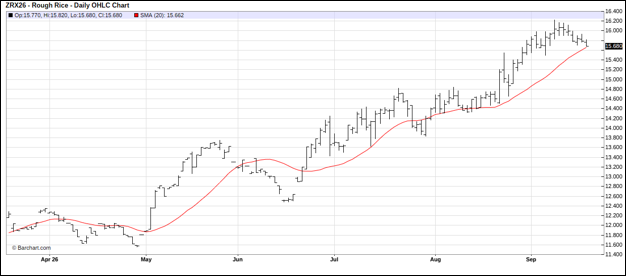
Rice futures trading this week saw modest daily volume and tight 20-cent ranges. The November contract worked steadily lower toward the 20-day moving average (red line) at $15.66. Some price pressure is coming from the near record harvest pace this year. The market is also paying close attention to the milling yields coming out of Arkansas and how that might impact export demand going forward. The local cash basis for rough rice has weakened substantially. A combination of the fast harvest along with milling quality issues and record high diesel prices have converged to pressure basis levels.
Fig. 4. CME Rough Rice Futures, November 2026 Daily Chart.
USDA NASS Crop Progress (rice harvest, bottom of page 8)
USDA Announces 2026 and 2027 Enrollment for ARC and PLC Programs
USDA announced earlier this week producers can make Agriculture Risk Coverage (ARC) and Price Loss Coverage (PLC) program elections and enroll for the 2026 crop year from September 16th through December 11th, 2026.
The ARC/PLC election and enrollment typically occur much earlier in the year. The process for the 2026 crop year was delayed in part by the addition of 30 million base acres across the United States. This delay is beneficial to producers since the 2026 crop harvest is underway. Producers will have a better sense of what yields will be (which has a significant bearing on ARC payments). Of further value, USDA has included 2026 projected season average prices for program commodities in its monthly WASDE reports. Both ARC and PLC payments use marketing year average prices from the 12 months following harvest. Before making a final election and enrollment decision for 2026, it may be beneficial to assess USDA’s yield and price outlook information from the October 9th and November 10th WASDE and Crop Production reports.
How To Enroll:
Producers can make program elections and enroll either online at fsa.usda.gov/arc-plc using a Login.gov account or by making an appointment at their local FSA office.
NOTE: If producers do not submit their 2026 election by December 11, 2026, their election remains the same as their 2025 election for crops on the farm, and the farm is ineligible for payments for the 2026 program year.
ARC/PLC Decision Aids:
Some land grant universities offer web-based decision tools to help producers make ARC/PLC election decisions using data specific to their farming operations. The Agricultural & Food Policy Center (AFPC) at Texas A&M University has provided a decision tool for ARC and PLC since those programs were first created in the 2014 Farm Bill. More information on the Texas A&M decision aid is in this article: Making the ARC/PLC Election for the 2026 Crop Year
Projected 2026 PLC Payment Rates:
The table below includes USDA’s September projections for 2026 PLC Payment Rates. Given the current price outlook for the 2026/27 marketing year, no 2026 PLC payments are expected for wheat, corn and soybeans. For long-grain rice, the 2026 projected PLC rate is 3.4 cents per pound or $1.53 per bushel. For southern medium grain, the projected PLC rate is 1.9 cents per pound or 86 cents per bushel. These payment rates are subject to change. USDA will provide an updated season average farm price in each monthly WASDE report.
Table 2. 2026 Projected PLC Payment Rates, Select Commodities, September 2026.
|
Commodity |
Marketing Year |
Unit |
2026 Effective Reference Price |
Projected (P) 2026/27 MYA Price |
Projected (P) 2026 PLC Payment Rate |
||
|---|---|---|---|---|---|---|---|
|
Wheat |
Jun. 1-May 31 |
Bushel |
$6.35 |
$6.40 |
P |
$0.00 |
P |
|
Peanuts |
Aug. 1-Jul. 31 |
Pound |
$0.3150 |
$0.2400 |
P |
$0.0750 |
P |
|
Corn |
Sep. 1-Aug. 31 |
Bushel |
$4.42 |
$4.80 |
P |
$0.00 |
P |
|
Grain Sorghum |
Sep. 1-Aug. 31 |
Bushel |
$4.67 |
$4.60 |
P |
$0.07 |
P |
|
Soybeans |
Sep. 1-Aug. 31 |
Bushel |
$10.71 |
$12.00 |
P |
$0.00 |
P |
|
Seed Cotton |
Aug. 1-Jul. 31 |
Pound |
$0.4200 |
$0.4114 |
P |
$0.0086 |
P |
|
Rice (long grain) |
Aug. 1-Jul. 31 |
Pound |
$0.1690 |
$0.1350 |
P |
$0.0340 |
P |
|
Rice (med/short grain) |
Aug. 1-Jul. 31 |
Pound |
$0.1690 |
$0.1500 |
P |
$0.0190 |
P |
|
|
|
|
|
|
|
|
|
source: USDA Farm Service Agency, September 2026.
Crop Insurance Changes:
Producers can now add SCO coverage (Supplemental Coverage Option) or the Enhanced Coverage Option (ECO) regardless of their ARC or PLC election.
Previously, producers who elected ARC-CO or ARC-IC were ineligible to purchase the Supplemental Coverage Option (SCO) through their Approved Insurance Provider for the same acres, but this restriction has been removed.
2027 Crop Year Enrollment:
Program election and enrollment for the 2027 crop year will begin November 2, 2026 through March 15, 2027.
NOTE: Although program election changes are optional, producers must enroll through a signed contract each year. Existing multi-year contracts ended in 2025, but producers have the option to sign a new multi-year contract for 2026 through 2031. Producers who opt out of a multi-year contract can enroll for the 2027 crop year starting November 2, 2026, through March 15, 2027.
USDA FSA Press Release: USDA Announces 2026 and 2027 Enrollment for Key Price and Revenue Safety Net Programs
DD50 Rice Management Program is Live
The DD50 Rice Management Program is live and ready for fields to be enrolled for the 2026 season. All log-in and producer information has been retained from the 2025 season, so if you used the program last year you can log in just as you did last year. Log in and enroll fields here: https://dd50.uada.edu.
Use the Arkansas Rice Advisor Internet App!
The Arkansas Rice Advisor site https://riceadvisor.uada.edu functions like an app on your mobile device. There you can readily access the DD50 program, rice seeding rate calculator, drill calibration, fertilizer and N rate calculators, publications, and more.
Additional Information
Arkansas Rice Updates are published periodically to provide timely information and recommendations for rice production in Arkansas. If you would like to be added to this email list, please send your request to rice@uada.edu.
This information will also be posted to the Arkansas Row Crops blog (http://www.arkansas-crops.com/) where additional information from Extension specialists can be found.
More information on rice production, including access to all publications and reports, can be found at http://www.uaex.uada.edu/rice.
Acknowledgements
We sincerely appreciate the support for this publication provided by the rice farmers of Arkansas and administered by the Arkansas Rice Research and Promotion Board.
The authors greatly appreciate the feedback and contributions of all growers, county agents, consultants, and rice industry stakeholders.
Specialist |
Area |
Phone Number |
|
|---|---|---|---|
|
Jarrod Hardke |
Rice Extension Agronomist |
501-772-1714 |
|
|
Tom Barber |
Extension Weed Scientist |
501-944-0549 |
|
|
Nick Bateman |
Extension Entomologist |
870-456-8486 |
|
|
Ralph Mazzanti |
Rice Verification Coordinator |
870-659-5507 |
|
|
Trent Roberts |
Extension Soil Fertility |
479-935-6546 |
|
|
Bob Scott |
Extension Weed Scientist |
501-837-0273 |
|
|
Scott Stiles |
Extension Ag Economics |
501-258-8455 |