Arkansas Rice Update 8-21-26
Arkansas Rice Update 2026-23
August 21, 2026
Jarrod Hardke, Scott Stiles, & Bob Scott
“Hey tomorrow, where are you goin’?”

Still Cooking
Do you yield? And by that I mean both are your field yields holding up, and at the same time have you given up hoping for relief from the heat?
The forecast appears to be a mixed bag right now. There appear to be some rain chances in the coming days but still some chances of very high temperatures depending on which forecast you look at and when you look at it.
Rain at this point will be a mixed blessing depending on exact stage of crops for everyone. Those getting in the full swing of harvest certainly don’t want to be slowed down, but those with later rice or soybeans with irrigations left in them would welcome a little help with the irrigation bill (and the dry reservoirs and well issues).
Yield reports continue to sound good overall, but there are some not-so-great numbers appearing as well. We’re just getting rolling into some research trial harvest, but I can already see what may be some variability of performance out there – only getting more trials cut will tell if that’s true, and the same for the rest of the crop.
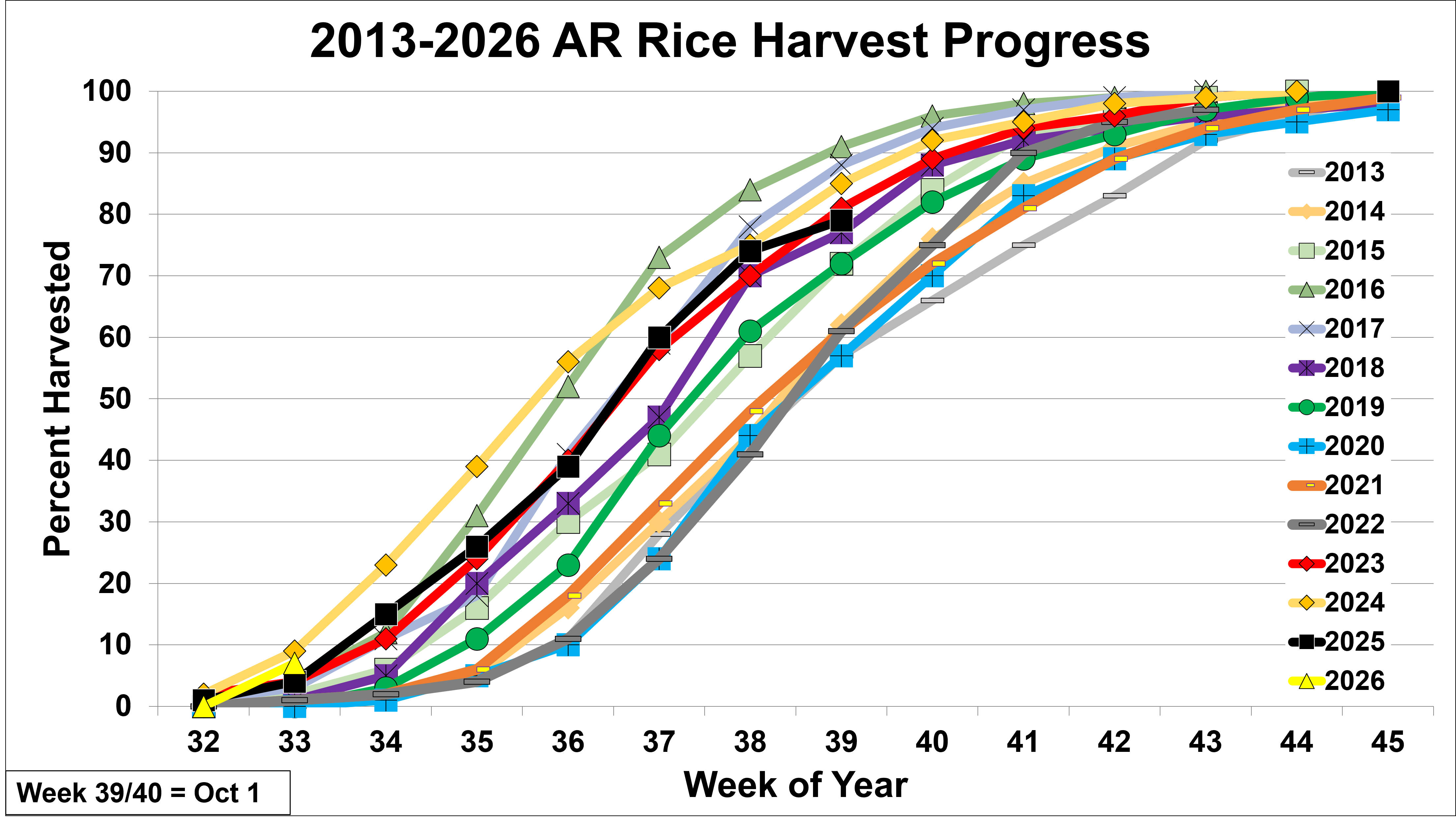
Of course it’s hot and rice continues to dry fast. Milling yields as a result aren’t stellar so far as some of this earliest rice is seeing moisture fall out and grains getting brittle. Weather permitting, rice harvest progress should make a big push over the next 10 days with many just having rice to the go point.
See more below on rice harvest loss, herbicide-resistant weed testing, and markets.
Let us know if we can help.
Fig. 1. NOAA 7-day precipitation forecast.
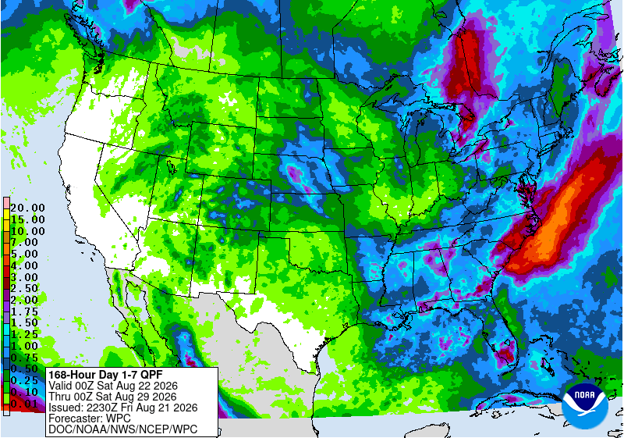
Fig. 2. Arkansas rice 2026 harvest progress.
Ricing Around
Jarrod Hardke
Rice Harvest Loss Behind the Combine
Table 1 provides a generalized estimate of converting rice kernel counts to harvest loss. There’s a process for arriving at an accurate average number though.
The most accurate way to do the count is to count a 10 ft2 area across the entire header width. For a 30 ft header, that’s an area 30 ft wide x 4 inches. Not a real feasible or convenient count to make.
Instead, it may be much more straightforward to take a few simple counts from respective areas behind the machine.
For a 30-ft header, think of it as having three 10-ft sections. Take a single square foot count in the center of each of these 10-ft sections. Add the three counts and divide them by three to give you an average per square foot.
Remember to count any kernels already on the ground in an unharvested area to deduct from your count what has already shattered on the ground.
Table 1. Converting rice field loss counts into bushels per acre.
|
Number of Kernels Per Square Foot |
Average Field Loss (Bu/A) |
|---|---|
|
25 |
1.3 |
|
50 |
2.5 |
|
75 |
3.7 |
|
100 |
5.1 |
|
125 |
6.4 |
|
250 |
12.8 |
Bobbing and Weeding
Bob Scott
Well, we missed a bunch of weeds what can we do…
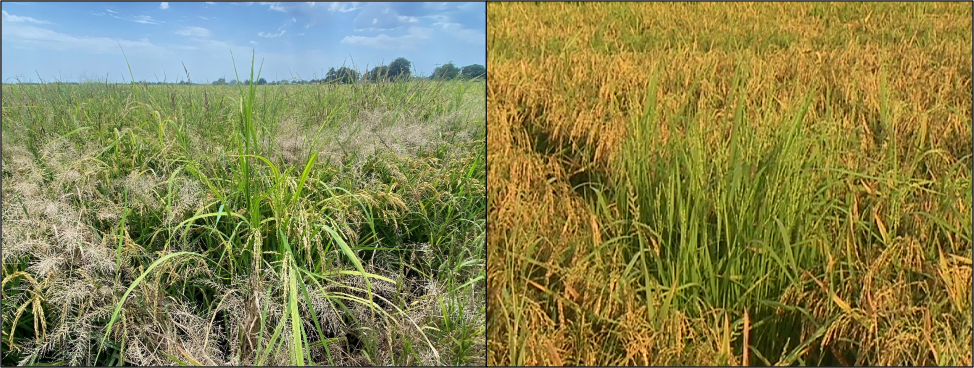
Let’s face it, if you are calling me this late in the year it means the wheels came off the weed control program and the truth is it’s too late to spray much of anything except maybe a harvest aid. So, what is left to do?
Well not much for this year’s crop. But perhaps we can help you prepare for next year and better understand what you are dealing with. For almost 20 years now, the weed science group has conducted a resistance screening program for weeds that make it to harvest. This program is made possible by support from the soybean and rice promotion boards, the Division of Agriculture, and is conducted at no cost to the grower, consultant or county.
The process that we use to determine if a weed is resistant is a whole plant assay. Simply put we plant the seed that is sent in, spray the young plants with a variety of herbicides and determine or estimate whether and to what degree the given plant is resistant to that herbicide. A report is then generated and sent back to the county or person who sent in the sample. You can plan a better weed control approach for next year armed with the knowledge of what resistance battle you may be facing and hopefully save some money!
Samples can be sent directly to Dr. Jason Norsworthy in Fayetteville, dropped off with myself or Dr. Tom Barber in Lonoke or sent in through your county office. It is important to remember that we need mature seed so that they will germinate. The samples should be stored in PAPER not plastic bags and ample seed should be collected to ensure enough comes up for complete testing. We will test any weed that you suspect you have resistance to. Also, be sure you are collecting seed, some plants like male pigweed plants or yellow nutsedge do not produce seed. You would need a female pigweed plant and in the case of yellow nutsedge collection of below ground tubers.
Follow the link to download the form: Herbicide Resistant Weed Information Sheet.
Market Update
Scott Stiles
Reminders / Upcoming FSA Deadlines:
August 31st is the deadline to review ARC/PLC Base Allocation Summary. This can be done online with your Login.gov account or at your local FSA office. Review the Base Allocation Summary (likely sent to you in June). Contact your local FSA office if:
- Acreage history is incorrect or missing.
- There are “subsequent acres” listed and you would like to choose the subsequent acreage for base allocation.
- To opt out of receiving any additional base acres.
September 15th deadline for new qualified pass-through entities to file an updated farm operating plan with FSA. For program year 2026, farm operations that are structured as LLCs or S-Corps or one of the new qualified pass-through entities must file updated farm operating plans with FSA by Sept. 15, 2026.
Previously, farm operations that were structured as an LLC or an S-Corp were limited to a single payment limitation. Starting with the 2026 crop year, for payment eligibility purposes, FSA will treat limited liability companies (LLCs) and S-Corporations (S-Corps), and other similar entities, as “pass through entities.” Each member of the qualified pass-through entity who meets actively engaged in farming criteria will help qualify the entity for expanded payments.
Rice Harvest Progress:
In Monday’s Crop Progress, NASS provided the season’s first look at the Midsouth rice harvest. With the recent heat and dry conditions, harvest in Arkansas is advancing a bit faster than the historical average with 7% of the crop harvested as of August 16th, compared to the 5-year average of 3% harvested. Mississippi also showed up in this week’s Crop Progress with 9% harvested, also ahead of the 5-year average.
Table 2. U.S. Rice Harvest - Selected States (% harvested).
|
State |
week ending |
2021 – 2025 Average |
||
|
Last Year |
Last Week |
Aug. 16, 2026 |
||
|
Arkansas |
4 |
|
7 |
3 |
|
California |
|
|
|
|
|
Louisiana |
63 |
72 |
80 |
60 |
|
Mississippi |
7 |
|
9 |
3 |
|
Missouri |
|
|
|
|
|
Texas |
54 |
31 |
50 |
50 |
|
|
|
|
|
|
|
U.S. |
16 |
14 |
20 |
15 |
Source: USDA NASS.
Harvest in Texas made a sizeable jump last week and is right in line with the average pace at 50% harvested. In areas south and west of Houston, the crop is reported to be about 70% harvested. Some indicate that Texas yields are down 5% to 15% compared to last year. Louisiana’s harvest is winding down fast with 80% of the crop out of the field; well ahead of the average 60% harvested. In parts of southwest Louisiana, cutting started as early as June. Louisiana is also seeing variable, slightly below-average yields.
CME Rice Futures:
As a reminder, First Notice Day for the September 2026 contract is August 31st. The contract expires September 14th. Volume and Open Interest in the September contract is dropping fast as the speculators head over to the November contract. If you still have a position in the September contract, have your exit plan ready. Volatility generally increases and daily trading ranges can be very wide in the days leading up to First Notice. Another point to be aware of, effective September 1, 2026, the CBOT is changing its Milling Yield Premium and Discount Fee Schedule. This could create short-term cash-to-futures price anomalies as the September contract goes into delivery.
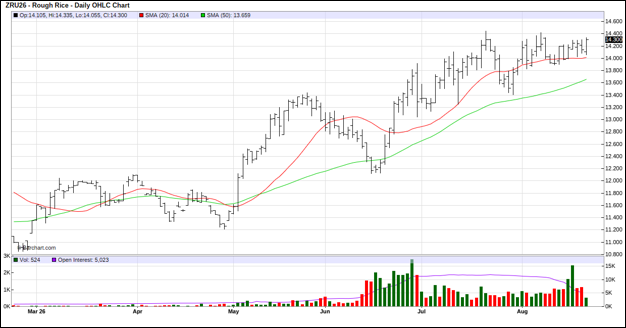
We’ll do one last look at the September contract this week. For the moment at least, daily trading ranges have been tight as the Midsouth harvest gets rolling and yield reports trickle in. The September contract is finding support on the 20-day moving average (red line) at $14.00. A decisive close above $14.44 will be needed to spark some new buying. For the November contract, key resistance is at the recent highs of $14.82 - $14.84. For either contract, Sept or Nov, maintaining support at the 20-day moving average is important and should be closely watched. Failure there would likely lead to a pullback to the 50-day moving average (green line) at $13.65 (Sept) or $14.05 (Nov). The technical indicators, like moving average lines, are helpful in the timing of marketing decisions.
Fig. 3. CME September 2026 Rough Rice Futures, Daily Chart.
As of Friday morning, cash rice bids at mills were $5.85 to $5.90/bu for fall (Aug.-Oct.) delivery. Dryer bids were in the $5.73 to $5.79 range. Mill bids for January-March delivery were in the $6.10 area. The Mississippi River at Memphis continues to rise and is projected to level off at 13.5’ on August 25th. Weather-wise, tropical activity in the Atlantic remains non-threatening.
The most vocal concern from growers lately has centered on diesel prices. Quotes for tanker loads of red dye were $4.65 to $4.70 at the close of the week. NYMEX diesel futures are right back where they were in early April, with the lead month futures trading around $4.55/gallon. Energy market news continues to focus on shipping (or lack of) through the Strait of Hormuz. This is keeping fuel and some fertilizer prices at elevated levels.
DD50 Rice Management Program is Live
The DD50 Rice Management Program is live and ready for fields to be enrolled for the 2026 season. All log-in and producer information has been retained from the 2025 season, so if you used the program last year you can log in just as you did last year. Log in and enroll fields here: https://dd50.uada.edu.
Use the Arkansas Rice Advisor Internet App!
The Arkansas Rice Advisor site https://riceadvisor.uada.edu functions like an app on your mobile device. There you can readily access the DD50 program, rice seeding rate calculator, drill calibration, fertilizer and N rate calculators, publications, and more.
Additional Information
Arkansas Rice Updates are published periodically to provide timely information and recommendations for rice production in Arkansas. If you would like to be added to this email list, please send your request to rice@uada.edu.
This information will also be posted to the Arkansas Row Crops blog (http://www.arkansas-crops.com/) where additional information from Extension specialists can be found.
More information on rice production, including access to all publications and reports, can be found at http://www.uaex.uada.edu/rice.
Acknowledgements
We sincerely appreciate the support for this publication provided by the rice farmers of Arkansas and administered by the Arkansas Rice Research and Promotion Board.
The authors greatly appreciate the feedback and contributions of all growers, county agents, consultants, and rice industry stakeholders.
Specialist |
Area |
Phone Number |
|
|---|---|---|---|
|
Jarrod Hardke |
Rice Extension Agronomist |
501-772-1714 |
|
|
Tom Barber |
Extension Weed Scientist |
501-944-0549 |
|
|
Nick Bateman |
Extension Entomologist |
870-456-8486 |
|
|
Ralph Mazzanti |
Rice Verification Coordinator |
870-659-5507 |
|
|
Trent Roberts |
Extension Soil Fertility |
479-935-6546 |
|
|
Bob Scott |
Extension Weed Scientist |
501-837-0273 |
|
|
Scott Stiles |
Extension Ag Economics |
501-258-8455 |