Arkansas Rice Update 8-14-26
Arkansas Rice Update 2026-22
August 14, 2026
Jarrod Hardke, Scott Stiles, & Bob Scott
“Proud Mary keep on burnin’.”

Five Alarm Fire
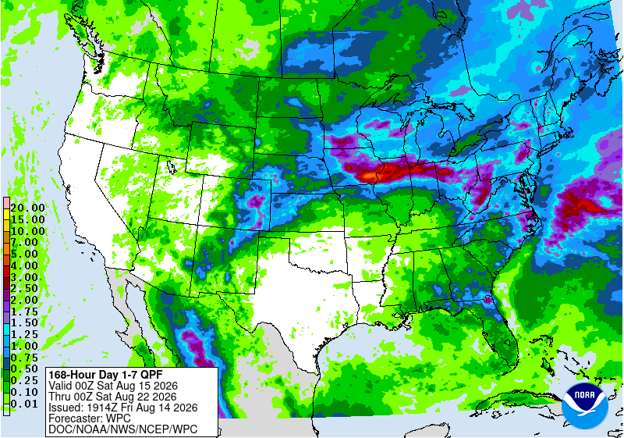
From the National Weather Service Little Rock Office on Thursday 8/13: “we have high confidence in a prolonged period of dangerous heat from today through at LEAST August 23 (next Sunday).” And another comment: “this extended period of significantly higher than normal temperatures combined with very little rainfall sets an almost perfect staging for a FLASH DROUGHT across much of the state of Arkansas.”
Draining: You know your ground better than anyone. Only drain as early as you need for it to hold the combine up when you get there. The ground is going to rapidly turn to concrete. When folks start throwing out terms like “flash drought” you know that rice plants can rapidly shut down and die. Suddenly we’re talking lodging and shattering from plant death, with grain moisture cratering and bringing milling yields down.
Grain Moisture: With this kind of heat and low afternoon humidity, grain moisture is going to fall much faster than normal. Reports of rapid drops have been coming in the last few days from the southeast through the northeast regions of the state. That being said, it does appear the DD50 is very close in terms of predicting 20% grain moisture right now – we just cut the first planting date at Stuttgart and the grain moisture compared to number of days after 50% heading places it very close. Use that as your guide for jumping in rice on time – the moisture is going to be running away from you screaming.
On a positive note, early yields so far continue to sound good, so let’s go get it!
See more below on certified acreage, ratoon rice tips, soybean desiccant drift on rice, and markets.
Let us know if we can help.
Fig. 1. NOAA 7-day precipitation forecast.
FSA Crop Acreage
Jarrod Hardke
On Wednesday (8/12), USDA’s Farm Service Agency released its August Crop Acreage file. In Table 1 is a summary of the certified acres reported by county, and in Table 2 is a summary by state. It’s worth noting that just 2 years ago in 2024, Arkansas alone planted over 1.3 million acres of long-grain, not much less than all states combined planted this year.
Table 1. Arkansas Rice Acres* Reported to FSA, August 12, 2026.
|
|
County |
Acres |
|
County |
Acres |
|---|---|---|---|---|---|
|
1 |
Lawrence |
83,355 |
19 |
Phillips |
14,577 |
|
2 |
Poinsett |
77,377 |
20 |
Lincoln |
11,964 |
|
3 |
Jackson |
72,251 |
21 |
Chicot |
9,301 |
|
4 |
Lonoke |
67,422 |
22 |
White |
7,735 |
|
5 |
Cross |
53,725 |
23 |
Independence |
7,654 |
|
6 |
Greene |
51,595 |
24 |
Lee |
6,751 |
|
7 |
Arkansas |
50,690 |
25 |
Drew |
4,728 |
|
8 |
Clay |
50,302 |
26 |
Pulaski |
3,266 |
|
9 |
Craighead |
48,066 |
27 |
Ashley |
2,224 |
|
10 |
Woodruff |
43,066 |
28 |
Lafayette |
2,037 |
|
11 |
Jefferson |
41,045 |
29 |
Faulkner |
1,288 |
|
12 |
Prairie |
40,124 |
30 |
Conway |
1,165 |
|
13 |
Randolph |
31,460 |
31 |
Pope |
1,067 |
|
14 |
Monroe |
26,258 |
32 |
Perry |
624 |
|
15 |
Mississippi |
21,856 |
33 |
Yell |
302 |
|
16 |
Crittenden |
18,790 |
34 |
Hot Springs |
267 |
|
17 |
St. Francis |
18,335 |
35 |
Clark |
179 |
|
18 |
Desha |
14,598 |
36 |
Little River |
162 |
|
|
|
|
|
TOTAL |
885,606 |
|
* Planted acres excluding failed acres and prevented planting. |
|||||
|
source: USDA Farm Service Agency, August 2026. |
|||||
Table 2. 2026 U.S. Rice Acres.
|
Planted Acres* Reported to Farm Service Agency. |
|||
|---|---|---|---|
|
unit: (1000) acres |
Long-grain |
Medium-Grain |
Short-Grain |
|
Arkansas |
771,632 |
113,603 |
370 |
|
California |
8,877 |
456,544 |
2,626 |
|
Louisiana |
335,943 |
60,547 |
-- |
|
Mississippi |
48,611 |
-- |
-- |
|
Missouri |
103,221 |
6,075 |
-- |
|
Texas |
114,214 |
2,236 |
219 |
|
|
|
|
|
|
U.S. Total |
1,382,498 |
639,005 |
3,215 |
|
* Planted Acres do not include Failed Acres or Prevented Planting. Source: USDA Farm Service Agency, August 2026. |
|||
The August report is the first of five (5) updates to FSA’s acreage information. Scheduled releases of FSA’s acreage reports are as follows:
- Sep 11
- Oct 9
- Nov 10
- Dec 10
- Jan 2027 TBD
Data for all crops, states, and counties are reported in the following categories: planted; prevented planting; and failed. The August dataset is available at this link 2026 acreage data as of August 12, 2026.
Ratoon Rice Tips
Jarrod Hardke
Early harvested fields are leading to discussions surrounding the opportunity for a ratoon rice crop. Here are a few general guidelines if you’re tempted to try a ratoon crop – these comments are based on limited observations in Arkansas and some of the guidance provided by LSU in the gulf region.
Additional comments specific to 2026 – last year some ratoon was attempted but the ground dried out so quickly that a lot of plants/stubble died before water could be re-applied and we ended up walking away from some of those fields as a result. Keep that in mind now and in the coming week with extreme temperatures and drought. I have also heard some comments related to the El Nino and possible late fall / winter conditions that suggest colder than normal conditions at the end of October. Could we be in for conditions that shut things down early this year? I don’t know, but it’s another factor in play if attempting a ratoon this year.
General guidelines:
- Nitrogen
- Harvest prior to Aug. 15 – consider applying 45 lb N (100 lb urea).
- Harvest after Aug. 15 – ZERO N should be applied.
- Harvest after Sept. 1 – unlikely a viable ratoon crop can be made.
- For reference – LSU recommends applying 90 lb N if harvest occurs prior to Aug. 15; from Aug. 15 to Sept. 1 use decreasing rate; after Sept. 1 apply zero N.
- In Arkansas with current cultivars, we have no business applying more than 100 lb urea at any time when attempting a ratoon crop – the maturity delay will be too great.
- The more N we apply the greater the yield potential, but the later the maturity and decreasing likelihood that we mature the crop out.
- Stubble height
- Harvest rice so that 8-12 inches of stubble height is left.
- The taller the stubble is left the faster the ratoon crop will come on, but the lower the yield potential.
- Flooding
- Reestablish a shallow flood as quickly as possible after the main crop harvest and
keep it wet.
- Yield expectations
- Range from 25-75 bu/acre. And some that press too late may not make a harvestable crop.
- We don’t have any recent ratoon plot data. General expectations should be that milling yields will be low but that quality will be excellent.
- Reestablish a shallow flood as quickly as possible after the main crop harvest and
keep it wet.
Desiccant Drift on Rice
Jarrod Hardke & Bob Scott
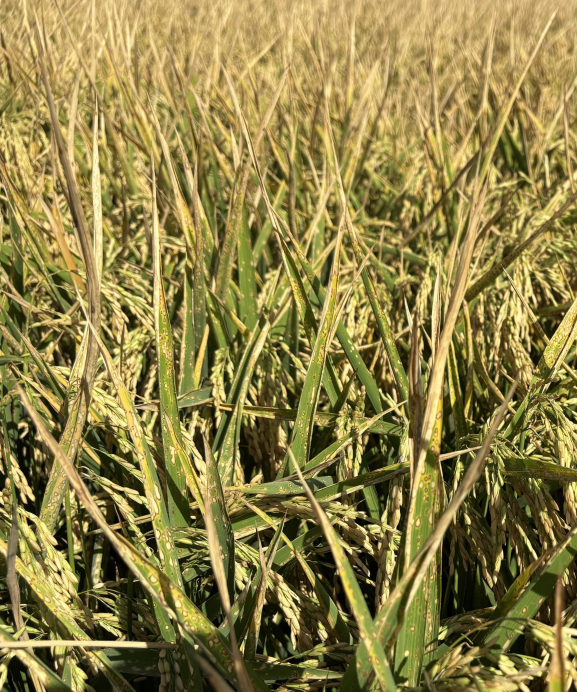
With many early planted soybeans this year, we’re likely to see more applications of soybean desiccants while rice is still in adjacent fields. The most important comment – rice is not safe from Gramoxone (paraquat) drift until it is in the combine.
Research out of Mississippi has shown that simulated drift rates of Gramoxone can cause yield losses and reductions in grain fill due to drift occurring from 50% heading (16-19% loss) up until one week prior to harvest (5% loss). Seed weight was reduced for all application timings of simulated paraquat drift except for one week prior to harvest. Simulated drift rates of glyphosate caused reductions in yield of 6-19% depending on timing.
Other desiccants have mixed results. Glyphosate drift can cause yield loss but typically there is little symptomology observed. Sharpen (saflufenacil) and sodium chlorate drift when applied alone often do little to impact yield, but if they are applied together in a tank-mix can significantly reduce yield.
The take-home message is to avoid getting unintended desiccants on rice! If the rice is more than a week prior to harvest, desiccants can cause injury in the form of yield loss, reduced grain weight, and milling yield.
Fig. 2. Paraquat drift on rice.
Market Update
Scott Stiles
USDA’s first survey-based production and yield estimates were the focal point of the August 12th Crop Production and WASDE. This month’s yield estimates were based primarily on farmer surveys, the week 30 Good/Excellent ratings of the crop, and satellite imagery. NASS also included FSA certified acreage in its crop production estimates. For Arkansas, total rice acreage certified by August 1 was 885,605 (771,632 long grain, 113,603 medium grain, 370 short grain).
August Acreage Adjustments:
The findings in the FSA acres ultimately led to an increase in long-grain production this month. Compared to NASS’ June Acreage survey, U.S. long-grain planted acres were revised higher by 22,000 acres to a total of 1.417 million. Arkansas’ long-grain acreage increased by 50,000 to a total of 780,000. Long-grain acres were also increased by a collective total of 17,000 in California, Mississippi, and Texas. A good part of the increase was offset by a combined 45,000-acre reduction in Louisiana and Missouri. The net change in U.S. long-grain acres was a 22,000-acre increase.
U.S. Long-Grain Supply and Demand:
For the 2026/27 crop year, U.S. long-grain supply increased this month on higher production and increased beginning stocks (from a 1 million cwt. reduction in 2025/26 exports). On the acreage bump, production was increased to 106.7 million cwt, up 2.6 million from last month. The U.S. average long-grain yield is forecast at 7,643 pounds per acre (169.8 bu/ac) compared to 7,359 (163.5 bu/ac) last year. Of note, long-grain production for 2026/27 is the lowest since 1993 and acres are the lowest since 1974.
Table 3. U.S. Long-Grain Rice, Supply and Demand.
|
monthly change |
|||||
|---|---|---|---|---|---|
|
unit: million cwt. |
2024/25 |
2025/26 |
2026/27 |
2026/27 |
|
|
July |
August |
||||
|
Beginning Stocks |
19.3 |
37.3 |
36.6 |
37.6 |
1.0 |
|
Production |
172 |
153.3 |
104.1 |
106.7 |
2.6 |
|
Imports |
42.7 |
37 |
43.0 |
43.0 |
0.0 |
|
Total Supply |
234 |
227.6 |
183.7 |
187.3 |
3.6 |
|
Domestic Use |
136 |
137 |
116.0 |
117.0 |
1.0 |
|
Exports |
60.7 |
53 |
50.0 |
50.0 |
0.0 |
|
Total Use |
196.7 |
190 |
166 |
167 |
1.0 |
|
Carry-Over |
37.3 |
37.6 |
17.7 |
20.3 |
2.6 |
|
stocks-use % |
19.0% |
19.8% |
10.7% |
12.2% |
1% |
|
Avg. Producer Price ($/cwt.) |
$14.00 |
$10.40 |
$13.50 |
$13.50 |
$0.00 |
|
Avg. Producer Price ($/bu.) |
$6.30 |
$4.68 |
$6.08 |
$6.08 |
$0.00 |
|
PLC Reference Price ($/bu.) |
$6.30 |
$7.61 |
$7.61 |
$7.61 |
|
|
Proj. PLC Payment Rate ($/bu.) |
$0.00 |
$2.93 |
$1.54 |
$1.54 |
Source: USDA WASDE (World Agricultural Supply and Demand Estimates).
Domestic and residual use was increased by 1.0 million to 117.0 million cwt on increased supply. Exports were unchanged at 50 million cwt. and remain at the lowest levels since the mid-1980s. Projected 2026/27 ending stocks increased 2.6 million to 20.3 million cwt. -- down 46 percent from last year. The 2026/27 season-average farm price (SAFP) for long-grain was unchanged at $13.50 per cwt ($6.08/bu.), compared to the 2025/26 SAFP of $10.40/cwt. or $4.68/bu. The projected PLC payment rate for the 2025 crop year remains at $2.93 per bushel for long-grain and 90 cents per bushel for southern medium grain.
The complete USDA August WASDE and NASS Crop Production reports can be found at these links:
The next monthly USDA reports are scheduled for September 11th.
U.S. Harvest Progress:
In Monday’s Crop Progress, NASS provided the season’s first look at the U.S. rice harvest. It is likely we see Arkansas show up in next Monday’s report. Harvest is advancing on schedule in Texas and moving rapidly in Louisiana and well ahead of the average pace. Pictures have recently circulated online of Louisiana rice being loaded for export. Those shipments showed up in this week’s Export Sales with 5,500 tons long-grain rough rice going to El Salvador and 5,940 tons to Honduras.
Table 4. U.S. Rice Harvest - Selected States (% harvested).
|
State |
week ending |
2021 – 2025 Average |
||
|---|---|---|---|---|
|
Last Year |
Last Week |
Aug. 9, 2026 |
||
|
Arkansas |
1 |
|
|
1 |
|
California |
-- |
-- |
-- |
-- |
|
Louisiana |
46 |
51 |
72 |
42 |
|
Mississippi |
3 |
-- |
-- |
1 |
|
Missouri |
-- |
-- |
-- |
-- |
|
Texas |
33 |
13 |
31 |
31 |
|
|
|
|
|
|
|
U.S. |
10 |
9 |
14 |
9 |
Source: USDA NASS.
Long-Grain Export Sales:
Thursday's Export Sales Report provided the first look at demand in the new marketing year. New Crop long-grain sales are off to a solid start. The U.S. sold 73,090 metric tons of rough rice last week (week ending Aug. 6th). Mexico and Colombia were the largest buyers. Rough rice sales thus far total 208,526 tons, compared to 135,969 last year—about 53% ahead. Long-grain milled rice sales are 132,940 tons to date, compared to 97,332 a year ago (up 37%).
Fig. 3. CME September 2026 Rough Rice Futures, Daily Chart.
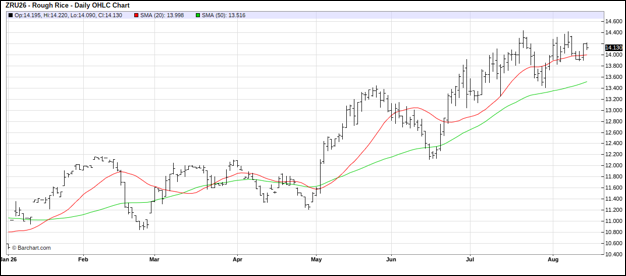
Although we did see a 2.6 million cwt. increase in ending stocks in the August WASDE, the September and November contracts have brushed it off. In Thursday’s trading, the market again pushed above the red 20-day moving average, with the September contract closing 28 cents higher.
The tough chart resistance sits between the recent highs at $14.41 to $14.44. A strong, daily close above $14.44 opens the possibility of a run toward $14.90. That could end up being a job for the November contract as First Notice Day (August 31, 2026) will be rolling up soon for the September contract. In the upcoming week, trading volume will gradually start to shift out of the September contract and into the November. On the downside, there is initial support at $14.00. Further down, major support is at $13.40 to $13.50 and near the 50-day moving average (green line).
Following some major flooding in the eastern Cornbelt states, the Mississippi River is rising and expected to be just above 10 feet (at Memphis) by August 22nd. At the close of the week, cash rice bids at mills are $5.80/bu for fall delivery. Dryer bids are in the $5.65 to $5.75 range. Mill bids for January-March delivery are $6.00 to slightly better as of Friday morning.
We are seeing very little relief on input costs. Urea prices are below the mid-April highs but have found a floor of support in the upper $500s lately (around $580/ton). The average price for phosphates this week in our survey was $945 for DAP and $858 for Triple Phosphate. Potash was $485 per ton. The lead futures months for diesel are trading $4.12 to $4.25 currently as harvest starts to gain traction. These challenges for rice farmers are highlighted in a recent feature story by KAIT in Jonesboro. Link: Newport rice farmer takes fight to Washington with ‘Soil Sisters’ group
DD50 Rice Management Program is Live
The DD50 Rice Management Program is live and ready for fields to be enrolled for the 2026 season. All log-in and producer information has been retained from the 2025 season, so if you used the program last year you can log in just as you did last year. Log in and enroll fields here: https://dd50.uada.edu.
Use the Arkansas Rice Advisor Internet App!
The Arkansas Rice Advisor site https://riceadvisor.uada.edu functions like an app on your mobile device. There you can readily access the DD50 program, rice seeding rate calculator, drill calibration, fertilizer and N rate calculators, publications, and more.
Additional Information
Arkansas Rice Updates are published periodically to provide timely information and recommendations for rice production in Arkansas. If you would like to be added to this email list, please send your request to rice@uada.edu.
This information will also be posted to the Arkansas Row Crops blog (http://www.arkansas-crops.com/) where additional information from Extension specialists can be found.
More information on rice production, including access to all publications and reports, can be found at http://www.uaex.uada.edu/rice.
Acknowledgements
We sincerely appreciate the support for this publication provided by the rice farmers of Arkansas and administered by the Arkansas Rice Research and Promotion Board.
The authors greatly appreciate the feedback and contributions of all growers, county agents, consultants, and rice industry stakeholders.
Specialist |
Area |
Phone Number |
|
|---|---|---|---|
|
Jarrod Hardke |
Rice Extension Agronomist |
501-772-1714 |
|
|
Tom Barber |
Extension Weed Scientist |
501-944-0549 |
|
|
Nick Bateman |
Extension Entomologist |
870-456-8486 |
|
|
Ralph Mazzanti |
Rice Verification Coordinator |
870-659-5507 |
|
|
Trent Roberts |
Extension Soil Fertility |
479-935-6546 |
|
|
Bob Scott |
Extension Weed Scientist |
501-837-0273 |
|
|
Scott Stiles |
Extension Ag Economics |
501-258-8455 |