Arkansas Rice Update 7-31-26
Arkansas Rice Update 2026-20
July 31, 2026
Jarrod Hardke, Scott Stiles & Bob Scott
“It’s hotter than a furnace fan out in Arizona.”

August and Everything After
Ding ding, we’ve got a green rice delivery in July! It has happened a couple of times in recent years, but it still always seems a little surprising. I was prepared to see combines start more next week, but it’s time already for some to load the wagons!
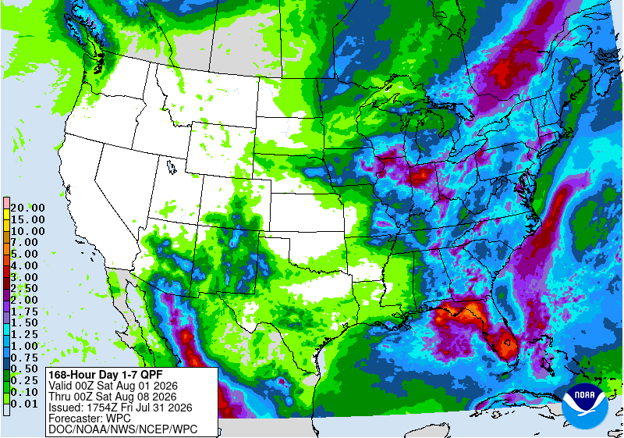
Drain timing and harvest can’t get here fast enough for many wishing for an end to an expensive irrigation season (dry weather and high fuel prices). One good rain could finish off irrigation for a lot of rice acres. Unfortunately, rain chances for the next week (Fig. 1) says “go around that spot” to the Mid-South.
Stink bugs are reaching treatment levels in places but most aren’t getting too out of hand. Many conversations are turning toward “should I spray this population before I drain”. Remember 60% straw-colored kernels (non-green kernels) is when we should be safe from stink bug damage.
While some have already drained a few acres and are ready to start harvest, most focus right now is on drain timing, so we’re covering that in-depth this week. Note that with so much of our crop planted very close together this spring, there will be some decisions on harvest order. I expect a fair amount of corn and rice to be ready at the same time, and rice can’t wait once it’s ready while corn is more forgiving. Get in the rice as soon as it’s ready.
See more below on drain timing, harvest aids for weed control, and markets.
Let us know if we can help.
Fig. 1. NOAA 7-day precipitation forecast.
Much About Drain Timing
Jarrod Hardke
We like to say “drain like it’s never going to rain again.” For parts of the state it has seemed like it’s never going to rain again for a while. For others, repeated small rains have been somewhat the norm over the past few weeks. At any rate, it’s hot and largely dry, with low chances of rain in the coming week.
If rice is drained too early in development, we can risk yield and milling losses.
If rice is drained “on time” for development, but too far ahead of the combine, we can risk milling loss and lodging (from premature plant death).
Drain according to expected harvest progress – start around 20% grain moisture (or above if possible) and chase the slide down).
Recommended drain timing is 25 days after 50% heading for long-grains and 30 days after 50% heading for medium-grains. The DD50 Rice Management Program builds these recommended dates into the program – but note that temperature, rainfall, humidity, and sunlight can impact how grains mature and dry down – so we also need to look at the grain progress, and harvest timing, to supplement the drain timing decision.
Fig. 2 below I’ve been using for years because it’s worked well as a visual representation:
Left, nearly all kernels are straw-colored – safe to drain for all soil types.
Center, 2/3 of kernels are straw-colored – safe to drain on silt loam soils.
Right, 1/3 of kernels are straw-colored – safe to drain on clay soils.
Fig. 2. Rice panicles at different maturity levels described by kernel percent straw color: (L) 100%, (C) 67%, and (R) 33%.
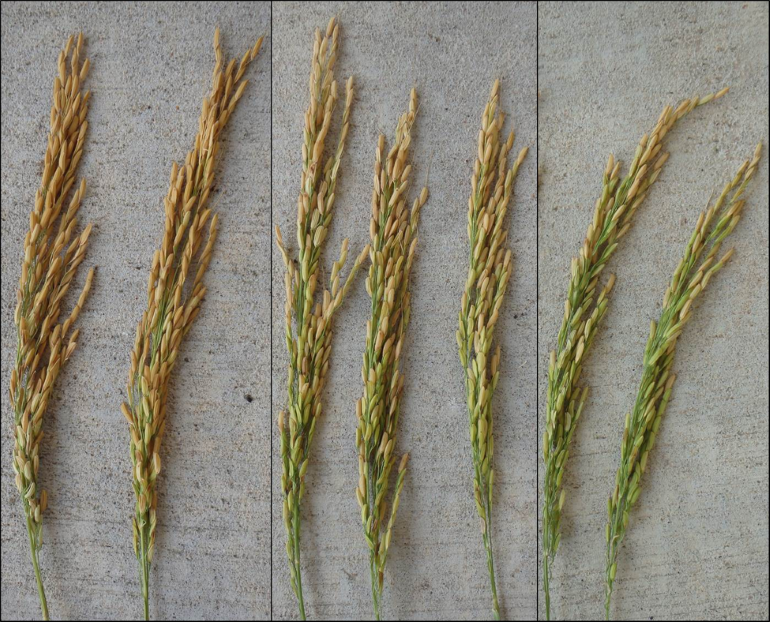
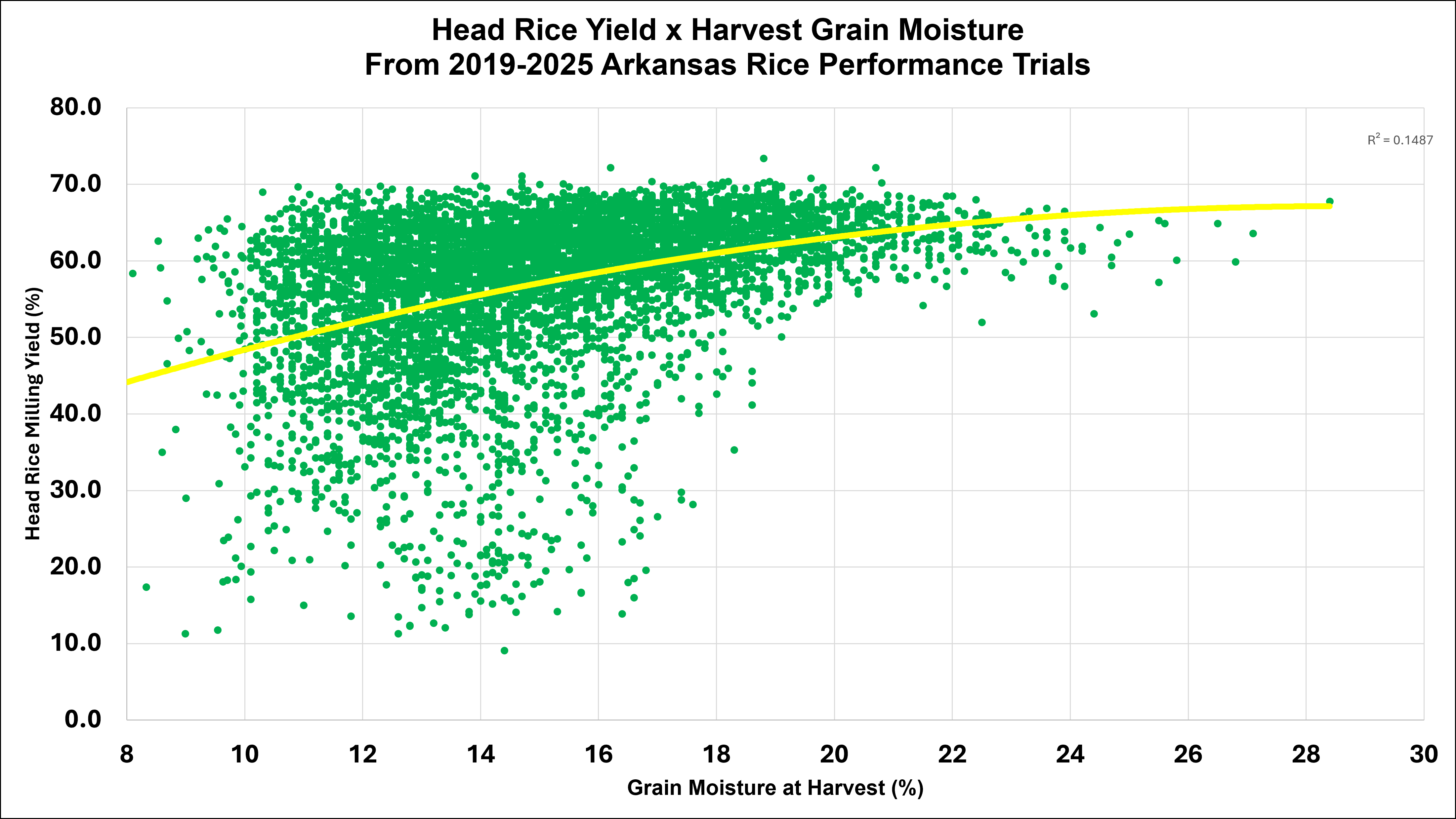
Fig. 3 shows the relationship between harvest grain moisture and head rice yields over recent years for entries in the Arkansas Rice Performance Trials (small plot cultivar testing). The general trend is evident, that harvesting at higher moisture generally has better head rice yield outcomes. That being said, it’s also true that head rice yield doesn’t always drop off dramatically – this is because grain moisture alone doesn’t dictate head rice yield – wetting and drying cycles that cause fissures in the grain are a huge piece of the puzzle. As we overdry the grain, the more opportunity there is for it to be rewet and then fissures form as it dries back down again.
Fig. 3. Head Rice Yield by harvest grain moisture from 2019-2025 Arkansas Rice Performance Trials.
Following anecdotal evidence in 2024 that delaying draining may provide help in preserving milling yields (and 2025 seemed similar), a single site study was conducted in 2025 to look at drain timing and milling yields.
In Fig. 4 and in Table 1 you’ll see the same data presented two different ways. This is because while it tells a straightforward story, the data itself is complicated to present. So maybe between the two versions it will help illustrate the point. In Fig. 4, each pair of bars for a given drain timing is a different color – the dark colored bars are the initial harvest timing and the lighter bar (of a similar color) beside it is where harvest was delayed another 7 days.
Take home message – delaying draining does appear to keep milling propped up, but only to a point. From this data, once it has been about 50 days since 50% heading, milling begins to drop off. So, with an expected timing of 20% grain moisture at 35 days after 50% heading, it means that we have about two weeks to get rice out before we see more potential for head rice yield declines.
Other comments – this was a single trial at Stuttgart (RREC) in 2025. The cultivars chosen were among the most widely planted in the state and also covered several different types of cultivars. While in this study the time to 50% heading was within a few days for all cultivars, we know their maturities differ somewhat and that could impact the results of comparing overall outcomes between cultivars. Also note the medium-grain Taurus follows the expected trend for medium-grains of experiencing a much greater drop off at lower grain moistures (remember that medium grains have a higher moisture range for optimal milling than long grains).
Again, the data in Table 1 is what Fig. 4 is based on. Note that numbers are rounded for clarity.
Fig. 4. Impact of drain timing and harvest timing on head rice yield.
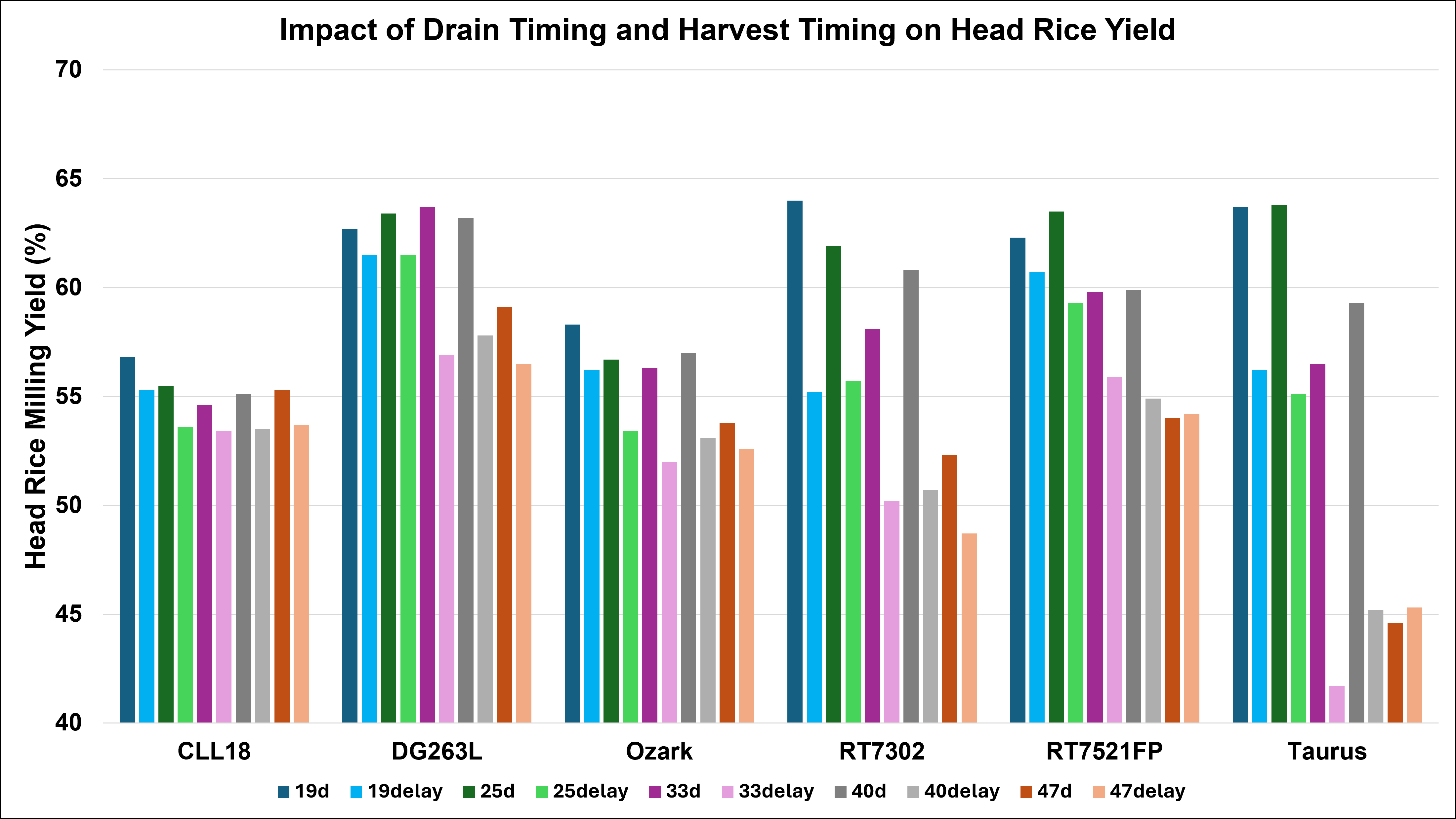
**Note for Fig. 4: Paired color bars represent same drain timing but timely versus late harvest. For example, the dark blue bar and light blue bar beside were drained on same date, but the light blue bar was harvested 7 days after the dark blue bar. The same pattern repeats for different paired color bars.**
Table 1. Impact of drain timing and harvest timing on head rice yield.
|
Drain Date |
Harvest Date |
CLL18 |
DG263L |
Ozark |
RT7302 |
RT7521FP |
Taurus |
||||||
|
MST |
HR |
MST |
HR |
MST |
HR |
MST |
HR |
MST |
HR |
MST |
HR |
||
|
19d 8/14 |
9/5 |
18 |
57 |
17 |
63 |
17 |
58 |
16 |
64 |
16 |
62 |
16 |
64 |
|
9/12 |
15 |
55 |
15 |
62 |
15 |
56 |
14 |
55 |
14 |
61 |
15 |
56 |
|
|
25d 8/21 |
9/5 |
18 |
56 |
18 |
63 |
18 |
57 |
17 |
62 |
18 |
64 |
17 |
64 |
|
9/12 |
15 |
54 |
14 |
62 |
14 |
53 |
14 |
56 |
14 |
59 |
14 |
55 |
|
|
33d 8/28 |
9/12 |
15 |
55 |
15 |
64 |
14 |
56 |
14 |
58 |
14 |
60 |
14 |
57 |
|
9/19 |
19 |
53 |
19 |
57 |
18 |
52 |
17 |
50 |
18 |
56 |
18 |
42 |
|
|
40d 9/4 |
9/12 |
15 |
55 |
15 |
63 |
14 |
57 |
14 |
61 |
15 |
60 |
14 |
59 |
|
9/19 |
18 |
54 |
18 |
58 |
17 |
53 |
17 |
51 |
17 |
55 |
17 |
45 |
|
|
47d 9/11 |
9/19 |
17 |
55 |
19 |
59 |
17 |
54 |
16 |
52 |
16 |
54 |
17 |
45 |
|
9/26 |
19 |
54 |
18 |
57 |
18 |
53 |
17 |
49 |
17 |
54 |
17 |
45 |
|
**Note for Table 1 - moistures rebounded for 9/19 and later timings due to a rain event.**
Bobbing and Weeding
Bob Scott
Harvest Aids for Rice Weed Control
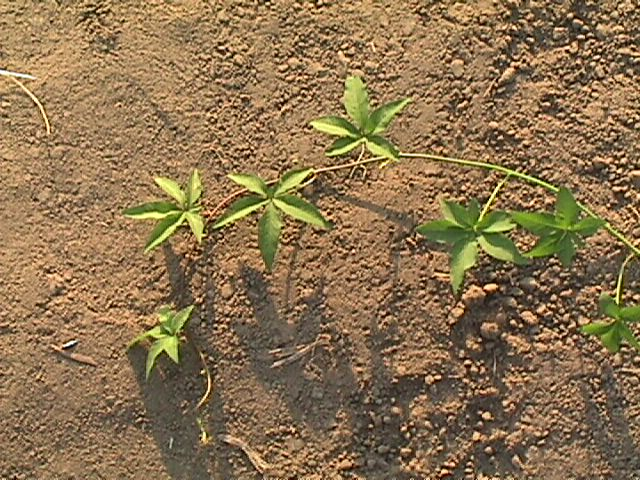
There are currently only two harvest aid or preharvest treatments labeled for rice – these are sodium chlorate applied at 3 to 6 lb/acre or 0.5 to 1.0 gal per acre of 6 lb/gal material; and Aim applied at 1.4 oz/acre with 1% crop oil concentrate. Both of these treatments should not be applied until rice is at or below 25% moisture for varieties or below 23% moisture for hybrids. Sodium chlorate should go out around 5 days prior to harvest. Delayed harvest can result in harvest issues and lower rice milling. Aim is typically reserved for severe late infestations of morningglories and I have recommended it for levee treatments and where palmleaf morningglory is present (only one that survives a flood), although morningglories are more common now with the increase in row rice acres. Aim can be tank-mixed with sodium chlorate. Both Aim and Sodium Chlorate are labeled for removal or desiccation of green weed material to increase harvest efficiency and do not make label claims about “drying down” rice or speeding along maturity. Care should be taken to not make applications too far ahead of harvest.
Fig. 5. Palmleaf morningglory.
Market Update
Scott Stiles
After a turbulent week, we thought a few technical comments on the September contract might be in order. All of the grain markets struggled this week, with sharp losses Monday and Wednesday. However, the September contract found support at $13.40 and remains in an up-trending channel. This week’s correction from the recent high at $14.44 has cooled down the daily RSI, pulling it out of overbought territory (>70) (green line in bottom panel). That’s helpful going forward.
Fig. 6. CME September 2026 Rough Rice futures.
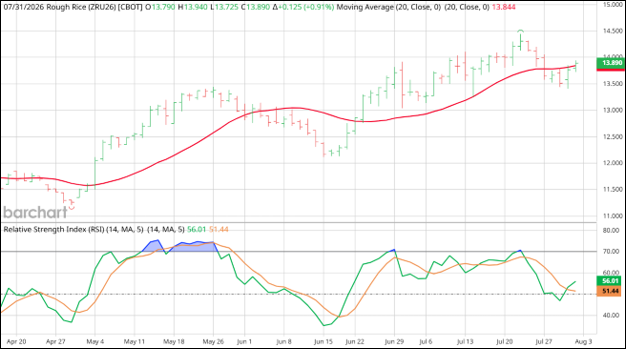
Where to next? The September contract is finishing the week stronger, closing 25 cents higher on Thursday and adding to those gains in early trading Friday. Weak resistance is showing up at the 20-day moving average at $13.84 (red line). A close above that level could provide some buying interest and a run back to $14.00 and possibly a retest of $14.44. Contract highs are always key areas to watch for making marketing decisions.
Turning to the cash market, rice bids at dryers for August to October delivery are in the $5.65 to $5.75/bu. range at the end of the week. Mill bids for fall delivery were averaging $5.80 per bushel. Mill bids for early 2027 delivery were $6.00 to $6.05 per bushel.
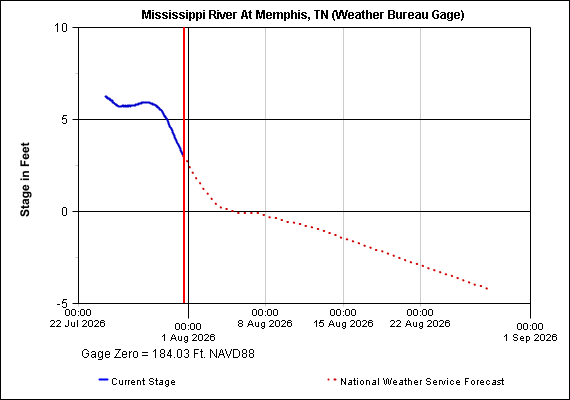
We are closely watching the Mississippi River as it currently sits at 3’ feet at Memphis and is projected to dip below zero (0) next Wednesday. Also of note, Lower Mississippi barge freight is starting its seasonal run higher. Last week, barge freight in the Cairo-Memphis leg increased $3.48/ton or 25% to a total of $17.36 per ton—the highest since February. Barge freight rates typically turn higher in August and peak in mid to late September before turning lower. This year, harvest is beginning earlier and the Mississippi River is about 6 ½ feet lower than it was at this time last year. This is already resulting in some draft and tow reductions on barges. On top of that, throw in the fact diesel prices are up 80% compared to a year ago. Expect some pressure on grain basis, especially if we don’t see any improvement in the Mississippi River water levels. Corn, rice, and soybeans will all hit the pipeline in August this year.
Fig. 7. Mississippi River at Memphis, TN.
DD50 Rice Management Program is Live
The DD50 Rice Management Program is live and ready for fields to be enrolled for the 2026 season. All log-in and producer information has been retained from the 2025 season, so if you used the program last year you can log in just as you did last year. Log in and enroll fields here: https://dd50.uada.edu.
Use the Arkansas Rice Advisor Internet App!
The Arkansas Rice Advisor site https://riceadvisor.uada.edu functions like an app on your mobile device. There you can readily access the DD50 program, rice seeding rate calculator, drill calibration, fertilizer and N rate calculators, publications, and more.
Additional Information
Arkansas Rice Updates are published periodically to provide timely information and recommendations for rice production in Arkansas. If you would like to be added to this email list, please send your request to rice@uada.edu.
This information will also be posted to the Arkansas Row Crops blog (http://www.arkansas-crops.com/) where additional information from Extension specialists can be found.
More information on rice production, including access to all publications and reports, can be found at http://www.uaex.uada.edu/rice.
Acknowledgements
We sincerely appreciate the support for this publication provided by the rice farmers of Arkansas and administered by the Arkansas Rice Research and Promotion Board.
The authors greatly appreciate the feedback and contributions of all growers, county agents, consultants, and rice industry stakeholders.
Specialist |
Area |
Phone Number |
|
|---|---|---|---|
|
Jarrod Hardke |
Rice Extension Agronomist |
501-772-1714 |
|
|
Tom Barber |
Extension Weed Scientist |
501-944-0549 |
|
|
Nick Bateman |
Extension Entomologist |
870-456-8486 |
|
|
Ralph Mazzanti |
Rice Verification Coordinator |
870-659-5507 |
|
|
Trent Roberts |
Extension Soil Fertility |
479-935-6546 |
|
|
Bob Scott |
Extension Weed Scientist |
501-837-0273 |
|
|
Scott Stiles |
Extension Ag Economics |
501-258-8455 |