Arkansas Rice Update 7-17-26
Arkansas Rice Update 2026-19
July 17, 2026
Jarrod Hardke & Scott Stiles
“I’ve always been crazy but it’s kept me from going insane.”

All Gas No Brakes
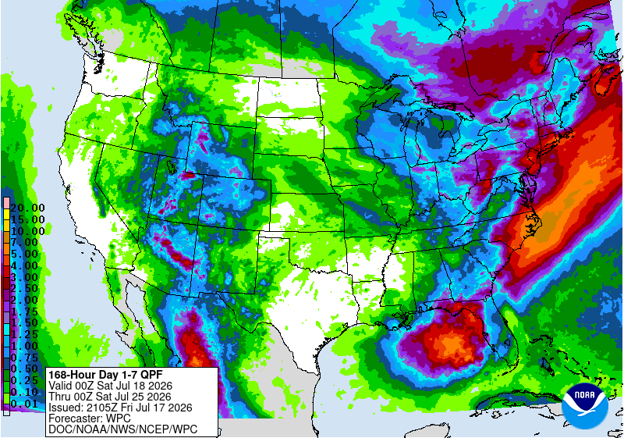
While it’s already hot enough, this weekend through Tuesday is going to kick it up a notch. After that we return to somewhat normal Arkansas heat. The past week was a tale of haves and have nots on rainfall. The randomness of storm cells made for interesting patterns where some received only a half inch while some received 4+, and all points in between. Congrats if you got a nice shot of supplemental irrigation, sorry if you didn’t.
Speaking of the scattered pop up storms – if you’ve been lucky enough to catch several of those over the past two weeks, then you may also have the fortune of some more sheath blight and blast pressure. We take the good with the bad.
Remember during the upcoming heat that “keeping the water moving” doesn’t just mean keep pumping. Having some active water movement to actually keep the water from being so stagnant and heating up too much is the real goal. Last year some of our best irrigated, deepest flooded fields seemed to suffer the most during the heat – if we say 74+ nighttime is bad and it’s 95 during the day then stagnant water temperature in theory is going to gravitate toward the mean (85) which can’t be good. Bottom ends of row rice fields where we held floods, and side inlet fields on the far side away from water inlet, were very telling on yield monitor data.
There won’t be an update next week, we’ll see you in two weeks. By then we’ll be seeing some of the first rice fields drained.
See more below on field days, stink bugs, disease, and markets.
Let us know if we can help.
Fig. 1. NOAA 7-day precipitation forecast.
Field Day Reminders
July 30 – Rice Field Day, Northeast Rice Research & Extension Center, Harrisburg, AR (contact Dr. Tim Burcham for more info)
August 6 – Rice Field Day, Rice Research & Extension Center, Stuttgart, AR (contact Dr. Alton Johnson for more info)
Ricing Around
Jarrod Hardke
Rice stink bug
Remember – do not add an insecticide in with your early fungicide apps prior to rice heading. Pyrethroids don’t work very well on rice stink bug anymore and adding them will only kill the beneficials and flare the stink bug numbers later. A product like Tenchu with its residual may provide some control (but there won’t be any residual on emerging heads) but that residual will play out well before we reach insecticide termination meaning we’ll likely spray again.
Disease
Some leaf blast is showing up on the medium grains – Taurus, Titan, ProGold M3 (reports of less on CLM05 which is unexpected). Remember that these medium grains are more susceptible to leaf blast than they are to neck and panicle blast. But that doesn’t mean they’re immune. If picking up increasing amounts of leaf blast, it increases the odds of needing to make at least one fungicide application for neck/panicle blast prevention.
If making a one-pass fungicide application to prevent neck/panicle blast, then that needs to be made when heads are 1/3 to 1/2 out of the boot (but necks still in the boot). If making a two-pass fungicide application, the first needs to be applied at boot split to 10% head emergence and the second when 50-70% of heads are out of the boot (but necks still in the boot).
If you treat well in front of heading, you will get little protection. And if you wait until heads and necks are out of the boot to spray, you will get little protection.
Extra Long Leaves
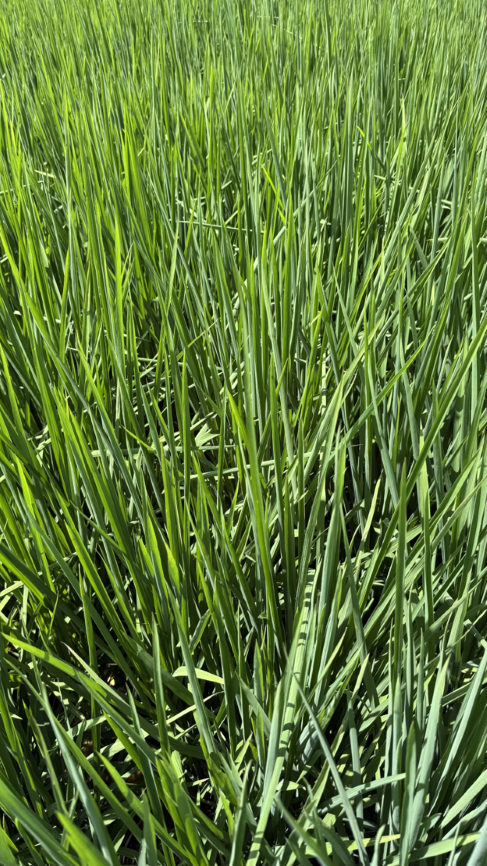
We’re seeing some elongated leaf lengths in some rice this year, which may catch you a little off-guard. Sometimes it’s the flag leaf and sometimes it’s a leaf or two down. This suggests what it usually has – a genetic by environment interaction. Looking at plots in northeast Arkansas this week it was observable to varying degrees in different hybrids and varieties. The way I have tried to describe it in the past is that it is likely due to weather conditions some time ago immediately prior to that leaf being formed, causing the plant to want to generate a longer (larger) leaf for better light interception. Some are staying more upright out of the canopy and others are bending and laying over.
Fig. 2. Elongated leaves laying over in the canopy.
Market Update
Scott Stiles
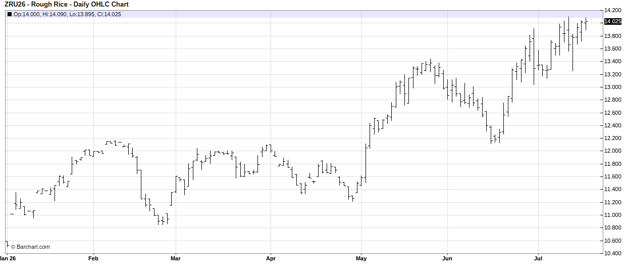
It hasn’t followed a straight line exactly, but Chicago rice futures continue to work their way higher. In Monday’s trading, we saw the September 2026 contract push to new highs at $14.10½ before backing off. The $14 level has mostly been resistance this week, although the September contract did close at $14.02 on Thursday. Since May 1, the September contract has gained about 21% or nearly $1.10 per bushel. No doubt, this year’s dramatic 34% drop in long-grain acres has been a driving force. New crop rice bids at mills are in the $6 to $6.15 per bushel range for fall delivery. Bids for early 2027 delivery hover around $6.30 per bushel at the close of this week.
Fig. 3. CME Rough Rice Futures, September 2026 Contract.
Export Sales:
The headline news this week was the sale of 88,000 metric tons of long-grain milled rice to Iraq. ADM confirmed the sale earlier this week. The shipments are scheduled to be loaded in September and November. This is the first sale to Iraq since last November.
Link: Iraq makes first US rice purchase since November | World Grain
Thursday’s Export Sales for the week ending July 9th was not as exciting. Old crop long-grain rough rice sales were 2,831 tons, but a bit better than the previous two weeks. Sales included 956 tons to Honduras and 1,875 tons to Mexico. Long-grain milled rice sales were 8,258 tons, with 7,203 of the total going to Haiti.
There are 3 reporting weeks remaining in the 2025/26 marketing year. Long-grain total commitments of 1.717 mmt are down 22% from last year's 2.194 mmt. The recent July estimates reflect only an 11% decline from last year after USDA increased 2025/26 exports by 4 million to 54 million cwt. in the July WASDE.
There were no new crop sales reported last week. Total long-grain sales for 2026/27 are 116,545 tons vs new crop sales at this time last year of 25,625 tons. This week’s sale to Iraq should show up in next Thursday’s Export Sales.
Fertilizer and Fuel:
We are seeing some relief on Urea prices with current quotes back at pre-Iran war levels. However, NYMEX diesel futures have rallied over $1 per gallon since mid-June and appear to be heading to the May highs around $4.18 per gallon. Phosphate prices remain firm, supported by tightening sulfur supplies and production cuts by Mosaic in the U.S. and Brazil. Potash prices are gradually working lower, reflecting ample supplies and seasonally slower consumption.
DD50 Rice Management Program is Live
The DD50 Rice Management Program is live and ready for fields to be enrolled for the 2026 season. All log-in and producer information has been retained from the 2025 season, so if you used the program last year you can log in just as you did last year. Log in and enroll fields here: https://dd50.uada.edu.
Use the Arkansas Rice Advisor Internet App!
The Arkansas Rice Advisor site https://riceadvisor.uada.edu functions like an app on your mobile device. There you can readily access the DD50 program, rice seeding rate calculator, drill calibration, fertilizer and N rate calculators, publications, and more.
Additional Information
Arkansas Rice Updates are published periodically to provide timely information and recommendations for rice production in Arkansas. If you would like to be added to this email list, please send your request to rice@uada.edu.
This information will also be posted to the Arkansas Row Crops blog (http://www.arkansas-crops.com/) where additional information from Extension specialists can be found.
More information on rice production, including access to all publications and reports, can be found at http://www.uaex.uada.edu/rice.
Acknowledgements
We sincerely appreciate the support for this publication provided by the rice farmers of Arkansas and administered by the Arkansas Rice Research and Promotion Board.
The authors greatly appreciate the feedback and contributions of all growers, county agents, consultants, and rice industry stakeholders.
Specialist |
Area |
Phone Number |
|
|---|---|---|---|
|
Jarrod Hardke |
Rice Extension Agronomist |
501-772-1714 |
|
|
Tom Barber |
Extension Weed Scientist |
501-944-0549 |
|
|
Nick Bateman |
Extension Entomologist |
870-456-8486 |
|
|
Ralph Mazzanti |
Rice Verification Coordinator |
870-659-5507 |
|
|
Trent Roberts |
Extension Soil Fertility |
479-935-6546 |
|
|
Bob Scott |
Extension Weed Scientist |
501-837-0273 |
|
|
Scott Stiles |
Extension Ag Economics |
501-258-8455 |