Arkansas Rice Update 7-10-26
Arkansas Rice Update 2026-18
July 10, 2026
Jarrod Hardke, Scott Stiles, Nick Bateman, & Bob Scott
“I’ve got a long list of real good reasons, for all the things I’ve done.”

Still Cooking
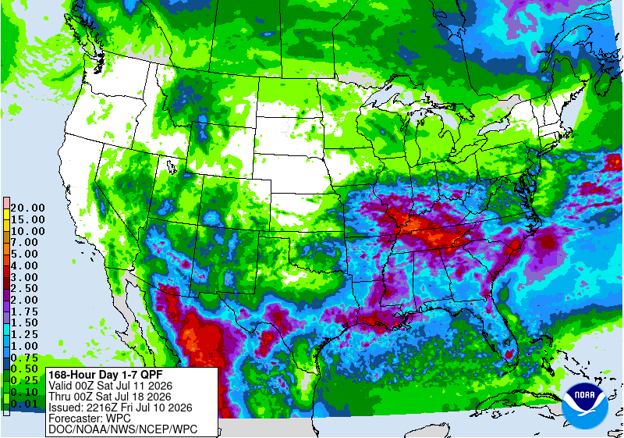
No shortage of heat this week while the rainfall was scattered. July is a good time to even have chances for rainfall, and some scattered chances appear to continue for this weekend and early next week. A slight reduction in temps (both day and night) should also help.
Disease pressure continues to remain low – minimal reports of sheath blight causing any concern, and little in the way of blast conversation. That’s a positive takeaway for once this year! Write that down!
Some watchouts for the coming week – heat will return so remember to keep water moving in fields where you can to offset the day and night temperature effects. If you’re in the spots that are catching some more pop-up showers, I would be more diligent in my disease scouting in case the added moisture fires things up.
There is fortunately not a great deal to report this week so I’m not going to waste more words proving that point. Big topics below in the update are on the Supply/Demand report, rice stink bug and rice delphacid, and comments on upcoming rice herbicide chemistry.
Let us know if we can help.
Fig. 1. NOAA 7-day precipitation forecast.
Rice Stink Bug Management / Delphacid Update
Nick Bateman
So far, calls have been sporadic on rice stink bug, with averages being less than 10 and highs being around 25 on 10 sweeps. We think a lot of this is due to the late spring rains that have made the ditches grow up in several different grass species. As the ditches dry up and more mowing occurs, we expect to see a lot of these populations end up in rice.
There are a few things we wanted to remind everyone on rice stink bug management since there have been some changes in recent years. The biggest change is with the threshold. We have moved the threshold to 10 bugs per 10 sweeps throughout the whole year, instead of the 5 per 10 during the first two weeks and 10 per 10 during the second two weeks. We have been evaluating this threshold since 2017 and all our data suggest that we can go to a straight 10 all season without jeopardizing yield or quality losses. Lastly on thresholds, let fields get to a minimum of 75% headed before making applications. If using products such as Tenchu, we want to get as much product on heads as possible to increase odds of residual control.
For control options things are similar to last year – lambda does not provide adequate control, and Tenchu and Kruger perform well. Both Tenchu and Kruger are dinotefuran and in the demo work we did last year, they looked very similar to each other. Another option is Transform. Transform has had a label in rice for several years but due to cost compared to lambda, not a lot of testing was done with it. Over the last few years, several of us in the midsouth have done some testing on rice stink bug, and initial looks suggest its comparable to Tenchu. Keep in mind this is based on a fairly small dataset, however we plan to do a lot more work this year.
One way to get the “most bang for your buck” with Tenchu (or similar) is to spray during the 2nd or 3rd week of heading (when heads just begin to turn down). It has the residual to get us to our termination timing of 60% straw-colored kernels. Our current situation doesn’t allow the flexibility to spray twice with Tenchu, so this method is something to consider if you can only spray once. We have done some work with lower rates of Tenchu and they perform well, however I would not want to go with a reduced rate if I need 10 plus days of residual. These reduced rates are really more intended for when populations blow up close to termination timing and we need really good knockdown but not a long residual.
Delphacid Update
So far we have not found rice delphacid in Arkansas. Additionally, our counterparts in Mississippi and Louisiana have not found them yet either. Things down in Texas seem to be progressing slower than last year. All of this is good news for our rice crop. A lot of this older rice that is late boot/into heading is at the stage that delphacid normally move into the field. I think it’s still worth scouting and hitting the most obvious areas-tree lines, double planted ends, etc., however the likelihood of finding them is extremely low. We will keep everyone posted on this situation if it changes, and feel free to call or text anytime.
Bobbing and Weeding
Bob Scott
New Rice Chemistry on the way… not soon enough!
Keenali Complete will be manufactured by FMC and is scheduled to be available as early as this coming spring for use in rice weed control. This product will be a co-Pak of clomazone and Tetflupyrolimet (Keenali). This product will be applied PRE and so far looks great on barnyardgrass, sprangletop, large crabgrass, and better control of signalgrass than Command alone. Keenali is in fact a completely new mode of action, the first in over 30 years! It is classified as Group 28 by the Weed Science Society of America (WSSA) or HRAC grouping number system. Group 28 herbicides are Triketones (procide) and kill weeds by inhibiting the plant enzyme dihydroorotate dehydrogenase. We had hoped to get a Section 18 for this product for barnyardgrass control for use in 2026, but the EPA let the eval period runout without making a decision. That’s a fancy way of saying we got denied. For reasons really unclear to me at this point. We have the packet ready to reapply this year.
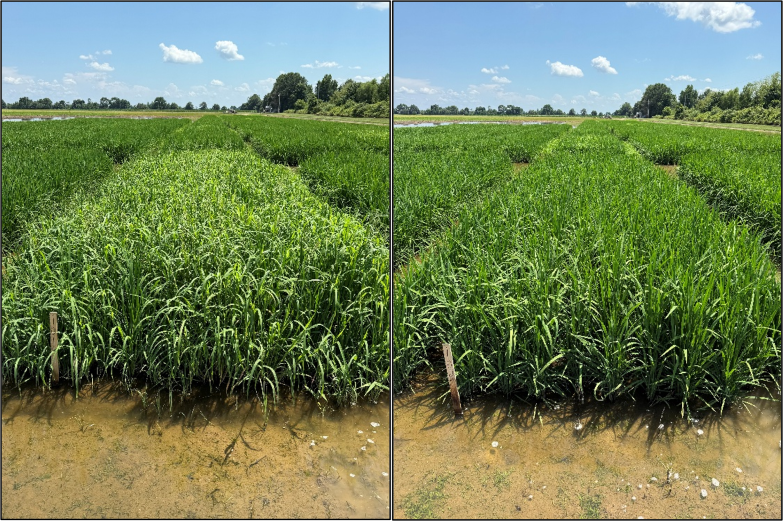
In November, Nissan Company filed for registration of their new HPPD inhibitor for rice. This product is being developed in the US for rice and other crops by Gowan Company. This is a very exciting new herbicide which has very broad spectrum of activity on rice weeds that we are still evaluating and gaining a full understanding of. The active is called iptriazopyrid. The only other product of its kind for rice is Rogue. However, Iptriazopyrid is applied Postemergence and has limited residual. It has excellent activity on barnyardgrass, annual sedge, signalgrass, crabgrass, sprangletop, and many other weeds. The base program for this product as it is formulated now will be a sequential post application of 10.3 oz of product per acre applied around 2-3 leaf grass and preflood (see photo). We hope to get the go-ahead for a Section 18 on this product as well, but we are early in the registration process.
I am excited to see a new product for rice farmers. These are very important if for no other reason than it has good activity on barnyardgrass. This will give us a new tool to fight herbicide resistance to this weed in rice.
I am sure there will be much more to come on Keenali and Iptriazopyrid once they receive a full registration and I will plan on following up with a more detailed article.
The research mentioned in this article is partially funded by the Arkansas Rice Research and Promotion Board, FMC Corporation, and Gowan Co., - we are grateful for their support.
Fig. 2. Untreated check (left) compared to two post-emergence applications of iptriazopyrid
at 10.3 oz/acre (right). Control of barnyardgrass, sprangletop, crabgrass, annual
sedge, and several other species of rice weeds.
Market Update
Scott Stiles
USDA’s monthly WASDE report was released Friday morning (7/10). The July WASDE incorporates the June 30 Acreage estimates along with any adjustments to usage. As expected, production was significantly reduced for long-grain, with changes to both acreage and yield this month. Adjustments to the U.S. long-grain balance sheet are shown in Table 1 below.
Table 1. U.S. Long-Grain Supply and Demand.
|
monthly change |
|||||
|---|---|---|---|---|---|
|
unit: million cwt. |
2024/25 |
2025/26 |
2026/27 |
2026/27 |
|
|
June |
July |
||||
|
Beginning Stocks |
19.3 |
37.3 |
40.6 |
36.6 |
(4.0) |
|
Production |
172 |
153.3 |
122.5 |
104.1 |
(18.4) |
|
Imports |
42.7 |
37 |
39.0 |
43.0 |
4.0 |
|
Total Supply |
234 |
227.6 |
202.1 |
183.7 |
(18.4) |
|
Domestic Use |
136 |
137 |
123.0 |
116.0 |
(7.0) |
|
Exports |
60.7 |
54 |
50.0 |
50.0 |
0.0 |
|
Total Use |
196.7 |
191 |
173 |
166 |
(7.0) |
|
Carry-Over |
37.3 |
36.6 |
29.1 |
17.7 |
(11.4) |
|
stocks-use % |
19.0% |
19.2% |
16.8% |
10.7% |
-6% |
|
Avg. Producer Price ($/cwt.) |
$14.00 |
$10.40 |
$12.00 |
$13.50 |
$1.50 |
|
Avg. Producer Price ($/bu.) |
$6.30 |
$4.68 |
$5.40 |
$6.08 |
$0.68 |
|
PLC Reference Price ($/bu.) |
$6.30 |
$7.61 |
$7.61 |
$7.61 |
|
|
Proj. PLC Payment Rate ($/bu.) |
$0.00 |
$2.93 |
$2.21 |
$1.54 |
Source: USDA July World Agricultural Supply and Demand Estimates (WASDE)
Changes to new crop supply this month included a 4 million cwt. reduction in Beginning Stocks. In a surprise move, USDA increased old crop (2025/26) exports by 4 million cwt.
The most notable change to new crop supply was the 18.4 million cwt. reduction in crop size. 2026 production was lowered from 122.5 million to 104.1 million cwt. This would be the smallest U.S. long-grain production since 1993 (103.1). Recall that long-grain acreage was reduced by 253,000 from the March intentions. It also appears USDA increased the U.S. average yield this month by 28 pounds to 7,571 pounds per acre.
On lower production, USDA increased 26/27 imports by 4 million to a record 43 million cwt.
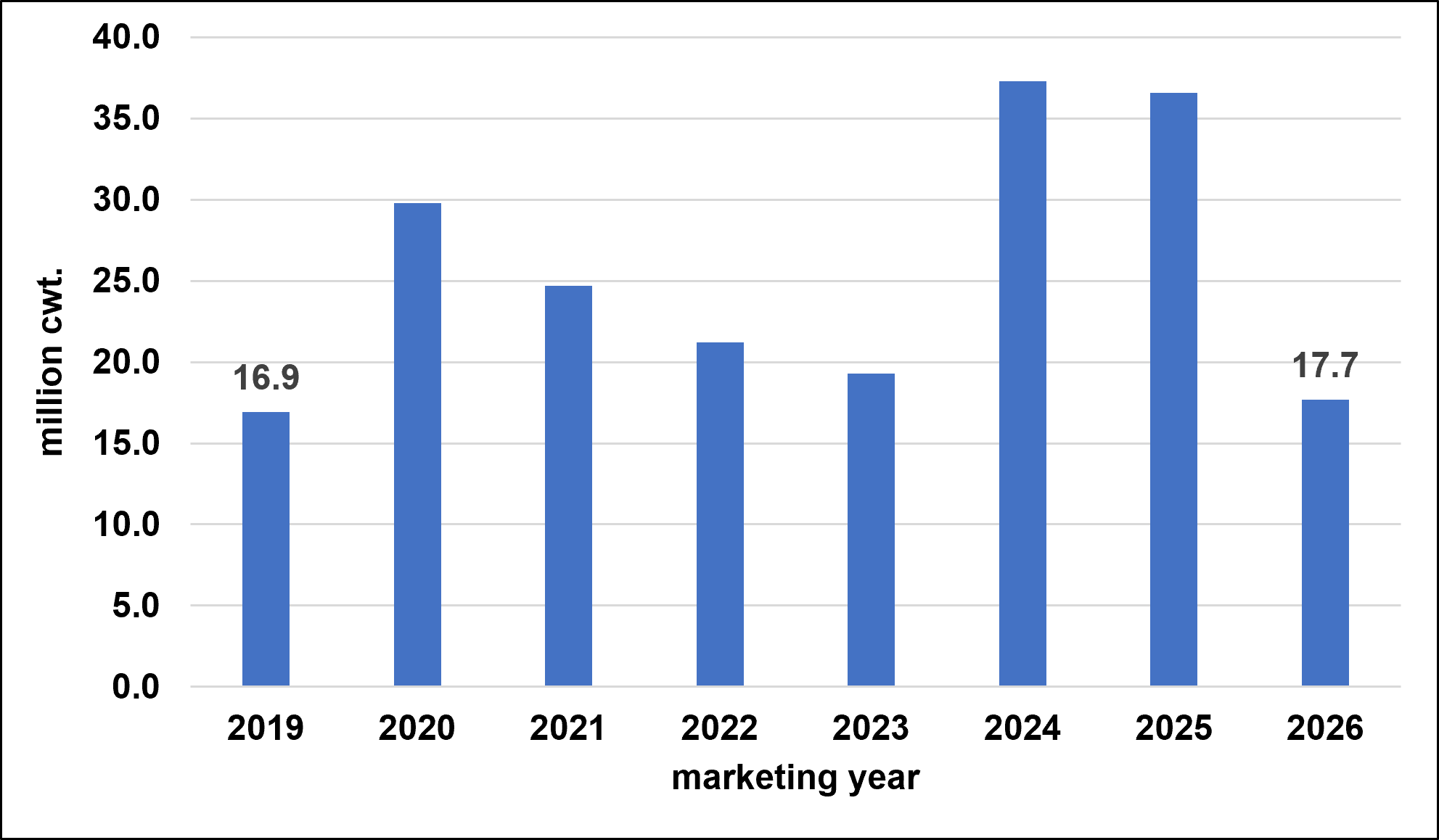
The sizeable decrease in total supply was partially offset by 7 million cwt. reduction in domestic use, now projected at 116 million cwt. Exports were left unchanged at 50 million cwt. In summary, 2026/27 ending stocks were lowered by 11.4 million to 17.7 million cwt. New-crop carryout is below last year by 18.9 million cwt. and at the lowest level since the 2019/20 marketing year.
Fig. 3. U.S. Long-Grain Ending Stocks.
Source: USDA ERS.
Long-grain prices were forecast higher for 2026/27 as supplies tighten. The season-average farm price was increased by $1.50 per cwt this month to $13.50/cwt or $6.08 per bushel.
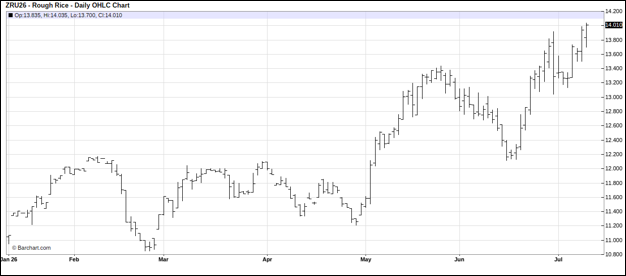
Futures have turned higher since the June 30 USDA Acreage report. September futures made a new contract high in Thursday and Friday’s session, trading up to $14.03 ½ at one point Friday.
Fig. 4. CME Rough Rice September 2026 Futures.
DD50 Rice Management Program is Live
The DD50 Rice Management Program is live and ready for fields to be enrolled for the 2026 season. All log-in and producer information has been retained from the 2025 season, so if you used the program last year you can log in just as you did last year. Log in and enroll fields here: https://dd50.uada.edu.
Use the Arkansas Rice Advisor Internet App!
The Arkansas Rice Advisor site https://riceadvisor.uada.edu functions like an app on your mobile device. There you can readily access the DD50 program, rice seeding rate calculator, drill calibration, fertilizer and N rate calculators, publications, and more.
Additional Information
Arkansas Rice Updates are published periodically to provide timely information and recommendations for rice production in Arkansas. If you would like to be added to this email list, please send your request to rice@uada.edu.
This information will also be posted to the Arkansas Row Crops blog (http://www.arkansas-crops.com/) where additional information from Extension specialists can be found.
More information on rice production, including access to all publications and reports, can be found at http://www.uaex.uada.edu/rice.
Acknowledgements
We sincerely appreciate the support for this publication provided by the rice farmers of Arkansas and administered by the Arkansas Rice Research and Promotion Board.
The authors greatly appreciate the feedback and contributions of all growers, county agents, consultants, and rice industry stakeholders.
Specialist |
Area |
Phone Number |
|
|---|---|---|---|
|
Jarrod Hardke |
Rice Extension Agronomist |
501-772-1714 |
|
|
Tom Barber |
Extension Weed Scientist |
501-944-0549 |
|
|
Nick Bateman |
Extension Entomologist |
870-456-8486 |
|
|
Ralph Mazzanti |
Rice Verification Coordinator |
870-659-5507 |
|
|
Trent Roberts |
Extension Soil Fertility |
479-935-6546 |
|
|
Bob Scott |
Extension Weed Scientist |
501-837-0273 |
|
|
Scott Stiles |
Extension Ag Economics |
501-258-8455 |