Arkansas Rice Update 6-5-26
Arkansas Rice Update 2026-13
June 5, 2026
Jarrod Hardke & Scott Stiles
“That bell can’t be unrung.”

Ramble On
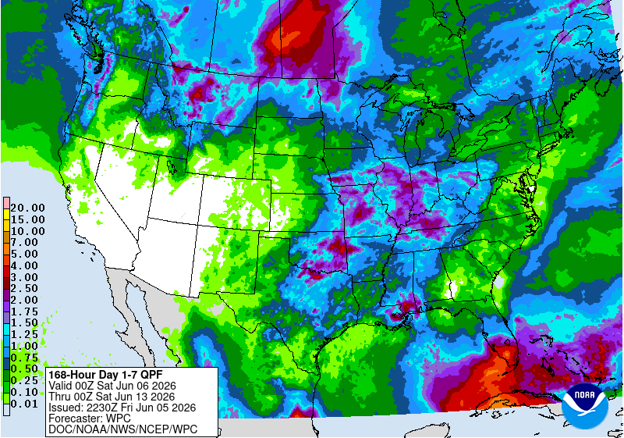
Well, the weather turned more in our favor this week than we originally expected, and I don’t know many who were mad at the drier conditions. This weekend into early next week has some rainfall but amounts are still in question. Given the number of planes in the air in recent days we’re trying to make tremendous progress spraying and fertilizing ahead of these next rain chances. What rain we do get will hopefully help improve the herbicide activity and get nitrogen incorporated as we start the flood on many remaining fields.
In addition to some rainfall chances this weekend, the overall outlook is toward high temperatures reaching steadily into the 90s next week. I guess summer is a go! A week full of maximum DD50 unit accumulation will have this crop off like a rocket.
We touched on herbicide cut-off timings last week and it continues to be relevant this week. There are a number of herbicides that have a green ring cut-off and we’re having to back away from applications we would like to make (e.g., 2,4-D, Regiment, Provisia, Ricestar, Highcard). I would rather not roll the dice on a risky herbicide application at this point this year. It’s tough enough out here without the possibility of deliberately injuring the rice.
In this update is info on progress, midseason N for varieties, markets, and PLC.
Let us know if we can help.
Fig. 1. NOAA 7-day precipitation forecast.
Midseason Nitrogen Timing
Jarrod Hardke
Looking at DD50 program enrollment, a lot of rice in the state is hitting, or is about to hit, reproductive growth stages. This is our annual reminder that for varieties such as Ozark, CLL18, DG263L, etc., our midseason nitrogen (N) timing recommendation is not based on growth stage alone.
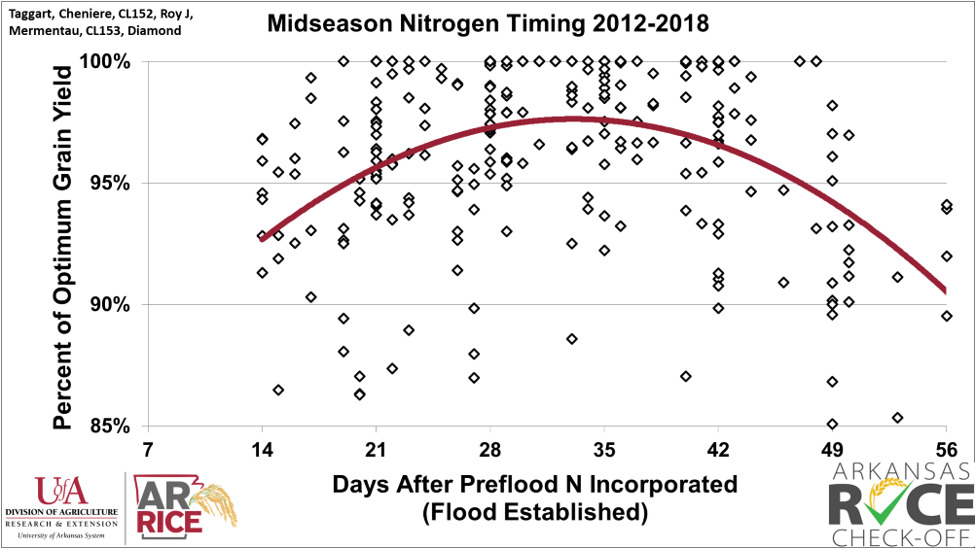
We recommend waiting 4 weeks after preflood N is incorporated by flood before applying midseason N. *Not from when it’s applied, but from when it’s incorporated and available to the plant.* Maximum N uptake occurs in the 3-4 weeks after incorporation. With modern, earlier maturing varieties, it is common to still be in this uptake mode of the preflood N when we enter reproductive growth (green ring / panicle initiation). If we apply midseason N too early while the plant is still busy with the preflood N, we risk the plant not being ready to take up the full value of that midseason N.
The full recommendation is to wait 4 weeks after preflood N is incorporated and be past panicle initiation / green ring.
This recommendation is increasingly important if you are already getting late on your preflood N application, which is all too common this year due to weather delays. If you go ahead and apply midseason N within a couple of weeks of going to flood it’s possible that you won’t see any measurable benefit to the midseason N at all.
Remember we’re just talking about varieties here – we’ll address the boot N application for hybrids in a later update. We don’t recommend a typical midseason N application for hybrids.
Fig. 2. Grain yield response from midseason nitrogen (N) application by days after preflood N incorporation across 60+ site-years from 2012-2018 including data from Cheniere, CL152, CL153, Diamond, Mermentau, Roy J, and Taggart.
Market Update
Scott Stiles
This week's technical action in rice futures has been disappointing. In trading Friday (6/5) morning, the September contract is testing resistance at the 20-day moving average (red line) and a down-trending channel that has developed since May 26th. It would be encouraging to close out the week above $13.02 ½ to regain some upside momentum.
Figure 3. CME September 2026 Rough Rice Futures, Daily Chart.
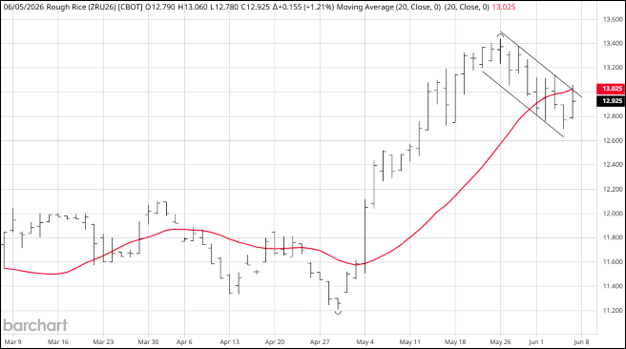
Although the chart action this month looks discouraging, for fundamental reasons we may be may near a support level in September futures. Bear in mind there is still widespread anticipation that the March intentions will be the highest rice acreage number that we see this year.
NEXT WEEK, the June 2026 WASDE report is scheduled for release on Thursday, June 11, 2026. This is historically a "quiet" report with USDA rarely making significant adjustments to new-crop supply and demand figures. This is especially true with the near-record planting pace this spring. We anticipate new-crop acreage remaining the same in June as the March Prospective Plantings data. Any adjustments to acreage will not occur until the July 10th WASDE report, when NASS integrates the June 30 Acreage. NASS will be conducting surveys over the next two weeks for the June 30 Grain Stocks and Acreage reports.
The most probable changes in the June report could be from adjustments to the old-crop balance sheet. Export demand simply continues to disappoint. If the USDA lowers 2025/26 exports a bit more, it could increase the 2026/27 beginning stocks. In the May WASDE, the old-crop season-average farm price was projected to be $10.40/cwt. or $4.68 per bushel. This outlook corresponds closely with the weighted average of producer prices received year to date (shown at the bottom of the table below).
Table 1. Long-Grain Rice, Monthly Average of Producer Prices Received, 2025/26.
|
Month/Year |
Avg. Producer Price Rec’d. ($/cwt.) |
Total Volume Marketed (000 cwt.) |
Total Value of Rice Marketed ($) |
|---|---|---|---|
|
August-25 |
$12.20 |
4,877 |
$59,499 |
|
September-25 |
$11.00 |
6,137 |
$67,507 |
|
October-25 |
$10.30 |
6,998 |
$72,079 |
|
November-25 |
$10.20 |
6,725 |
$68,595 |
|
December-25 |
$10.20 |
8,622 |
$87,944 |
|
January-26 |
$10.20 |
8,299 |
$84,650 |
|
February-26 |
$10.10 |
8,359 |
$84,426 |
|
March-26 |
$10.20 |
8,959 |
$91,382 |
|
April-26 |
$10.30 |
11,409 |
$117,513 |
|
May-26 |
$0 |
||
|
June-26 |
$0 |
||
|
July-26 |
$0 |
||
|
Total |
70,385 |
$733,595 |
|
|
Weighted Avg. Price to date ($/cwt.) |
$10.42 |
(total value / total volume) |
|
|
Weighted Avg. Price to date ($/bu.) |
$4.69 |
||
Source: USDA NASS Agricultural Prices.
For review, Price Loss Coverage (PLC) payments are triggered if the final national average producer price falls below a commodity's effective reference price. The long-grain effective reference price for the 2025 crop year is $16.90/cwt or $7.61 per bushel. Using the weighted average farm price of $4.69 per bushel (from the table above), this equates to a projected PLC payment of $2.92 per bushel ($7.61 - $4.69 = $2.92). PLC payments are made on 85% of base acres and a historical PLC payment yield—and subject to payment limits. A final 2025 marketing year average price for long-grain and southern medium grain will be published on October 30, 2026.
DD50 Rice Management Program is Live
The DD50 Rice Management Program is live and ready for fields to be enrolled for the 2026 season. All log-in and producer information has been retained from the 2025 season, so if you used the program last year you can log in just as you did last year. Log in and enroll fields here: https://dd50.uada.edu.
Use the Arkansas Rice Advisor Internet App!
The Arkansas Rice Advisor site https://riceadvisor.uada.edu functions like an app on your mobile device. There you can readily access the DD50 program, rice seeding rate calculator, drill calibration, fertilizer and N rate calculators, publications, and more.
Additional Information
Arkansas Rice Updates are published periodically to provide timely information and recommendations for rice production in Arkansas. If you would like to be added to this email list, please send your request to rice@uada.edu.
This information will also be posted to the Arkansas Row Crops blog (http://www.arkansas-crops.com/) where additional information from Extension specialists can be found.
More information on rice production, including access to all publications and reports, can be found at http://www.uaex.uada.edu/rice.
Acknowledgements
We sincerely appreciate the support for this publication provided by the rice farmers of Arkansas and administered by the Arkansas Rice Research and Promotion Board.
The authors greatly appreciate the feedback and contributions of all growers, county agents, consultants, and rice industry stakeholders.
Specialist |
Area |
Phone Number |
|
|---|---|---|---|
|
Jarrod Hardke |
Rice Extension Agronomist |
501-772-1714 |
|
|
Tom Barber |
Extension Weed Scientist |
501-944-0549 |
|
|
Nick Bateman |
Extension Entomologist |
870-456-8486 |
|
|
Ralph Mazzanti |
Rice Verification Coordinator |
870-659-5507 |
|
|
Trent Roberts |
Extension Soil Fertility |
479-935-6546 |
|
|
Bob Scott |
Extension Weed Scientist |
501-837-0273 |
|
|
Scott Stiles |
Extension Ag Economics |
501-258-8455 |