Arkansas Rice Update 6-26-26
Arkansas Rice Update 2026-16
June 26, 2026
Jarrod Hardke & Scott Stiles
“Therapy is extremely expensive, popping bubble wrap is radically cheap.”

Trucking into July
June 30 is the arrival of the Acreage report – where we get our next survey-based glimpse into rice acres. Reminder – reporting of actual certified acreage totals doesn’t begin until August, so this June report is still a guesstimate based on responses from growers who completed the survey.
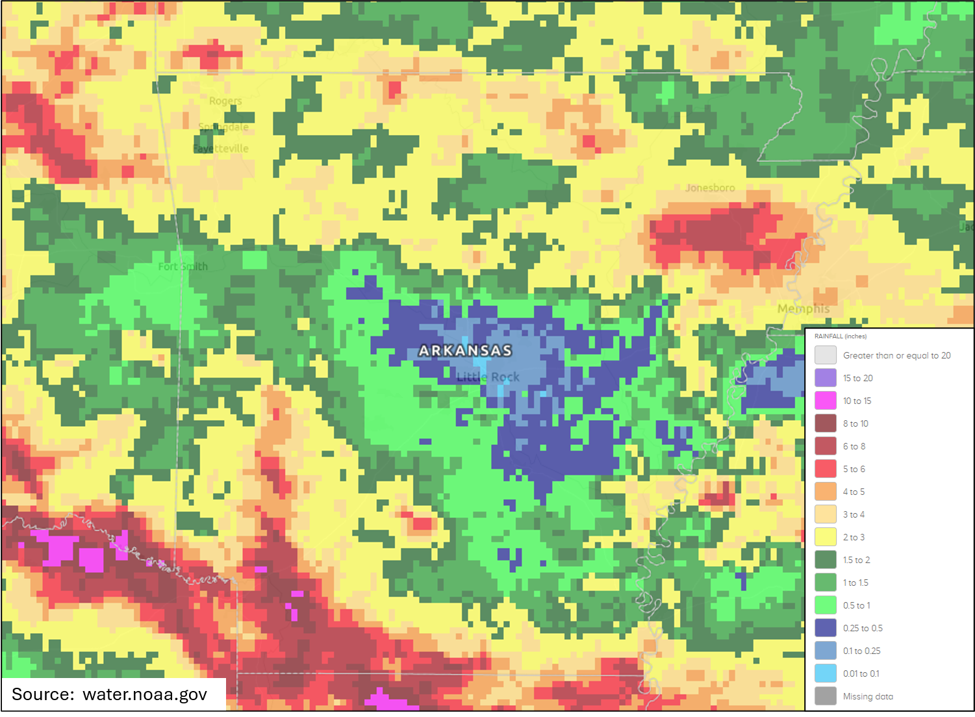
It’s been an interesting week, or not so interesting week, depending on where you are. Monday brought a big pile-up of rain for portions of Craighead and Poinsett Counties (and surrounding areas) to the tune of 6-8 inches and as much as 10 inches reported in certain spots. Rains have been scattered and inconsistent for most of the rest of the state throughout the week. Other than the flash flood area, other regions received some rain they were happy with in the northeast and southeast, while the central area of the state seems to be left in the dry.
We’re starting to see and get reports of the earliest rice beginning to reach heading, indicating the start of the downhill run. Upcoming conditions are trending much warmer and drier. The daytime highs in the mid-90s aren’t troubling – rice always seems to like it about where we’re good and miserable. But the nighttime temperatures climbing into the upper 70s are a concern as fields begin flowering. Hopefully this will be a short-lived burst of those temps. But keep in mind, if we’re going to start trending hot, try to keep the water moving in those rice fields – getting the water hot and stagnant is not great for rice.
In this update is info on progress, DD50 unit accumulation, submerged rice, general rules for disease management, and markets.
Let us know if we can help.
Fig. 1. NOAA 7-day precipitation forecast.
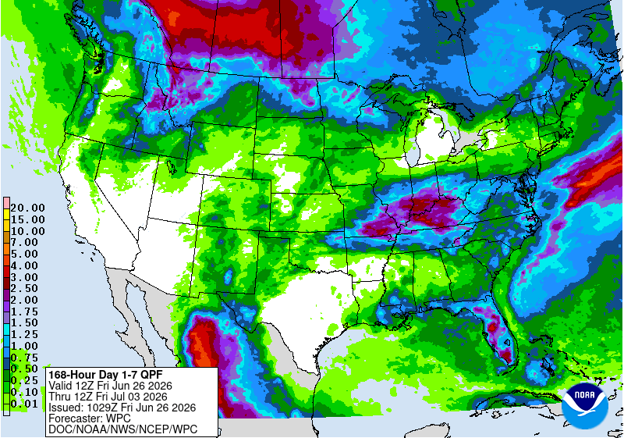
Fig. 2. NOAA 7-day precipitation accumulation (6/19 to 6/26).
DD50 Unit Accumulation and Crop Progress
Jarrod Hardke
The crop seems to be moving along rapidly, and that makes sense given the early season temperatures this year and accumulated DD50 units. Table 1 is a snapshot of DD50 unit accumulation from April 1 to June 15. With much of our rice crop planted and emerging very early this year, rapid accumulation of DD50 units started early with a big jump in early April. Since then, 2026 has kept up a good pace and is still the third-most DD50 units accumulated for this period in my entire dataset that goes back to 1983. Only 2010 and 2024 have more – one bad year and one great year. So, we don’t know what this means for yields at this point, weather still to come will have its say in that, but we are moving well ahead of average for this period which should set up for an early crop harvest.
Table 1. Cumulative rice DD50 units at Stuttgart, AR.
|
Year |
4/1-4/15 |
4/16-4/30 |
5/1-5/15 |
5/16-5/31 |
6/1-6/15 |
Total 4/1-6/15 |
|---|---|---|---|---|---|---|
|
2006 |
228 |
*297* |
248 |
414 |
410 |
1597 |
|
2007 |
80 |
201 |
*371* |
359 |
427 |
1439 |
|
2008 |
123 |
188 |
244 |
384 |
*458* |
1398 |
|
2009 |
86 |
265 |
268 |
338 |
399 |
1355 |
|
2010 |
239 |
232 |
338 |
420 |
*471* |
*1701* |
|
2011 |
230 |
252 |
254 |
347 |
*476* |
1557 |
|
2012 |
*243* |
220 |
349 |
432 |
378 |
1621 |
|
2013 |
142 |
211 |
209 |
393 |
398 |
1354 |
|
2014 |
136 |
214 |
292 |
355 |
396 |
1392 |
|
2015 |
*256* |
221 |
323 |
366 |
403 |
1569 |
|
2016 |
185 |
*293* |
303 |
340 |
420 |
1540 |
|
2017 |
230 |
263 |
265 |
371 |
397 |
1526 |
|
2018 |
60 |
159 |
*396* |
*453* |
453 |
1520 |
|
2019 |
161 |
232 |
272 |
*452* |
390 |
1506 |
|
2020 |
156 |
165 |
260 |
372 |
422 |
1373 |
|
2021 |
153 |
169 |
247 |
355 |
385 |
1307 |
|
2022 |
163 |
189 |
352 |
380 |
408 |
1490 |
|
2023 |
194 |
169 |
315 |
385 |
425 |
1487 |
|
2024 |
222 |
251 |
*359* |
*440* |
417 |
*1688* |
|
2025 |
186 |
*332* |
279 |
366 |
423 |
1585 |
|
2026 |
*296* |
278 |
254 |
408 |
436 |
*1672* |
Submerged Rice
Jarrod Hardke
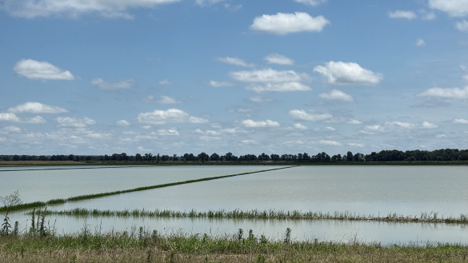
While the flash flooding event earlier this week wasn’t extremely widespread, it was a hammer where it hit. Let’s discuss a little about rice survival and what happens after an event like this.
Rice is semi-aquatic and tolerates a flood but does not like deep water and submergence. It all depends on the overall conditions but the condition of the floodwater is a key component. While there are no real management recommendations other than ‘get the water off’, here is some of what you can expect on rice survival which may influence your efforts on which fields to work hardest to remove water from.
Younger rice, still in the seedling / tillering / vegetative stages, can survive for long periods of time under submerged conditions. When conditions are mild, and the floodwater is cool and moving, we’ve seen rice survive submergence for a month. However, we’ve also seen rice die in a week when floodwater conditions are deep, muddy, and stagnant.
Older rice at midseason or around joint movement / reproductive growth is more sensitive to being submerged. If submerged for less than 7 days, it generally survives but there may be issues with it laying over as the water goes down and need time to stand up. In the 7-10 day window, survival can be a coin flip. As we approach 10 days or more of submergence, the outcome is usually bad and plants die. Keep in mind these comments are based on years of observations of flooding events that have occurred and have been the most common responses.
Fig. 3. Submerged rice field from flash flood event.
Some General Rules for Disease Management
Jarrod Hardke
Sheath Blight:
- Scouting should begin at ½” IE.
- Threshold is 35% positive stops for VS/S cultivars, or 50% positive stops for MS cultivars.
- If we exceed these positive stops AND sheath blight is threatening the upper canopy leaves, then we can consider fungicide treatment.
- Fungicide rate is dependent on the amount of time to suppress sheath blight. Research has shown that 8 oz of Quadris provides suppression for 14 days, 10 oz for 21 days, and 12 oz for 28 days. Under intense pressure, suppression may not last that long. If we reach 50% heading and upper canopy leaves are clean, we have successfully outrun the disease and yield will not be improved by making a fungicide application.
- Occasionally, intense sheath blight pressure near 50% heading could justify a fungicide application to protect rice standability. NOTE: you cannot apply propiconazole-containing fungicides after heading.
Kernel Smut / False Smut:
- Field history, susceptible cultivar, late planting date, excessive nitrogen rate are all factors that increase the chances of a fungicide application being beneficial for smut prevention.
- Apply a minimum of 6 oz/acre of Tilt (or equivalent) for adequate suppression of smuts.
- Higher water volumes are preferred to increase plant coverage.
- Mid-morning or late evening applications may be best.
- Rice growth stage timing – mid boot to the beginning of late boot. As we get too close to boot split, our efficacy declines.
Blast:
- Fungicide applications to prevent neck and panicle blast should not be made before late boot.
- If making two fungicide applications to VS/S cultivars, the first application should be made in the window of late boot to beginning heading, and the second application when panicles are halfway out of the boot but necks are still in the boot.
- If making a single application to MS cultivars, split the difference with the application made around boot split to when panicles are 1/3 out of the boot (necks still in the boot).
Cercospora:
- Susceptible cultivar and field history are the two most important factors increasing the chances of issues with Cercospora.
- Note that this disease can present as Narrow Brown Leaf Spot (NBLS) on leaves, Cercospora Net Blotch (CNT) on the sheath, or as Cercospora Panicle Blight (CPB) on the panicle. We rarely see NBLS, rather CNT and CPB are most common.
- Apply 6 to 10 oz/acre of Tilt (or equivalent) during the boot stages for prevention of Cercospora.
- Research is limited in Arkansas due to the sporadic nature of this disease in the state, so future research will be necessary to fine-tune management recommendations and fungicide timings.
Market Update
Scott Stiles
Reminder: USDA will release their quarterly Rice Stocks report and annual Acreage report on Tuesday, June 30 at 11:00 a.m. CT.
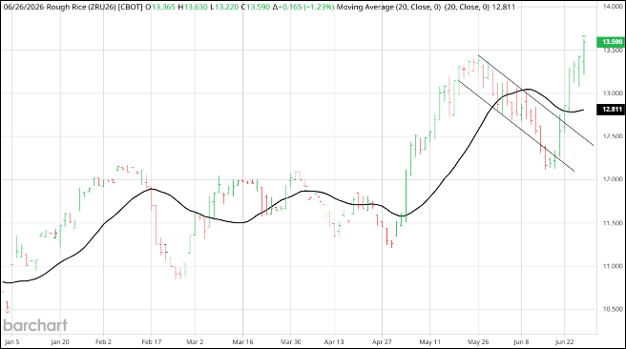
There were sharp gains this week in rice futures. We saw a combination of both technical and fundamental buying as traders position for next Tuesday’s big Acreage report. In Monday’s session, the September contract closed above the 20-day moving average and broke out of the down-trending channel that had been in place since late May. With the July contract reaching option expiration this week, volume and open interest increased rapidly in the September contract. That has provided some momentum for this week’s rally.
Fig. 4. CME Rough Rice September 2026, Daily Chart.
From the fundamental side of the market, the tropical storm (Arthur) that came up the coast of Texas and hit Louisiana last week brought with it a large amount of rain that is expected to reduce harvestable acres. On June 18th, Louisiana broke its 24-hour precipitation record, reaching 29.06 inches in one day. The total actually fell in less than 12 hours. That doesn’t include the rain in the days leading up to and after that 24-hour period.
Thursday’s Export Sales report for the week ending June 18th confirmed delivery of 44,000 MT of long-grain milled rice to Iraq. The cargo had been stranded outside the Strait of Hormuz during the Iran conflict. It was recently diverted to Jordan for unloading and overland delivery to Iraq. Additionally, there were old crop rough rice sales of 17,125 tons to El Salvador and 12,000 tons to Mexico. There was one new crop sale last week of 6,000 tons to “unknown”. That brings 2026 crop rough rice sales to a total of 80,545 tons, compared to zero at this time last year.
Trading in Thursday’s session did reach a high of $13.43 ½ and came within a ½ cent of the May 26th high. Prior to the close Friday, fresh highs were being made with the September contract pushing up to $13.60/cwt. The life of contract high is $13.94, set back in August 2025. New crop mill bids for early 2027 delivery are back above the $6.00/bu. mark to finish out the week.
For review, we included a table this week with USDA’s March planting intentions compared to recent years. At 900,000, that would be Arkansas’ lowest long-grain acreage since 1987 (885,000). During the 1980’s the state’s long-grain acreage got as low as 794,000 in 1983. With the sharp increases in fuel and fertilizer this spring, there’s a strong bias heading into the June 30 report that we see long-grain acres revised lower and perhaps close to 1983 levels—if not lower.
In the March intentions, NASS pegged Arkansas’ medium grain acres at 100,000 and down 3% from 2025. This seemed surprisingly low given talk of favorable price offers earlier this spring. It would not be a shock to see an increase in medium grain acres in the June survey.
Overall, Arkansas’ rice acres were estimated to come in at roughly 1 million this year, down 22% from 2025 and the lowest total since 1983 (925,000). Some in the industry believe total acres may dip as low as 840,000 to 850,000 seen in the late 1970s. We’ll know more next Tuesday.
Table 2. Rice: Planted Acres, U.S. and Arkansas.
|
million acres |
2024 |
2025 |
2026 March |
% change y/y |
|---|---|---|---|---|
|
Long-grain: |
|
|
|
|
|
Arkansas |
1.330 |
1.180 |
.900 |
-24% |
|
U.S. |
2.275 |
2.118 |
1.648 |
-22% |
|
|
|
|
|
|
|
Medium grain: |
|
|
|
|
|
Arkansas |
.117 |
.103 |
.100 |
-3% |
|
U.S. |
.615 |
.658 |
.640 |
-3% |
|
|
|
|
|
|
|
Total: |
|
|
|
|
|
Arkansas |
1.448 |
1.284 |
1.001 |
-22% |
|
U.S. |
2.919 |
2.812 |
2.319 |
-18% |
Source: USDA NASS, Prospective Plantings, March 2026.
DD50 Rice Management Program is Live
The DD50 Rice Management Program is live and ready for fields to be enrolled for the 2026 season. All log-in and producer information has been retained from the 2025 season, so if you used the program last year you can log in just as you did last year. Log in and enroll fields here: https://dd50.uada.edu.
Use the Arkansas Rice Advisor Internet App!
The Arkansas Rice Advisor site https://riceadvisor.uada.edu functions like an app on your mobile device. There you can readily access the DD50 program, rice seeding rate calculator, drill calibration, fertilizer and N rate calculators, publications, and more.
Additional Information
Arkansas Rice Updates are published periodically to provide timely information and recommendations for rice production in Arkansas. If you would like to be added to this email list, please send your request to rice@uada.edu.
This information will also be posted to the Arkansas Row Crops blog (http://www.arkansas-crops.com/) where additional information from Extension specialists can be found.
More information on rice production, including access to all publications and reports, can be found at http://www.uaex.uada.edu/rice.
Acknowledgements
We sincerely appreciate the support for this publication provided by the rice farmers of Arkansas and administered by the Arkansas Rice Research and Promotion Board.
The authors greatly appreciate the feedback and contributions of all growers, county agents, consultants, and rice industry stakeholders.
Specialist |
Area |
Phone Number |
|
|---|---|---|---|
|
Jarrod Hardke |
Rice Extension Agronomist |
501-772-1714 |
|
|
Tom Barber |
Extension Weed Scientist |
501-944-0549 |
|
|
Nick Bateman |
Extension Entomologist |
870-456-8486 |
|
|
Ralph Mazzanti |
Rice Verification Coordinator |
870-659-5507 |
|
|
Trent Roberts |
Extension Soil Fertility |
479-935-6546 |
|
|
Bob Scott |
Extension Weed Scientist |
501-837-0273 |
|
|
Scott Stiles |
Extension Ag Economics |
501-258-8455 |