Arkansas Rice Update 6-19-26
Arkansas Rice Update 2026-15
June 19, 2026
Jarrod Hardke, Scott Stiles, & Trent Roberts
“And I’ll leave these shadows behind, for a new peace of mind, if today doesn’t do me in.”

Forward March
Words of advice: if someone tells you they’ve got this crop figured out, you best keep a hand on your wallet around them.
Depending on which part of the state you were in, this past week’s weather was either welcome or a letdown. Sounds about right. Some were banking on the numerous rain chances as part of their management and missed them. Some were banking on missing the rain chances to get caught up so were happy with a miss. And still some caught the help they were looking for. Which brings me to the most common question of the week, “how’s the crop looking?” and my answer, “variable.”
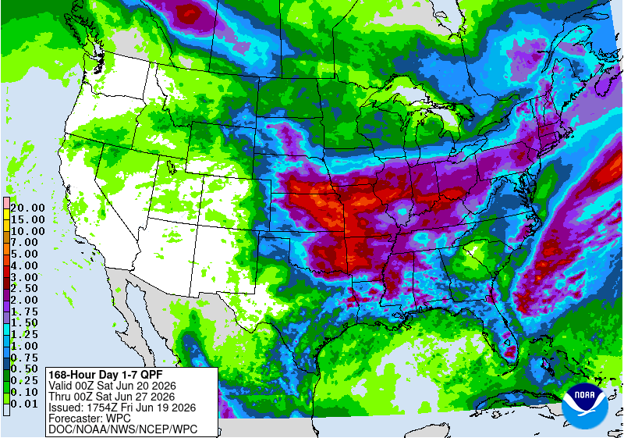
Once again we have strong rain chances and amounts forecast for the upcoming week. Scattered rains across the southeast today give way to a break this weekend, but Sunday begins a full week of 50+% rain chances. Mild temps, high humidity, rain chances – cue disease pressure…
With so much rice having crossed the threshold into reproductive growth we are starting to see some midseason deficiencies show up. Unfortunately they’re not always telling the truth, giving mixed symptoms of what is really going on. This is why we frequently recommend taking a tissue sample from both good and bad areas of the field so we can have a diagnostic comparison of nutrient levels BEFORE we make any fertilizer application. We want to make sure we spend smart money.
Some fields are being reported as running 5-7 days ahead of the DD50 program. When comparing our predicted dates in the program to cultivars we’re cutting and measuring internode elongation on – we’re at most 2-3 days different and some are spot on. This is the normal variability of the program. Odds are, given the uneven emergence of early-planted rice, we probably used an emergence date that was a little later than it should have been in some of the fields that appear further off. It might be worth adjusting that emergence date if you think that’s the case so the rest of your timings will be more accurate.
In this update is info on progress, fungicide application timing by disease, boot N in hybrid rice, and markets.
Let us know if we can help.
Fig. 1. NOAA 7-day precipitation forecast.
Fungicide Application Timing by Disease
Jarrod Hardke
Typical all-over-the-board Arkansas weather consistently keeps us guessing on the disease front. Repeated rainfall over the past month or so is of course conducive to disease development, but so far nothing has jumped to worrisome levels. The most recent window of “supposed to rain but didn’t” may have given us some reprieve, but next week’s mid-80s with regular rain chances is concerning for the possibility of driving disease. I’m looking at you, sheath blight.
With that in mind, below are fungicide timings for various diseases (Table 1) and comments on fungicide selection for those various diseases (Table 2).
Table 1. Fungicide timing by disease and rice growth stage.
|
Disease |
Scout? |
PD+7 days |
Early boot |
Mid Boot |
Late Boot |
Up to 10% Head out |
50-75 % Head out |
After heading |
|---|---|---|---|---|---|---|---|---|
|
Rice Blast |
Yes |
- |
- |
- |
✓✓ Rec |
✓✓ Rec |
✓✓ Rec |
✗ Late |
|
Sheath Blight |
Yes |
✓ If needed |
✓ If needed |
✓✓ Rec |
✓✓ Rec |
✓ If needed |
✓ If needed |
? Check PHI |
|
Cercospora (NBLS) |
No |
- |
✓✓ Rec |
✓✓ Rec |
✓✓ Rec |
✗ Late |
✗ Late |
✗ Late |
|
False Smut |
No |
- |
✓✓ Rec |
✓✓ Rec |
✗ Late |
✗ Late |
✗ Late |
✗ Late |
|
Kernel Smut |
No |
- |
✓✓ Rec |
✓✓ Rec |
✗ Late |
✗ Late |
✗ Late |
✗ Late |
Note: Rec = Recommended.
Table 2. What fungicide should I use?
|
MoA Group |
Active Ingredient |
Product |
Rate (fl oz/ac) |
Blast |
Sheath Blight |
Kernel & False Smut |
Cercospora |
|---|---|---|---|---|---|---|---|
|
Group 11 |
Azoxystrobin |
Quadris |
8.5 – 12.5 |
G |
VG |
P |
P |
|
Trifloxystrobin |
GEM |
3.1 – 4.7 |
VG |
G |
NL |
NL |
|
|
Group 7 |
Flutolanil |
Elegia |
32 |
NL |
G |
NL |
NL |
|
Group 3 |
Propiconazole |
Tilt |
6 – 10 |
NL |
F |
G |
G |
|
Group 11 + 3 |
Azoxystrobin, Propiconazole |
Quilt Xcel |
15.75 – 27 |
G |
VG |
G |
G |
|
Azoxystrobin, Difenconazole |
Amistar Top |
10 – 15 |
G |
VG |
G |
G |
P = poor; F = fair; G = good; VG = very good; NL = not labeled.
Boot Nitrogen in Hybrid Rice
Jarrod Hardke and Trent Roberts
For hybrid rice – we recommend a preflood N application dependent on soil texture (generally 120 lb N/acre on loam soils and 150 lb N/acre on clay soils) followed by a late boot application of 30 lb N/acre.
What is the late boot timing? Once the flag leaves on main stem tillers are fully emerged to where you can see the leaf collar up until boot-split. This is the late boot stage.
What is the recommended rate? 30 lb N/acre (65 lb urea/acre). Rates higher than this have not displayed an added benefit. There’s no reason to apply 100 lb urea/acre “just because you’re paying for 100 lb minimum flying”. That just means you’re adding another cost of 35 lb urea that isn’t giving a benefit.
Why the late boot and not a midseason application? The preflood N rate for hybrids is sufficient to supply season-long N needs for hybrids. Any potential shortfalls during the season can be resolved by the hybrids taking up additional native soil N to bridge the gap. So, a true midseason is not needed to drive overall yield potential.
The late boot N application to hybrids serves to reduce lodging potential, slightly improve yields, and slightly improve milling yields. If you were to make this application earlier at a true midseason timing, we would still expect similar benefits, but some negative consequences could occur such as increased plant height and increased rank (excessive) growth. Stick with the late boot timing to get the positives while minimizing the negatives.
**Note that in Table 3 below, even with the changes in economics this year, applying boot N still results in a better net return compared to not applying it.**
Table 3. Data from a single 2022 trial at Stuttgart evaluating timing and rate of midseason and late boot nitrogen (N) applications to hybrid rice (RT XP753).
|
Treatment |
Moisture |
Grain Yield |
Milling Yield |
Net Return |
|---|---|---|---|---|
|
Preflood N only |
15.3 |
198.8 |
59.6-70.1 |
$88.79 |
|
PFN + 30 lb N @ midseason |
15.6 |
200.5 |
60.6-70.5 |
$76.09 |
|
PFN + 30 lb N @ late boot |
15.6 |
202.7 |
61.9-70.6 |
$94.57 |
|
PFN + 46 lb N @ midseason |
15.8 |
194.0 |
61.3-70.6 |
$28.03 |
|
PFN + 46 lb N @ late boot |
15.9 |
200.7 |
61.5-70.7 |
$67.44 |
|
PFN + 30 lb N @ midseason & 30 lb N @ late boot |
16.0 |
201.7 |
61.8-70.6 |
$62.91 |
|
Foliar N (2 gal – 2 lb N) @ midseason |
15.3 |
198.3 |
58.3-70.5 |
$86.53 |
|
Foliar N (2 gal – 2 lb N) @ late boot |
15.5 |
201.2 |
59.9-70.6 |
$60.21 |
Notes: Net return calculated using $5.50/bu rice as a base adjusted for milling yield. Generalized operating cost base of $900/acre with costs for N added based on treatment using current average urea price of $670/ton.
What about other N sources? The late boot N recommendation is to be applied as urea. After rice enters reproductive growth, it can take up urea N with high efficiency (90% uptake) when grown under a continuous flood. Foliar N applications cannot supply these N rate levels. A foliar N product containing 32% N can only deliver 3.2 lb N per gallon. Even if applied at 3 gallons per acre and similar efficiency to urea, you’re only getting 8.6 lb N versus 27 lb N from urea (at 90% uptake for each).
The product in the table above was a 10% N product so it only supplied 2 lb N from a 2 gallon application. One other cost element not included in the table is that the liquid N could be applied along with a fungicide (if one were already being applied) which would eliminate an extra application cost. However, in this single trial, incorporating differences in application cost still results in a higher return for 30 lb N as urea applied at late boot. Based on continual questions on this topic, we will initiate further studies comparing urea to liquid N sources at the midseason and late boot timings.
Fig. 2. Leaf burn from foliar nitrogen application.
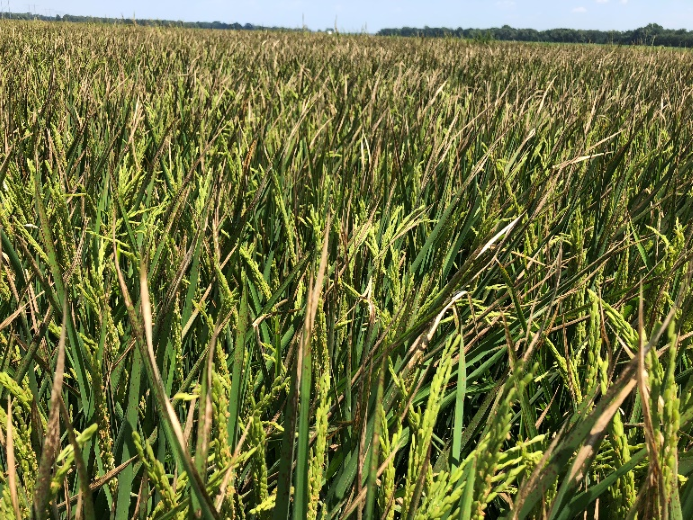
Table 4. Hybrid response to late boot nitrogen (N) applications at three locations in 2025.
|
Hybrid and Location |
30 lb N/acre @ Late Boot |
No Late Boot N |
||
|---|---|---|---|---|
|
|
Yield (bu/ac) |
Head Rice-Total Rice (%) |
Yield (bu/ac) |
Head Rice-Total Rice (%) |
|
RT 7331 MA @ Keiser |
173 |
46/70 |
165 |
45/70 |
|
RT 7331 MA @ Pine Tree |
175 |
39/68 |
157 |
39/67 |
|
RT 7331 MA @ Stuttgart |
204 |
41/72 |
197 |
38/71 |
|
RT 3202 @ Keiser |
187 |
47/69 |
174 |
40/68 |
|
RT 3202 @ Pine Tree |
169 |
36/65 |
167 |
34/65 |
|
RT 3202 @ Stuttgart |
198 |
33/71 |
175 |
31/71 |
|
RT 7521 FP @ Keiser |
193 |
46/70 |
193 |
45/70 |
|
RT 7521 FP @ Pine Tree |
176 |
48/65 |
171 |
48/64 |
|
RT 7521 FP @ Stuttgart |
201 |
50/71 |
196 |
48/71 |
At Stuttgart and Pine Tree, 120 lb N/acre preflood N rate was used. At Keiser, 150 lb N/acre preflood N rate was used.
Market Update
Scott Stiles
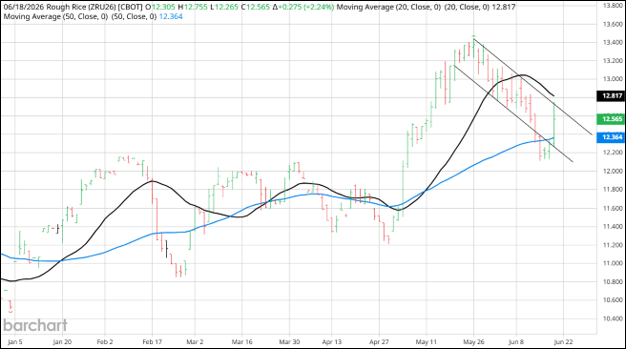
Rice futures finished the short week on a positive note. U.S. markets were closed Friday, June 19, in observance of Juneteenth. The September contract gained 16 ½ cents on the week with a higher close on Tuesday, Wednesday, and Thursday. Thursday’s session was eye-opening with nearly a 50-cent trading range. Market news was supportive Thursday, and the September contract closed 27 ½ cents higher at $12.56 ½ .
Figure 3. CME Rough Rice September 2026, Daily Chart.
In Thursday’s Export Sales report, long-grain rough rice sales for the week ending June 11 hit an 11-week high of 53,687 MT. Mexico was the largest buyer, in for 49,615 MT. There were additional sales to Honduras (1,072 MT) and Unknown (3,000 MT). Old crop (25/26) shipments were impressive as well, reaching the second highest weekly total of the year at 77,061 MT. Mexico and Honduras were the destinations. Also, there were two new crop sales of long-grain rough rice: Colombia (29,545 MT) and Unknown (28,000 MT). This brings new crop sales to a total of 74,545 MT compared to zero at this time last year.
With the re-opening of the Strait of Hormuz, there is talk of new business with Iraq and export possibly resuming this fall. This inspires some optimism, but shipping traffic will remain limited for a while yet. At present, traffic is averaging roughly 6 to 8 transits per day. The main central shipping route remains closed because an estimated 80 underwater mines must still be cleared.
Technically, the rice market is trying to stabilize after a sharp correction and work itself out of oversold conditions. Closing above the 50-day moving average (blue line) on Thursday was constructive. The next key layer of resistance is the 20-day moving average (black line) at $12.81.
The June 30 Acreage report is what the market is waiting for. That, and other factors, could be the catalyst that brings in a new round of buying. The Climate Prediction Center recently updated its alert system status to an El Nino Advisory, saying that El Nino conditions are now present. Chances of seeing a “very strong” El Nino were listed at 63 percent. In the last 15 years, there have been two episodes of “strong” (2023/24) and “very strong” (2015/16) El Niño years. Rice production in southeast Asia has generally been adversely impacted during strong El-Niño events. In 2015/16, Thailand’s rice production was affected most in the region, with production dropping 16% compared to the previous year. With sharply lower acreage and production in the U.S. and the potential for lower production in Asia, the rice market is building a good base of support.
DD50 Rice Management Program is Live
The DD50 Rice Management Program is live and ready for fields to be enrolled for the 2026 season. All log-in and producer information has been retained from the 2025 season, so if you used the program last year you can log in just as you did last year. Log in and enroll fields here: https://dd50.uada.edu.
Use the Arkansas Rice Advisor Internet App!
The Arkansas Rice Advisor site https://riceadvisor.uada.edu functions like an app on your mobile device. There you can readily access the DD50 program, rice seeding rate calculator, drill calibration, fertilizer and N rate calculators, publications, and more.
Additional Information
Arkansas Rice Updates are published periodically to provide timely information and recommendations for rice production in Arkansas. If you would like to be added to this email list, please send your request to rice@uada.edu.
This information will also be posted to the Arkansas Row Crops blog (http://www.arkansas-crops.com/) where additional information from Extension specialists can be found.
More information on rice production, including access to all publications and reports, can be found at http://www.uaex.uada.edu/rice.
Acknowledgements
We sincerely appreciate the support for this publication provided by the rice farmers of Arkansas and administered by the Arkansas Rice Research and Promotion Board.
The authors greatly appreciate the feedback and contributions of all growers, county agents, consultants, and rice industry stakeholders.
Specialist |
Area |
Phone Number |
|
|---|---|---|---|
|
Jarrod Hardke |
Rice Extension Agronomist |
501-772-1714 |
|
|
Tom Barber |
Extension Weed Scientist |
501-944-0549 |
|
|
Nick Bateman |
Extension Entomologist |
870-456-8486 |
|
|
Ralph Mazzanti |
Rice Verification Coordinator |
870-659-5507 |
|
|
Trent Roberts |
Extension Soil Fertility |
479-935-6546 |
|
|
Bob Scott |
Extension Weed Scientist |
501-837-0273 |
|
|
Scott Stiles |
Extension Ag Economics |
501-258-8455 |