Arkansas Rice Update 6-12-26
Arkansas Rice Update 2026-14
June 12, 2026
Jarrod Hardke, Scott Stiles, & Jason Norsworthy
“Don’t let the sound of your own wheels drive you crazy.”

Rock N’ Roll Yoyo
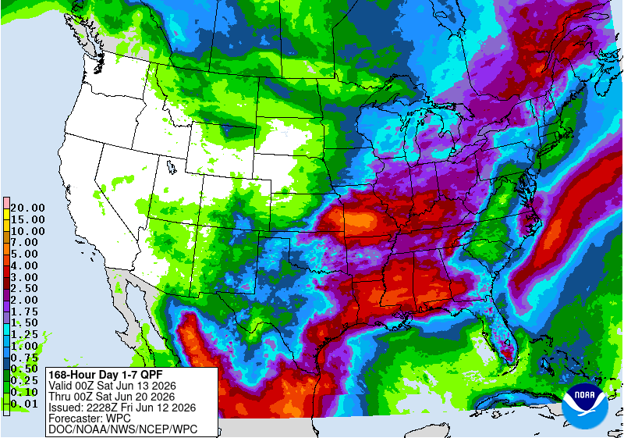
We’re going back and forth for June. We’ve surged out of the cool weather pattern and found a stretch of heat, but the only thing consistent is change. Rain chances that once seemed certain this weekend are now highly variable or possibly vanishing. Forecasts now point to more significant chances next weekend, but as with every summer rain chance it’s a wait-and-see game.
Temperatures also seem headed for interesting swings with some bounces into the low 80s, then back into the 90s, then back down again. The concerning piece of the temperature puzzle is that we’ve been collecting some nighttime temperatures in the mid-70s already and after the brief cooldown more are expected. We don’t need to see a return of that mess again this year.
Some rice is surging ahead with flag leaves beginning to emerge, which means we’re closing in on some fungicide applications (if needed) for smuts and the late boot N applications on hybrid. This is the earliest rice of course, but plenty of the next wave of rice in early to mid-April is entering or has entered reproductive growth stages. We’re also noticing strange patterns in some fields that may point to carryover issues from last year’s crop.
Be on the lookout for nutrient deficiencies (particularly K and N) and increasing disease pressure (some sheath blight is starting at waterlines). Remember for varieties the midseason N application timing is to wait 4 weeks after preflood N is incorporated and be past green ring before applying.
In this update is info on progress, MaxAce rice and Highcard, hydrogen sulfide toxicity, and markets.
Let us know if we can help.
Fig. 1. NOAA 7-day precipitation forecast.
MaxAce Rice & Highcard: Efficacy and Understanding Risks for Crop Response
Jason Norsworthy
Failures of Highcard herbicide to provide adequate grass control, mainly barnyardgrass and broadleaf signalgrass, and high levels of crop response of MaxAce rice to the herbicide have been the most common calls received over the past few weeks. More than 25 years ago, Dr. Ford Baldwin worked with Bayer CropScience to add isoxadifen to fenoxaprop to lessen the risk for injury to rice. Some of you may recall that, at that time, fenoxaprop was sold under the trade name Whip, which was changed to Ricestar HT once it was safened. This same safener is present in Highcard today because MaxAce rice has a narrow margin of selectivity, and it slows the rate of kill when applied to annual grasses.
Where or when might one see injury from these herbicides? First, Provisia rice has much better tolerance to Provisia herbicide than MaxAce rice has to Highcard. Secondly, some rice cultivars appear to be inherently more sensitive to Group 1 herbicides than others. Based on recent calls and field observations, it is likely that RT 7531 MA and RT 7331 MA are more sensitive to Highcard than is RTv7231 MA. Thirdly, the growth stage matters. Larger rice is more tolerant of these herbicides. For instance, the Highcard label states that the herbicide is not to be applied to rice until the 2- to 3-leaf stage. However, even then, substantial injury can occur.
About 2 to 3 weeks ago, as the weather shifted from clear and dry to cloudy and wet, it was inevitable that the phone would begin ringing with calls about injury to rice from Group 1 (ACCase-inhibiting) herbicides. Quizalofop (Highcard & Provisia) and fenoxaprop (Ricestar HT) are the most common culprits, which brings me to my fourth point. There are other factors at play, some of which are less under the grower’s control, that can substantially increase the risk for injury to rice from these herbicides. Cool, cloudy, and wet conditions, especially when it’s prolonged, tend to lead to greater injury in rice. Soils that stay wet longer or hold more moisture will lead to a greater risk for injury from these herbicides. Moving rice from an aerobic environment to an anaerobic environment (flood establishment) within 24 hours of applying Highcard, Provisia, or Ricestar HT, will increase the likelihood of injury. One of the more common ways Whip would cause injury was from applications at 2-3 leaf followed by fertilizer and flushing. This same situation may exaggerate injury potential with Highcard on MaxAce.
With that said, weeds must be controlled in a timely manner. There have been times in recent weeks when I’ve recommended Regiment, Facet, Rhinde (Regiment + Facet premix), and Ricestar HT on MaxAce rice, knowing that conditions were not conducive for good crop tolerance to Highcard. As a reminder, the isoxadifen in Highcard slightly reduces the herbicide’s effectiveness on grasses, especially if the grass is large and only a single application is made. Overall, Highcard is more effective on weedy rice than most other annual grasses of rice, and that should be the main target when applying the herbicide.
Consequently, growers should not expect the same level of grass control from Highcard that they may see with Provisia. While Highcard can suppress several annual grass species, its greatest strength lies in controlling weedy rice, which should be the primary target when selecting and applying the herbicide. Given the narrow window of crop selectivity in MaxAce rice and the influence of environmental conditions on crop response, careful consideration of rice variety, growth stage, weather patterns, and flood timing is essential to maximize weed control while minimizing the risk of injury.
Fig. 2. Highcard injury to MaxAce rice.
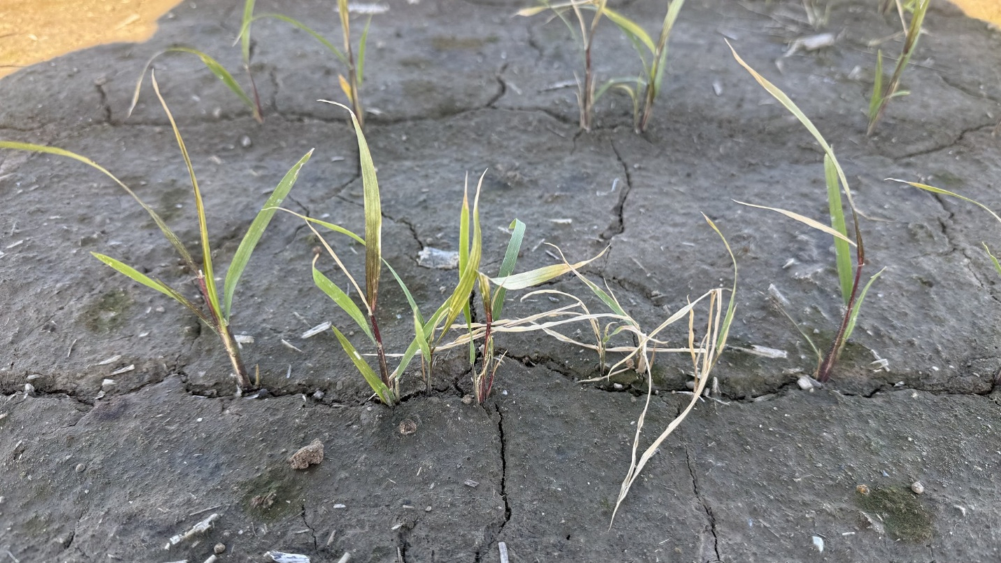
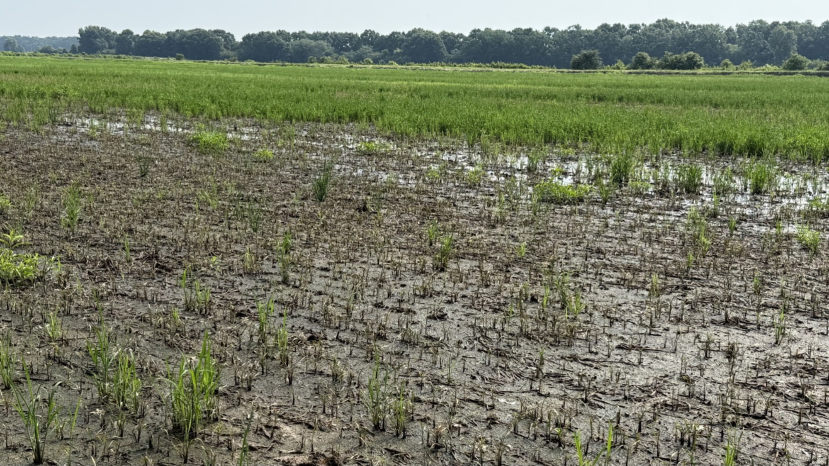
Fig. 3. Highcard injury to large areas in MaxAce rice field.
Hydrogen Sulfide Toxicity
Jarrod Hardke
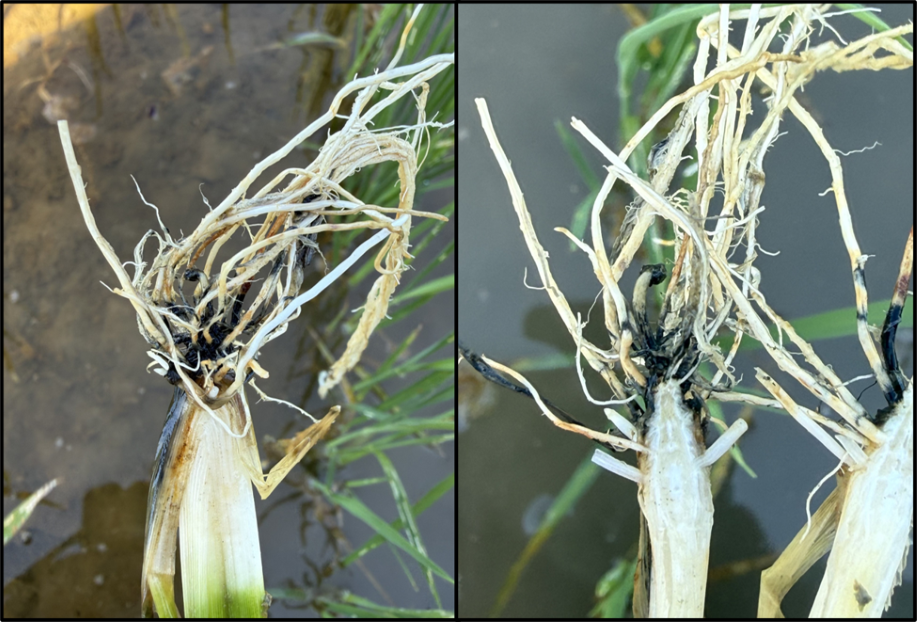
Hydrogen sulfide toxicity (autumn decline) is a disorder that seems to come and go. It’s been a few years since it was much of an issue, and this (Fig. 4) represents the first find in the 2026 season. The problem is how small the rice is in this first find. Typically, hydrogen sulfide toxicity (H2S) becomes notable as we move into midseason once rice has been flooded for some time. This small rice that hasn’t been flooded for long is very concerning.
Over the years, we have identified the three factors that could lead to H2S are high sulfur content (well water), high organic matter, and silt content of the soil. The extremely dry winter may have left more residue to break down in fields postflood this year that would have normally broken down in the winter. Perhaps this could contribute to early onset H2S? I would say be on the lookout in high organic matter fields irrigated with groundwater and particularly in rice behind rice situations.
The only solution to H2S problems is to drain the field to incorporate oxygen back into the soil profile. This reverses the chemical reaction we’re seeing that causes the blackening on roots. As a reminder – if uncertain, throw affected plants in your truck and within 30 minutes to an hour the blackening should virtually disappear from the roots.
Fig. 4. Hydrogen sulfide toxicity on small rice postflood – same plant in both images – note the toxicity reaching the outer crown wall in image on right.
Market Update
Scott Stiles
The rice market needed some help from the USDA report on Thursday. Unfortunately, it didn’t happen. The June report is usually not a market mover anyway and per usual there were no major domestic changes this month to the U.S. rice balance sheets.
Long-Grain:
Looking first at long-grain, USDA lowered old crop 2025/26 exports by 1 million to 50 million cwt. This is about 18% below the 2024/25 export total of 60.8 million cwt. Weekly export data for 2025/26 indicate sales are actually about 25% below last year. The 1 million cwt. reduction in exports was this month’s only demand adjustment to the old crop balance sheet. This increased 2025/26 ending stocks to 40.6 million cwt.—the highest since 1985/86. There were no changes to the 2025 season-average farm price (SAFP), holding at $10.40/cwt. or $4.68 per bushel. That would equate to a projected PLC payment of $2.93 per bushel.
Table 1. U.S. Long-Grain Rice Supply and Demand, 2025/26.
|
monthly change |
|||
|
unit: million cwt. |
2025/26 |
2025/26 |
|
|
May |
June |
||
|
Beginning Stocks |
37.3 |
37.3 |
0.0 |
|
Production |
153.3 |
153.3 |
0.0 |
|
Imports |
37.0 |
37.0 |
0.0 |
|
Total Supply |
227.6 |
227.6 |
0.0 |
|
Domestic Use |
137.0 |
137.0 |
0.0 |
|
Exports |
51.0 |
50.0 |
(1.0) |
|
Total Use |
188.0 |
187.0 |
(1.0) |
|
Carry-Over |
39.6 |
40.6 |
1.0 |
|
stocks-use % |
21.1% |
21.7% |
|
|
Avg. Producer Price ($/cwt.) |
$ 10.40 |
$ 10.40 |
$ - |
|
Avg. Producer Price ($/bu.) |
$ 4.68 |
$ 4.68 |
$ - |
|
PLC Reference Price ($/bu.) |
$ 7.61 |
$ 7.61 |
$ - |
|
Proj. PLC Payment Rate ($/bu.) |
$ 2.93 |
$ 2.93 |
$ - |
Source: USDA World Agricultural Supply and Demand Estimates, June 2026.
Adjustments for the new crop 2026/27 long-grain balance sheet included a 1 million cwt. increase in beginning and ending stocks. No changes were made to the 2026 production estimate of 122.5 million cwt., which would be the smallest U.S. long-grain crop since 2011 (116.4 million cwt.). The 2026/27 season-average farm price (SAFP) was unchanged at $12 per cwt ($5.40/bu.), which amounts to a projected PLC payment for the 2026 crop of $2.21 per bushel.
Table 2. U.S. Long-Grain Rice Supply and Demand, 2026/27.
|
monthly change |
|||
|
unit: million cwt. |
2026/27 |
2026/27 |
|
|
May |
June |
||
|
Beginning Stocks |
39.6 |
40.6 |
1.0 |
|
Production |
122.5 |
122.5 |
0.0 |
|
Imports |
39.0 |
39.0 |
0.0 |
|
Total Supply |
201.1 |
202.1 |
1.0 |
|
Domestic Use |
123.0 |
123.0 |
0.0 |
|
Exports |
50.0 |
50.0 |
0.0 |
|
Total Use |
173.0 |
173.0 |
0.0 |
|
Carry-Over |
28.1 |
29.1 |
1.0 |
|
stocks-use % |
16.2% |
16.8% |
|
|
Avg. Producer Price ($/cwt.) |
$ 12.00 |
$ 12.00 |
$ - |
|
Avg. Producer Price ($/bu.) |
$ 5.40 |
$ 5.40 |
$ - |
|
PLC Reference Price ($/bu.) |
$ 7.61 |
$ 7.61 |
$ - |
|
Proj. PLC Payment Rate ($/bu.) |
$ 2.21 |
$ 2.21 |
$ - |
Source: USDA World Agricultural Supply and Demand Estimates, June 2026.
Medium Grain:
USDA made only a minor change this month to the U.S. medium grain balance sheet. Old crop 2025/26 imports were lowered 0.5 million this month to 6.2 million cwt. Ending stocks were reduced by the same amount to 11.4 million cwt. The 2025/26 SAFP for Southern medium grain was increased 20 cents/cwt. to $14.90 ($6.71/bu.). This lowered the projected 2025 PLC payment rate from $1.00 per bushel in May to 91 cents per bushel.
The new crop 2026/27 medium grain balance sheet saw a 0.5 million cwt. reduction in beginning and ending stocks. At 10.9 million cwt., new crop ending stocks are projected to be at a four-year low. The 2026/27 SAFP was unchanged this month at $13.50 per cwt. ($6.08/bu.). The projected 2026 PLC payment rate for Southern medium grain is currently $1.54 per bushel.
The June 2026 WASDE Report can be found here.
June Outlook
The big focus for the remainder of the month is going to be on the June 30th Acreage report. Early calls are pointing to a larger decline in U.S. long-grain acres than the 22% reduction indicated in the March Prospective Plantings. Arkansas’ long-grain acres were projected to decline 24% from last year to 900,000 acres. That would be the state’s lowest long-grain acreage since 1987 (885,000).
Quarterly Rice Stocks will also be a key June 30th report as it will show the amount of rice still in on-farm storage. Coinciding with the NASS reports at the end of the month is First Notice Day for the July futures contract. The week leading up to First Notice Day can sometimes be very volatile and oftentimes bearish. It feels like that could be the case again this year with all the surplus rice that’s still around from 2025 and even 2024.
On a positive note, Urea prices have turned lower with average quotes this week below $700.
DD50 Rice Management Program is Live
The DD50 Rice Management Program is live and ready for fields to be enrolled for the 2026 season. All log-in and producer information has been retained from the 2025 season, so if you used the program last year you can log in just as you did last year. Log in and enroll fields here: https://dd50.uada.edu.
Use the Arkansas Rice Advisor Internet App!
The Arkansas Rice Advisor site https://riceadvisor.uada.edu functions like an app on your mobile device. There you can readily access the DD50 program, rice seeding rate calculator, drill calibration, fertilizer and N rate calculators, publications, and more.
Additional Information
Arkansas Rice Updates are published periodically to provide timely information and recommendations for rice production in Arkansas. If you would like to be added to this email list, please send your request to rice@uada.edu.
This information will also be posted to the Arkansas Row Crops blog (http://www.arkansas-crops.com/) where additional information from Extension specialists can be found.
More information on rice production, including access to all publications and reports, can be found at http://www.uaex.uada.edu/rice.
Acknowledgements
We sincerely appreciate the support for this publication provided by the rice farmers of Arkansas and administered by the Arkansas Rice Research and Promotion Board.
The authors greatly appreciate the feedback and contributions of all growers, county agents, consultants, and rice industry stakeholders.
Specialist |
Area |
Phone Number |
|
|---|---|---|---|
|
Jarrod Hardke |
Rice Extension Agronomist |
501-772-1714 |
|
|
Tom Barber |
Extension Weed Scientist |
501-944-0549 |
|
|
Nick Bateman |
Extension Entomologist |
870-456-8486 |
|
|
Ralph Mazzanti |
Rice Verification Coordinator |
870-659-5507 |
|
|
Trent Roberts |
Extension Soil Fertility |
479-935-6546 |
|
|
Bob Scott |
Extension Weed Scientist |
501-837-0273 |
|
|
Scott Stiles |
Extension Ag Economics |
501-258-8455 |