Arkansas Rice Update 5-1-26
Arkansas Rice Update 2026-08
May 1, 2026
Jarrod Hardke, Scott Stiles, & Bob Scott
“I’m learning to fly, but I ain’t got wings.”

Change in the Air
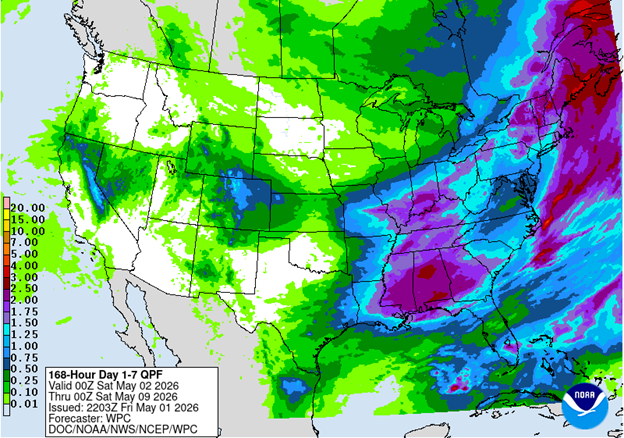
Multiple meaningful rainfall events in a week? After months of trying to get a single meaningful rainfall, now a cool pattern with repeated rainfall chances. We all hoped it would happen eventually, and now we’re staring at a rinse and repeat. Last Friday’s rain was variable throughout the Delta with amounts ranging from 0.2 inches to over 2 inches. That was followed on Tuesday by another good rain with those on the lesser end Friday getting some larger amounts, and some receiving more than they bargained for (5+ inches).
Here we are in a cool spell that’s expected to last through the coming week before temps climb back into the 80s. Rice progress will slow some, but given how far ahead we are currently, don’t let it lull you to sleep. A good amount of rice will be ready to see a flood in the next couple of weeks. Run a DD50 report to see where you stand!
The rains did tell us that some of that Command put out early that waited a long time for an activating rainfall was still there to varying degrees. The overly dry soil clearly held onto more than we typically expect. That’s good news for some of our weed control, but it caught some off-guard with a white flash. And those that went ahead and overlayed more Command may have gotten a little more than they bargained for.
Stands are variable but beginning to even out. With good sealed soil and more rainfall expected this coming week, further planting progress will be minimal, but it’s a good time to overlay additional residual herbicides.
In this update is info on crop progress, preflood N with low stands, yield by planting date, grass and sedge control, and rice markets.
Let us know if we can help.
Fig. 1. Arkansas rice weekly planting progress, 2013-2026.
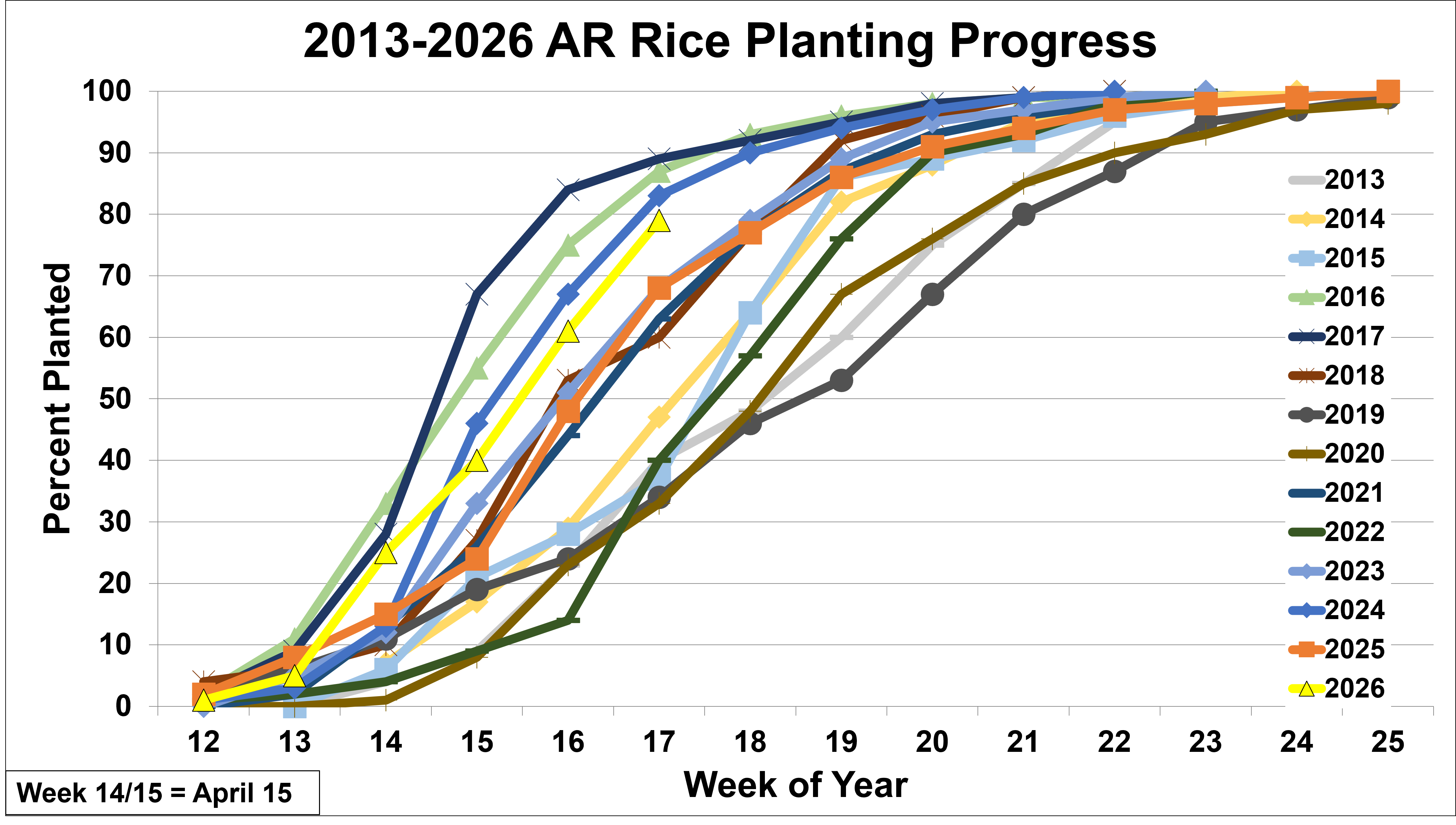
Fig. 2. NOAA 7-day precipitation forecast.
Low Stands & Preflood Nitrogen
Jarrod Hardke
Stand densities and growth stages are all over the place. I think more stands have improved with recent moisture, but there are still those out there that are questionable. Given the increased cost of urea these days, how to manage nitrogen (N) gets more delicate.
General Recommendations:
- For varieties such as Ozark, CLL18:
- Stands below 5 plants/ft2, consider increasing PFN by 10-20 lb N/acre.
- Stands over 5 but less than 10 plants/ft2, consider increasing PFN by 0-10 lb N/acre.
- For hybrids such as RT 7302, RT 7521 FP:
- Stands below 3 plants/ft2, consider increasing PFN by 10-20 lb N/acre.
- Stands over 3 but less than 5 plants/ft2, consider increasing PFN by 0-10 lb N/acre.
Reducing N rates is not the answer here! Ensuring that adequate N is near all plants at a sufficient rate is the goal to maximize yield and profitability. This year given the economics of urea, it stands to reason we may need to lean toward the low end of increased N. But keeping our standard N rates, or slightly increasing, consistently provides the best outcomes with suboptimal stands.
May Planted Rice
Jarrod Hardke
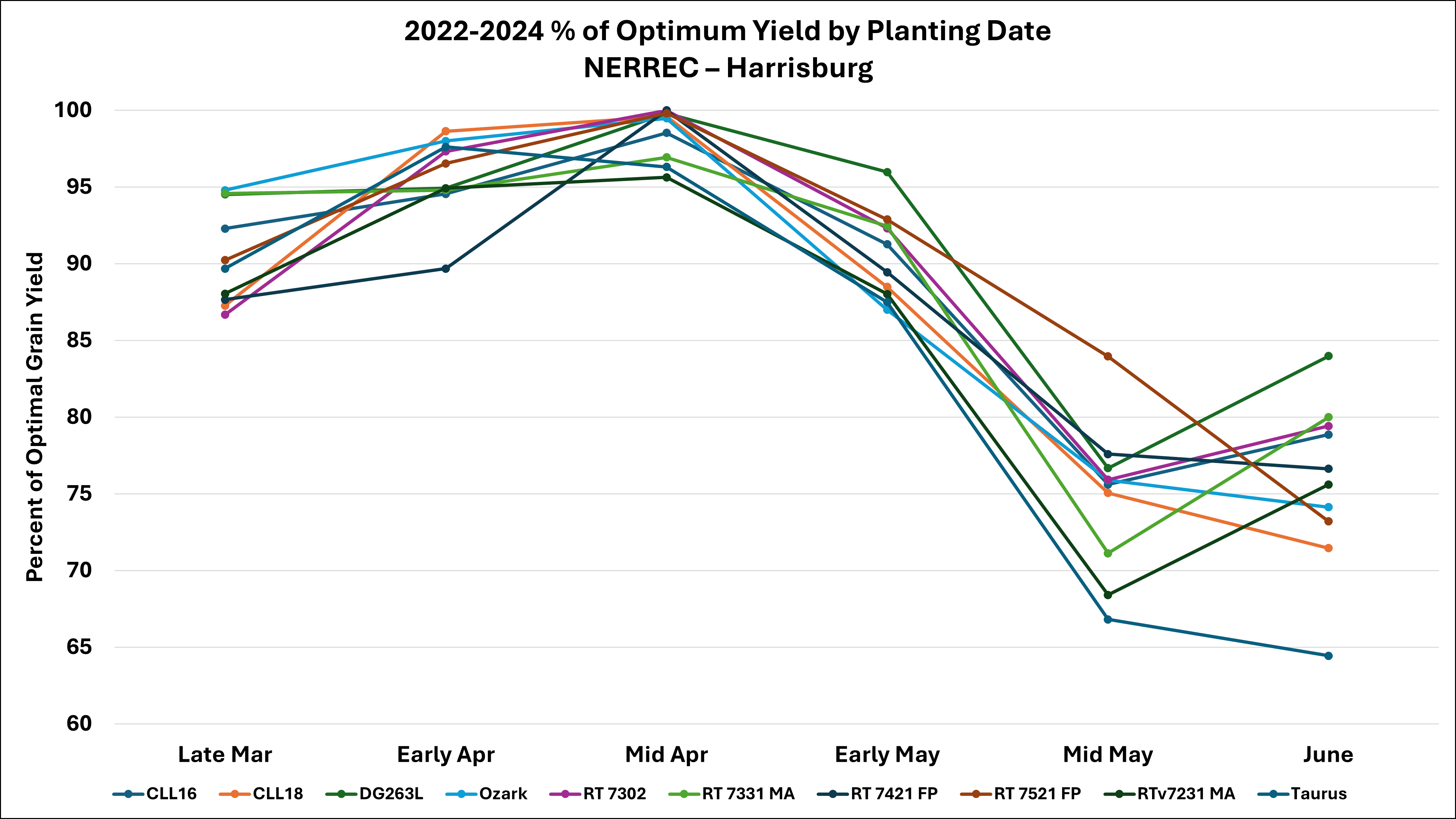
For those with rice acres left to plant, the shift into May should have additional considerations. While not many have rice left to plant, there will be some. Still others may be considering replants now that they have a better look at stands after some rain. Looking at yield results from the Rice Research Verification Program (Fig. 3), the general downtrend in yield potential begins as we shift into May. Additional figures from small plot planting date studies (Figs. 4 and 5) echo a similar trend but with some differences between the study in south Arkansas and the study in north Arkansas.
Early May can still produce very good rice in south Arkansas (Fig. 4). However, the decline has begun in north Arkansas (Fig. 5) – but yields are typically still on par with earlier planting dates. Note the steep drop off for both in mid-May. Late May / early June yield rebounds do happen occasionally like in 2025 but that is washed out in the this multi-year average data – given that it only happens about 1 of 4 or 1 of 5 years, it’s not something to plan on working out.
Fig. 3. 2015-2025 Rice Research Verification Program (RRVP) Field Yields by Planting Date.
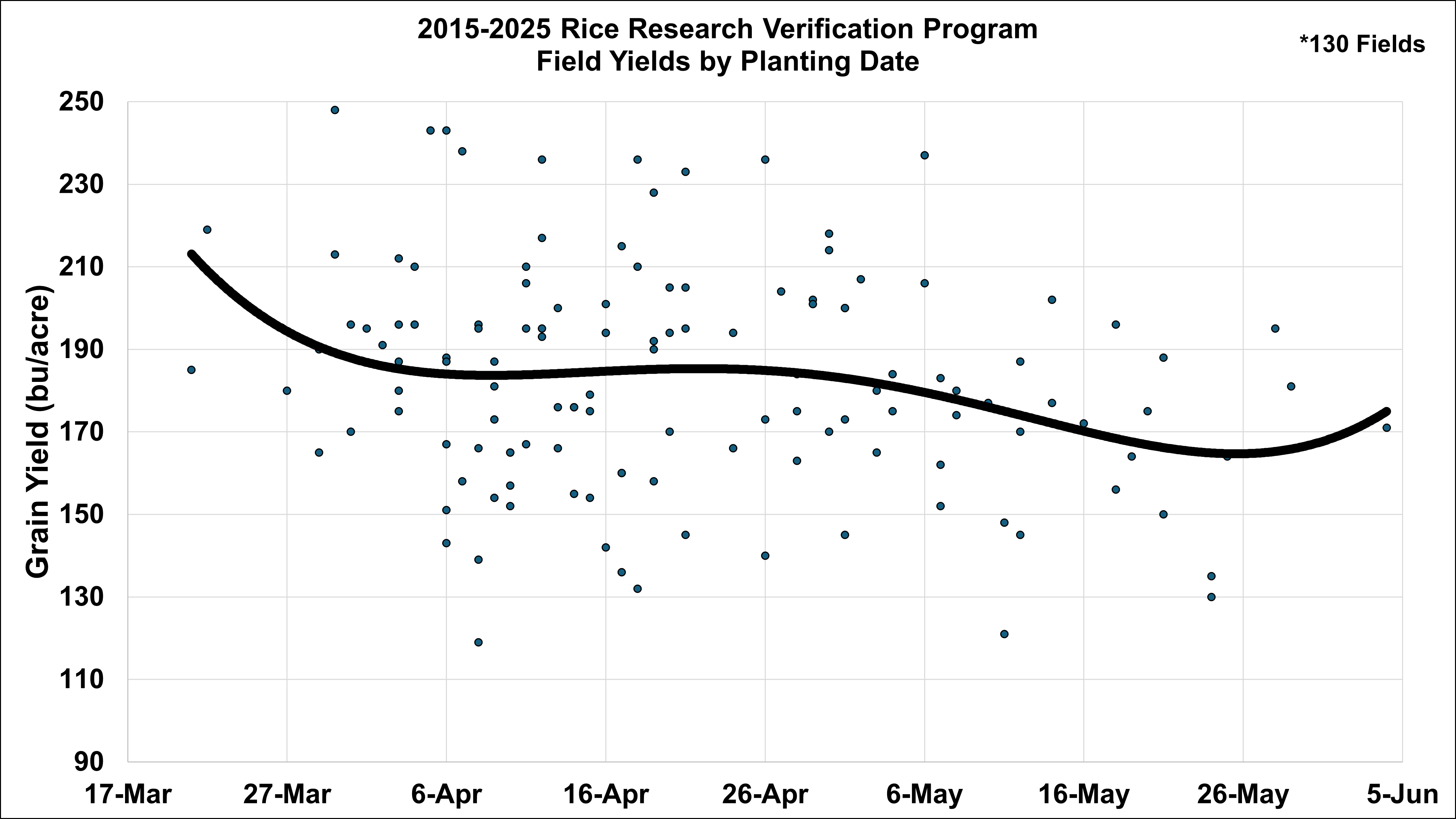
Fig. 4. 2022-2025 Optimum Grain Yield by Planting Date – RREC, Stuttgart.
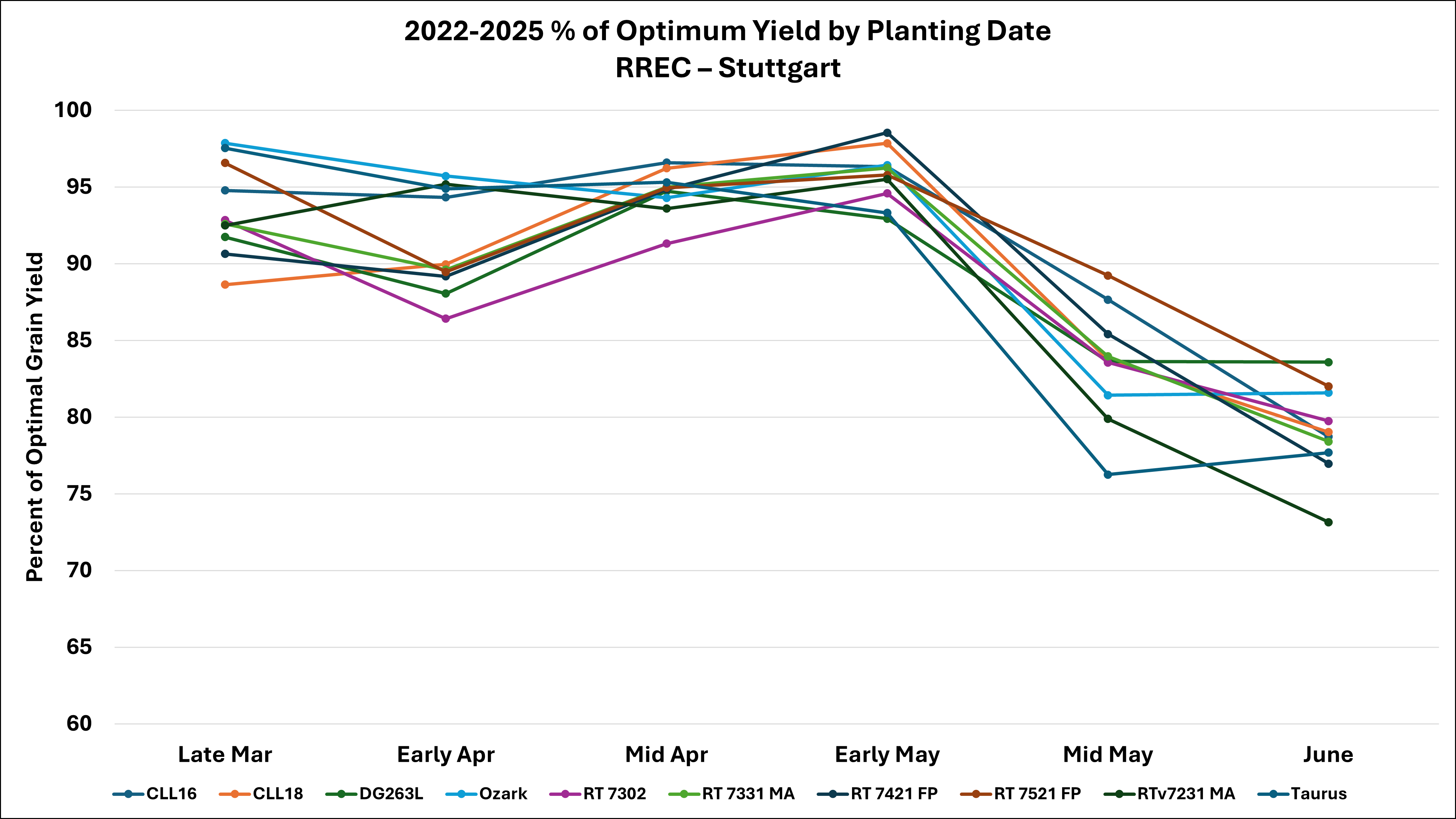
Fig. 5. 2022-2025 Optimum Grain Yield by Planting Date – NERREC, Harrisburg.
Bobbing and Weeding
Bob Scott
Finally, the rain came. Now what? We had our plot area ready to plant but now it’s been wet for a few days, and we will be faced with having to clean up some weeds and start weed-free to make our protocols work right. I have heard and gotten a few calls from several of you all about running into some larger grass following this rain. It is very hard to kill large grass in rice as you all know.
If your residual broke during the rain or it didn’t get put out, you may be faced with some tillered barnyardgrass, sprangletop, and signalgrass. Possibly also looking at some larger crabgrass and sedges. While a flood can kill some grass like crabgrass it can make a mess along field edges and levees where the roots are dryer. So, my advice is to attack these weeds as soon as possible with what will probably be the first of a two-shot program to clean them up. I like Ricestar mid-POST to preflood on larger grass, I go with the full rate and will likely mix with Facet if possible as a sort of salvage with residual. Clincher can work good under these wet conditions also, but if I must pick, I like Ricestar first then Clincher or maybe Regiment as a final shot. The propanil products where they still work on grass work better up to maybe one tiller then control drops off sharply. I like these wet conditions for Highcard and Provisia activity as well.
I know that due to weed resistance you may have to pick and choose your options carefully based on test results or just your previous experience with that field. If it was resistant last year or 2 years ago it probably still is… use something else.
I suspect that once it warms up some more, we will see more flushes of annual sedges. Yellow nutsedge has already been a problem for many. If Gambit or Newpath or other ALS herbicides have been working for you then control should not be that tough. But last year it seems like we had a lot of failures with this family of chemistry, especially on the annual sedges. POST options for sedges include: Loyant, Grandstand, propanil, in various mixtures and RiceBeaux. Basagran alone or in a tank mix with propanil is effective across all types of sedges and may be your best bet for mixed populations especially if they include white marge and umbrella or if you are unsure about which species you have, they are difficult to identify without a seedhead. See pages 89-90 of the 2026 MP44. Also check out our Sedge Fact Sheet.
Market Update
Scott Stiles
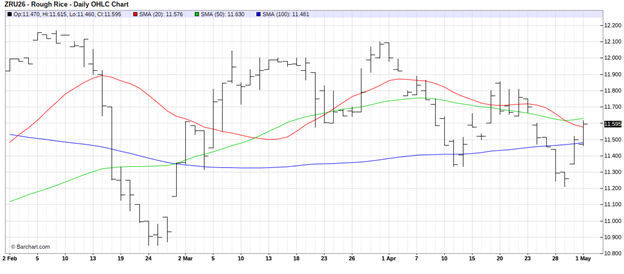
Rice futures are in recovery mode to finish out the week. After a sharp break lower last Friday (4/24), the July and September contracts turned 24 cents higher in Thursday’s session. There was follow-through in trading Friday morning. Both contracts were back above their 100-day (blue) and 20-day (red) moving averages. September rice is attempting to refill last week’s chart gap between $11.60 and $11.66 ½ but running into resistance at $11.60.
Figure 6. CME July 2026 Rough Rice Futures, Daily Chart.
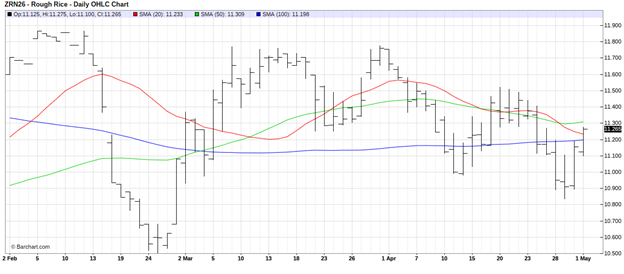
Figure 7. CME September 2026 Rough Rice Futures, Daily Chart.
New crop, fall delivery bids were in the $4.80 to $4.90/bu. range at local elevators at the close of the week. Mill bids averaged $4.95/bu. for fall delivery and early 2027 mill bids were around $5.20 per bushel.
Table 1. Rice Planted, Week Ending April 26, 2026.
|
State (% planted) |
April 26, 2026 |
Last Week |
Last Year |
5-year avg. |
|---|---|---|---|---|
|
Arkansas |
79 |
61 |
65 |
54 |
|
California |
10 |
5 |
17 |
11 |
|
Louisiana |
92 |
90 |
92 |
86 |
|
Mississippi |
91 |
70 |
59 |
45 |
|
Missouri |
48 |
36 |
40 |
44 |
|
Texas |
78 |
71 |
87 |
82 |
|
U.S. |
69 |
56 |
62 |
53 |
|
Source: USDA NASS, Crop Progress, April 26, 2026. |
||||
Prior to this week’s rain, rice planting continued to move forward at a faster pace than last year and the 5-year average. Monday’s Crop Progress from USDA showed U.S. rice planting advanced 13% on the week to 69% complete, up from 62% last year and the five-year average of 53%. Relative to last year, planting continues to be ahead of the average pace for all states except Texas, which is 4% behind the 5-year average.
At the state level, the biggest gains in rice planting over the previous week were seen in AR (+18%), MS (+21%), and MO (+12%). Planting is wrapping up in Louisiana and Mississippi. Arkansas will not be far behind as fields dry out. However, recent rainfall totals were variable in eastern Arkansas with some growers returning to the field this week. To view the full report from USDA here: Crop Progress
Rice Exports:
Export sales for the week ending April 23rd included long-grain rough rice sales of 2,460 MT. The only buyers were Honduras (5,816 MT) and Mexico (644 MT). Unknown destinations canceled 4,000 MT. Cumulative long-grain rough rice sales are down 31% from last year.
Long-grain milled rice sales for the week were 11,041 MT. Key buyers were Haiti (8,000 MT) and Saudi Arabia (2,000 MT). Haiti and Iraq account for 62% of our long-grain milled export sales. U.S. sales to Haiti are currently 5% ahead of last year. Overall, year to date long-grain milled rice sales total 650,786 MT, which is a 5-year low. Cumulative long-grain milled rice sales are down 12% from last year with lower year-to-year sales to Iraq, Canada, and Saudi Arabia.
Export demand for U.S. long-grain remains weak with much cheaper rice available on the world market. In the first quarter of 2026, South American (Argentina, Brazil and Uruguay) long-grain prices averaged $449/ton compared to the U.S. at $548/ton.
Furthermore, the situation in Iran has presented some challenges in exporting rice to Iraq and Saudi Arabia. As traffic has been disrupted, shipments to the Persian Gulf from all origins were either stranded, rerouted, or cancelled. As a result, all our competitors in the world rice market had to pivot to alternative destinations outside the Strait of Hormuz.
As a final thought, USDA will release its’ next WASDE on May 12th. It will include the first new crop (2026/27) supply/demand balance sheets. The initial production estimates for the year include acres from the March 31 Prospective Plantings survey. Many in the industry continue to point to the sharp rise in fertilizer and fuel as a factor that may have diverted more rice acres to soybeans or other crops. A more accurate depiction of rice acres will be found in the NASS June 30 Acreage report?
UADA Row Crop Text Message Service
To sign up to receive text messages regarding row crop updates (including to receive the Arkansas Rice Update link via text):
- Text the number 501-300-8883 with the following word to join that list:
- Cotton
- Fieldcorn (all one word)
- Irrigation
- Rice
- Soil
- Sorghum
- Soybean
- Weeds
- Wheat
- Once you’ve sent the list word to 501-300-8883, you should receive an automatic reply confirming your enrollment in the group.
- If you would like to join multiple lists, send separate text messages with each list word above to 501-300-8883.
- Reply STOP to cancel, HELP for help. Message and data rates may apply. Terms and privacy: https://terms.smsinfo.io/tc.php?id=1885323 .
We recommend saving 501-300-8883 as a contact in your phone. If you ever have a question regarding a message sent, you can reply directly to the text message. The responses will only be visible to the Extension specialists, and we will reply on a one-on-one basis.
If you have any questions regarding the UADA Row Crop Text Message Updates, please feel free to contact me at jhardke@uada.edu and thank you for continuing to support the University of Arkansas Division of Agriculture.
DD50 Rice Management Program is Live
The DD50 Rice Management Program is live and ready for fields to be enrolled for the 2026 season. All log-in and producer information has been retained from the 2025 season, so if you used the program last year you can log in just as you did last year. Log in and enroll fields here: https://dd50.uada.edu.
Use the Arkansas Rice Advisor Internet App!
The Arkansas Rice Advisor site https://riceadvisor.uada.edu functions like an app on your mobile device. There you can readily access the DD50 program, rice seeding rate calculator, drill calibration, fertilizer and N rate calculators, publications, and more.
Additional Information
Arkansas Rice Updates are published periodically to provide timely information and recommendations for rice production in Arkansas. If you would like to be added to this email list, please send your request to rice@uada.edu.
This information will also be posted to the Arkansas Row Crops blog (http://www.arkansas-crops.com/) where additional information from Extension specialists can be found.
More information on rice production, including access to all publications and reports, can be found at http://www.uaex.uada.edu/rice.
Acknowledgements
We sincerely appreciate the support for this publication provided by the rice farmers of Arkansas and administered by the Arkansas Rice Research and Promotion Board.
The authors greatly appreciate the feedback and contributions of all growers, county agents, consultants, and rice industry stakeholders.
Specialist |
Area |
Phone Number |
|
|---|---|---|---|
|
Jarrod Hardke |
Rice Extension Agronomist |
501-772-1714 |
|
|
Tom Barber |
Extension Weed Scientist |
501-944-0549 |
|
|
Nick Bateman |
Extension Entomologist |
870-456-8486 |
|
|
Ralph Mazzanti |
Rice Verification Coordinator |
870-659-5507 |
|
|
Trent Roberts |
Extension Soil Fertility |
479-935-6546 |
|
|
Bob Scott |
Extension Weed Scientist |
501-837-0273 |
|
|
Scott Stiles |
Extension Ag Economics |
501-258-8455 |