Arkansas Rice Update 4-3-26
Arkansas Rice Update 2026-04
April 3, 2026
Jarrod Hardke, Scott Stiles, & Bob Scott
“Help, I need somebody, help!”

Waiting for the Weekend
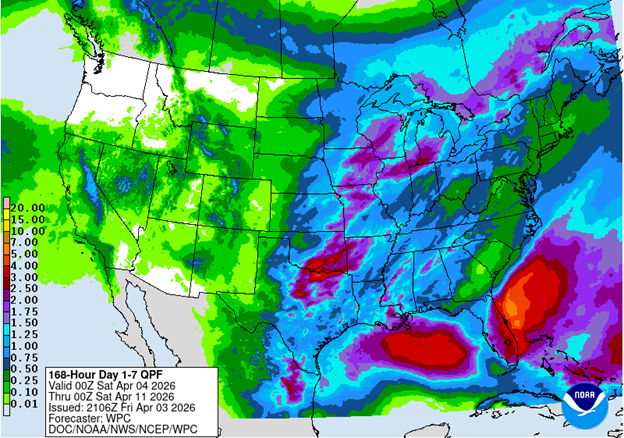
All eyes point to this weekend and the rainfall forecast. Not only has it been ridiculously dry, it has turned to a point of blowing dust being an issue throughout much of the delta with the high winds. Hopefully some much needed help arrives Saturday. It’s not expected to be a large amount of rain, maybe 1+ inch, but we’ll take it given the current situation. And we don’t want the other end of the spectrum we were getting at this time last year of over 12 inches.
Certain areas have made modest rice planting progress to date, but what a tangled web it is. Rice planted two weeks ago found some moisture and is beginning to find a stand, though dryness and crusting issues are affecting some. Anything planted in the last 7-10 days has various versions of either sitting in dust, some rice emerging and some not germinating, and everything in between.
While the right calls have mostly been made in putting off residual herbicide applications over the past two weeks with no activating rain in the forecast, the past several days have been unkind. With legitimate rain in the forecast, winds have kept spraying opportunities limited, and the high winds blowing dust may have impacted what residual did get applied.
Assuming a nice soaking rain Saturday, by middle of next week it will be all hands on deck planting. Hopefully that leads to a very successful few days before rain chances are currently forecast to show up again next weekend. It sure would be nice to have one of those rare springs where we get some rain, then we’re able to work for several days, then catch another, and repeat. Haven’t seen one of those in a while.
In this update is a lot of info on acreage outlook and history, weed control, planting progress, the Prospective Plantings report, stocks, and markets.
Let us know if we can help.
Fig. 1. NOAA 7-day precipitation forecast.
Rice Acreage Estimates and History
Jarrod Hardke
In my mind, our Arkansas rice acreage outlook is 850,000 total acres (ballpark 700,000 LG / 150,000 MG). Let me stress that estimate is based on right now at the beginning of April. We need some things to work in our favor to even reach that number – rains to bust up drought conditions, improvement on fertilizer and fuel prices, etc. Over the next 6 weeks, we’ll see if things keep working against us or if anything turns in our favor. Historical rice acres are below in Table 1. 1977 was the last time we didn’t plant at least 900,000 acres. It looks like we won’t be able to say that after this year, and ’77 and ’76 are the next years on deck we may fall below. So, it looks as though this year will be the lowest rice acres planted since 1974 at this point. Be sure to read more below in the market update on acreage numbers. I'll note that from what I'm seeing and hearing, all states are currently overestimated on acres (except CA) and we could see the US total acreage below 2.1 million acres.
Table 1. Arkansas planted rice acres 1972-2025, USDA-NASS.
|
Year |
Rice Acres |
Year |
Rice Acres |
Year |
Rice Acres |
|---|---|---|---|---|---|
|
1972 |
442,000 |
1990 |
1,240,000 |
2008 |
1,401,000 |
|
1973 |
534,000 |
1991 |
1,300,000 |
2009 |
1,486,000 |
|
1974 |
715,000 |
1992 |
1,400,000 |
2010 |
1,791,000 |
|
1975 |
900,000 |
1993 |
1,280,000 |
2011 |
1,196,000 |
|
1976 |
850,000 |
1994 |
1,440,000 |
2012 |
1,291,000 |
|
1977 |
840,000 |
1995 |
1,350,000 |
2013 |
1,076,000 |
|
1978 |
1,100,000 |
1996 |
1,180,000 |
2014 |
1,486,000 |
|
1979 |
1,030,000 |
1997 |
1,400,000 |
2015 |
1,311,000 |
|
1980 |
1,300,000 |
1998 |
1,500,000 |
2016 |
1,546,000 |
|
1981 |
1,560,000 |
1999 |
1,630,000 |
2017 |
1,161,000 |
|
1982 |
1,350,000 |
2000 |
1,420,000 |
2018 |
1,441,000 |
|
1983 |
925,000 |
2001 |
1,631,000 |
2019 |
1,161,000 |
|
1984 |
1,160,000 |
2002 |
1,516,000 |
2020 |
1,461,000 |
|
1985 |
1,060,000 |
2003 |
1,466,000 |
2021 |
1,211,000 |
|
1986 |
1,030,000 |
2004 |
1,561,000 |
2022 |
1,106,000 |
|
1987 |
1,020,000 |
2005 |
1,643,000 |
2023 |
1,436,000 |
|
1988 |
1,220,000 |
2006 |
1,406,000 |
2024 |
1,448,000 |
|
1989 |
1,150,000 |
2007 |
1,331,000 |
2025 |
1,284,000 |
Bobbing and Weeding
Bob Scott
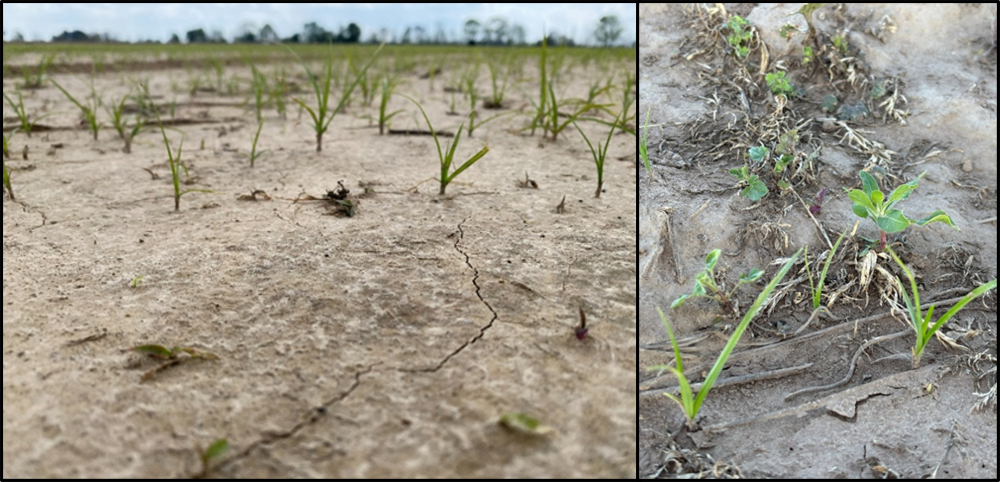
This week there have been a lot of calls regarding small emerging summer annual weeds in fields that are otherwise ready to plant. The number one weed by far has been annual sedge and yellow nutsedge as seen in the photos. These calls would be pretty easy to answer by just recommending some Permit product like Gambit be added to a preplant burndown of either Roundup or Gramoxone depending on what other weeds are there. However, many of these fields are known to have some difficulties or resistant populations of sedges so consultants are worried that the standard fix may not work. Another good option is Sharpen at around 2-3 oz/acre. If you check page 22 of the new MP44 you will see that by good I mean about a “7” not too many good burndown options for this weed. I would probably go ahead and use a combination of Sharpen and Gambit with Roundup because we still get some control from Gambit and this combo offers broad spectrum broadleaf control with some residual to go along with grass control with Command. Other 7’s with no plant-back issues include FirstShot and Roundup plus Liberty.
At the time I am writing this we have some rain coming in this weekend. This is much needed. Some of you are putting your residuals out in front of this rain and the plan is to plant back into moist soil. This is OK with me. Just remember the clock starts running on how long Command and other products will last when they go out and get activated not when we plant. If you are struggling with resistant sedge and barnyardgrass this might create a great scenario to get some Bolero Delayed PRE either alone or with Prowl into your program early on moist soils, a true delayed PRE, we don’t have much resistance to Bolero and it is currently underutilized in my opinion especially on troublesome fields.
PSA: Please pay attention to what products you are using. There are several different “generic” formulations of some materials out there and the concentrations of active ingredients can vary greatly (e.g., Facet, Liberty, and many premixes). Always read the label for the material you’re using not the name brand.
Fig. 2. Early weeds emerged.
Market Update
Scott Stiles
Good Friday Commodity Trading Schedule:
- Friday, April 3: Grain and Energy markets were closed for Good Friday. Government offices are open. The CFTC Commitment of Traders report will be released Friday afternoon.
- CME Grains will reopen at 7:00 pm Central on Sunday night, April 5th.
Planting Progress:
Monday’s Crop Progress showed rice planting continuing to advance with the above normal temperatures and dry conditions seen last week. Louisiana had 2/3 of their crop planted as of March 29th compared to the 5-year average of 50% complete. Planting in Mississippi (8%), Arkansas (5%), and Missouri (1%) was also ahead of the 5-year average. Texas was 31% planted, slightly behind the average pace of 35 percent.
Table 2. Rice, Percent Planted, Week Ending March 29, 2026.
|
State (% planted) |
2026 |
2025 |
5-year avg. |
|---|---|---|---|
|
Arkansas |
5 |
7 |
3 |
|
Louisiana |
66 |
56 |
50 |
|
Mississippi |
8 |
10 |
2 |
|
Missouri |
1 |
0 |
0 |
|
Texas |
31 |
45 |
35 |
|
Source: USDA NASS, Crop Progress, March 30, 2026. |
|||
Grower calls and comments this week focused on the dry soil conditions and the need for weekend rain to materialize. Planting had stopped for some due to a lack of moisture. Urea prices in eastern Arkansas averaged $800/ton this week. Crude oil and diesel futures turned higher in Thursday’s trading session with the lead months back above $110/bbl and $4.40/gallon respectively— both at 4-year highs.
2026 Rice Acreage Estimates:
The Prospective Plantings, released on March 31st, is one of the most anticipated USDA reports of the year. The survey confirmed a sharp decline in 2026 rice acres. Industry analysts expected total U.S. rice acres to be in a wide 600,000-acre range of 2.3 to 2.9 million. The average pre-report guess was 2.663 million, compared to 2.812 last year. Total rice acres came in at the low end of estimates at 2.319 million; down 493,000 or 18% from 2025.
Table 3. U.S. and Arkansas Rice Acres, 2026 Prospective Plantings and 2025 Final.
|
(million acres) |
Mar. 31, 2026 |
Avg. Pre-Report Estimate |
Range of Estimates |
2025 |
|
U.S.: |
|
|
|
|
|
Total Rice |
2.319 |
2.663 |
2.300 – 2.900 |
2.812 |
|
Long-Grain |
1.648 |
|
|
2.118 |
|
Medium Grain |
.640 |
|
|
.658 |
|
|
||||
|
Arkansas: |
|
|
|
|
|
Total Rice |
1.001 |
|
|
1.284 |
|
Long-Grain |
.900 |
|
|
1.180 |
|
Medium Grain |
.100 |
|
|
.103 |
Source: USDA NASS and private industry.
U.S. long grain acres at 1.648 million would be down 22% from last year and the lowest since 1983. Medium grain acres are projected to be down 3% to 640,000 acres. Arkansas’ total rice acres of 1.001 million would also be the lowest since 1983. Long-grain acres at 900,000 would be the lowest since 1987.
Fig. 3. 2026 Rice planted area, USDA-NASS.
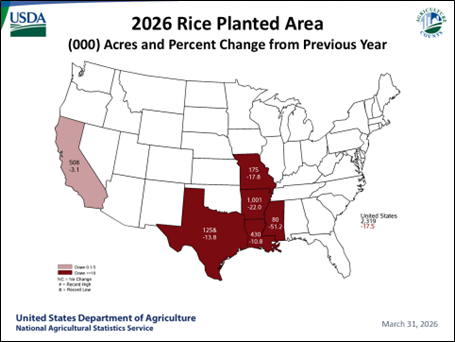
All states are expected to reduce rice acreage this year. Mississippi could have its’ lowest rice acreage since 1973 at 80,000. Texas’ rice acreage is expected to fall to the lowest level since records began in 1929 (125,000 acres).
Could final rice acres be lower than the March intentions? Keep in mind the survey for the Prospective Plantings ended March 17th. Fuel and fertilizer both continued to push higher through the remaining weeks of March. Will that divert more acres to soybeans? That question will be debated until we see the June 30th Acreage from NASS. Further confirmation will be in the August FSA acreage data.
Nevertheless, the Prospective Plantings findings will be used in the first 2026/27 supply/demand estimates, released on May 12th. For certain, the sizeable cut in long-grain acres points to a second consecutive year of sharply lower production. It appears today we’ll see the smallest long-grain crop since at least 2011 (which was 116.4 million cwt.).
Rice Stocks:
In addition to the Prospective Plantings, NASS also released the quarterly Rice Stocks report on March 31st. The Rice Stocks give us some insight into how much old crop rice is on hand and needs to move before the next harvest. Of particular interest, Arkansas growers were holding 12.9 million cwt. in on-farm storage as of March 1st. That’s not a record amount, but it is the highest in the last 11 years and up about 16% from a year ago.
Figure 4. Arkansas On-Farm Rice Stocks, March 1.
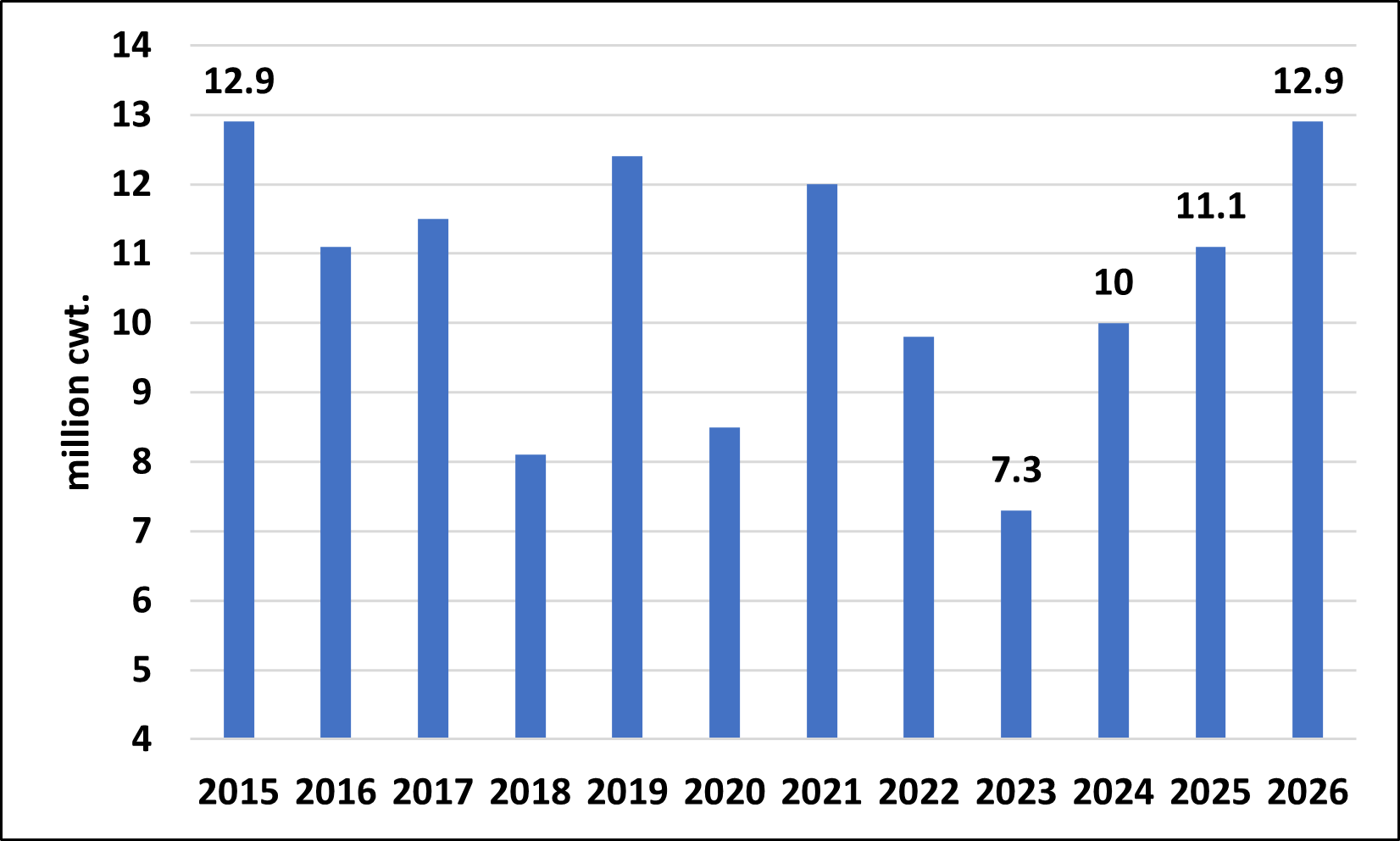
Source: USDA NASS, Rice Stocks, March 1, 2026.
Export Sales:
Good news to report here. For the week ending March 26th, long-grain rough rice sales were the second highest of the marketing year at 65,385 metric tons. Most of the total was a 62,000-ton sale to Mexico. If correct, that is not only the largest sale to Mexico this crop year but the largest sale to Mexico since August 2021. In addition, there was a 10,000-ton rough rice sale to Nicaragua and a 20,000-ton sale to Unknown. A cancellation of 26,764 tons by Colombia kept weekly sales from hitting a marketing year high.
Weekly long-grain milled sales came in at 10,091 tons. Haiti made up most of the total with 9,809 tons. Shipments totaled 15,835 tons for the week with Haiti taking in 13,609 tons. Iraq, our second largest milled rice market, has been absent since the week of November 20, 2025.
Farmer Bridge Assistance (FBA) Update:
Reminder: April 17, 2026 is the deadline to apply for FBA.
As of March 30th, USDA had disbursed $310 million in FBA payments to Arkansas producers. Rice accounted for $150.8 million (49%) of the total payments since enrollment opened February 23rd. The FBA payment rate for rice is $132.89 per planted acre.
More information on the Farmer Bridge Assistance Program can be found at this link: Farmer Bridge Assistance (FBA) Program.
Use the Arkansas Rice Advisor Internet App!
The Arkansas Rice Advisor site https://riceadvisor.uada.edu functions like an app on your mobile device. There you can readily access the DD50 program, rice seeding rate calculator, drill calibration, fertilizer and N rate calculators, publications, and more.
Additional Information
Arkansas Rice Updates are published periodically to provide timely information and recommendations for rice production in Arkansas. If you would like to be added to this email list, please send your request to rice@uada.edu.
This information will also be posted to the Arkansas Row Crops blog (http://www.arkansas-crops.com/) where additional information from Extension specialists can be found.
More information on rice production, including access to all publications and reports, can be found at http://www.uaex.uada.edu/rice.
Acknowledgements
We sincerely appreciate the support for this publication provided by the rice farmers of Arkansas and administered by the Arkansas Rice Research and Promotion Board.
The authors greatly appreciate the feedback and contributions of all growers, county agents, consultants, and rice industry stakeholders.
Specialist |
Area |
Phone Number |
|
|---|---|---|---|
|
Jarrod Hardke |
Rice Extension Agronomist |
501-772-1714 |
|
|
Tom Barber |
Extension Weed Scientist |
501-944-0549 |
|
|
Nick Bateman |
Extension Entomologist |
870-456-8486 |
|
|
Ralph Mazzanti |
Rice Verification Coordinator |
870-659-5507 |
|
|
Trent Roberts |
Extension Soil Fertility |
479-935-6546 |
|
|
Bob Scott |
Extension Weed Scientist |
501-837-0273 |
|
|
Scott Stiles |
Extension Ag Economics |
501-258-8455 |