Arkansas Rice Update 3-27-26
Arkansas Rice Update 2026-03
March 27, 2026
Jarrod Hardke, Scott Stiles, & Bob Scott
“All we are is dust in the wind.”
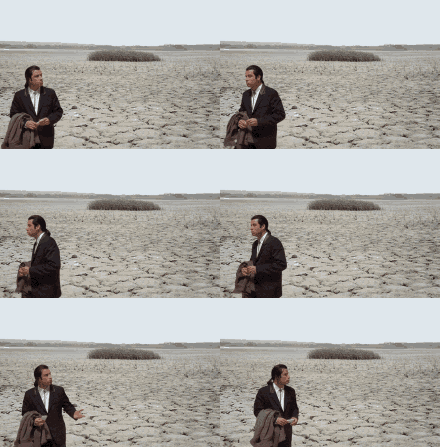
Time for a Change
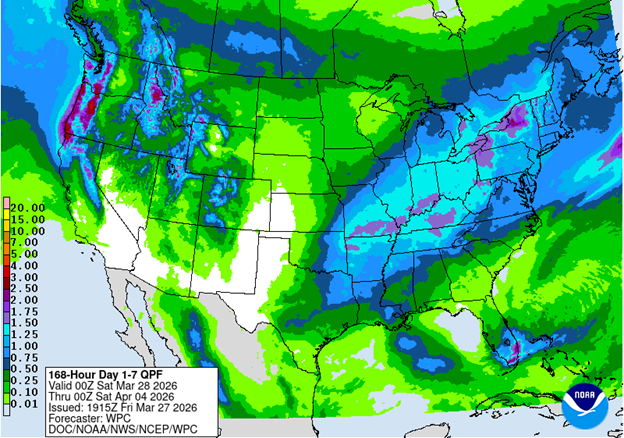
Saying we’re in need of a rain is putting it mildly. As of now there is rain forecast for the 1st of April. At this point we all want to see it before we believe it in this drought. Should it rain on the first, will we see 15 days of rain in April as the old saying goes? The majority sound ready to take whatever they can get so we have moisture for fieldwork, planting, and shutdown the dust and fire risk.
When it is getting too dry to even plant rice on already prepared ground, you know it’s dry. I’ve stopped at a few fields that have been planted in the past week and the rice is not sitting in moisture, it’s sitting in pebbles.
Not much has changed this week so fairly little to report. Just some continued planting progress. The lack of excitement for this year continues, and all eyes are pointed toward the Prospective Plantings report due out next week.
Read on below for more on the planting date performance, weeds, and markets.
Let us know if we can help.
Fig. 1. NOAA 7-day precipitation forecast.
Rice Management Guide Now Available
The 2026 Rice Management Guide publication is made possible by the growers of Arkansas through the Arkansas Rice Check-Off administered by the Arkansas Rice Research and Promotion Board and support from the University of Arkansas Division of Agriculture. It contains the most requested production recommendations for rice in a single, easy-to-reference PDF. It is now available for download, and printed copies will soon be available at local county Extension offices.
Rice Performance by Planting Date
Jarrod Hardke
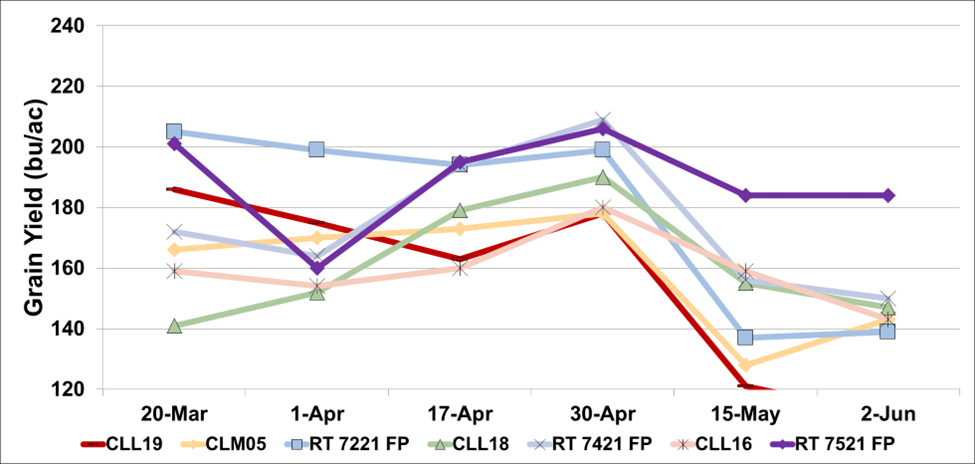
The figures below show the results of planting date studies in 2025. Due to some drift at one site, the figures only show Clearfield and FullPage lines since those were less impacted. Full results for these studies and other years can be found in the Arkansas Rice Performance Trials publication on the Rice Extension page HERE.
This is just a reminder that April is a great time to be planting rice in any part of the state. Late March is always good, but it can have its better and worse years. Late May into early June seems like it can have a good year every once in a while (2025 was one of those years). But ultimately April into early May continues to be primetime for rice performance.
Fig. 2. Average grain yield by planting date for selected cultivars at the Northeast Rice Research and Extension Center, Harrisburg, 2025.
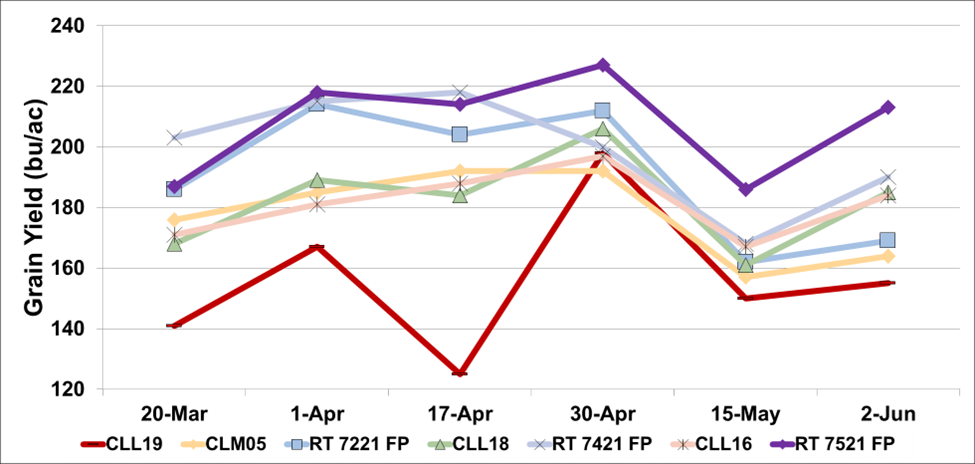
Fig. 3. Average grain yield by planting date for selected cultivars at the Rice Research and Extension Center, Stuttgart, 2025.
Bobbing and Weeding
Bob Scott
- Continue receiving calls on 2,4-D burndown applications and concern over planting back to rice. Plant-back intervals and dry conditions have got me a little spooked. Continue working on leveling ground and getting ready plant until we get some moisture. Wait at least 21 days before planting rice after 2,4-D if no rain is received.
- If planting now, either wait on rain chance before applying residual, or if spraying anyway be prepared to flush for activation.
- No update yet on Keenali Section 18. We wait…
Market Update
Scott Stiles
Planting Progress:
State level crop progress data released Monday showed rice planting is underway across the southern U.S. Louisiana is the furthest along and well ahead of average at 54% complete. Texas was 15% planted. Mississippi and Arkansas were both 1% planted as of March 22nd.
Table 1. Rice, Percent Planted, Week Ending March 22, 2026.
|
State (% planted) |
2026 |
2025 |
5-year avg. |
|---|---|---|---|
|
Arkansas |
1 |
2 |
1 |
|
Louisiana |
54 |
42 |
36 |
|
Mississippi |
1 |
1 |
0 |
|
Texas |
15 |
32 |
15 |
|
Source: USDA NASS, Crop Progress, March 23, 2026. |
|||
March 31 Prospective Plantings:
As a reminder, NASS will release their annual Prospective Plantings report on Tuesday, March 31st at 11:00 AM Central. The findings will lay the foundation for the new crop 2026/27 balance sheets. At this point the big question is not whether we see rice acres decline in 2026, but rather by how much. This month’s price spike in Urea and diesel has added even more uncertainty and speculation around rice acres. In addition to the Prospective Plantings report, NASS will also release the quarterly Grain Stocks and Rice Stocks reports on March 31st. Links to these USDA-NASS reports are below.
Grain Stocks
Prospective Plantings
Rice Stocks
Export Sales:
Thursday’s Export Sales provided nothing exciting for rice. USDA reported net sales of 13,204 tons of long-grain rough rice and 829 tons of long-grain milled in the week ending March 19th. Honduras, Mexico, and El Salvador were the only rough rice buyers for the week. Rough rice shipments totaled 7,350 tons, with Mexico and El Salvador the only two destinations. In total, cumulative ‘25/’26 long-grain sales are close to 30% behind this time last year. USDA’s current 54 million cwt. export target for long-grain implies an 11% year-to-year decline in exports. This is a key number to watch as it has implications for new crop Beginning Stocks. The next USDA WASDE report is scheduled for April 9th. WASDE Report | USDA
New Crop Futures:
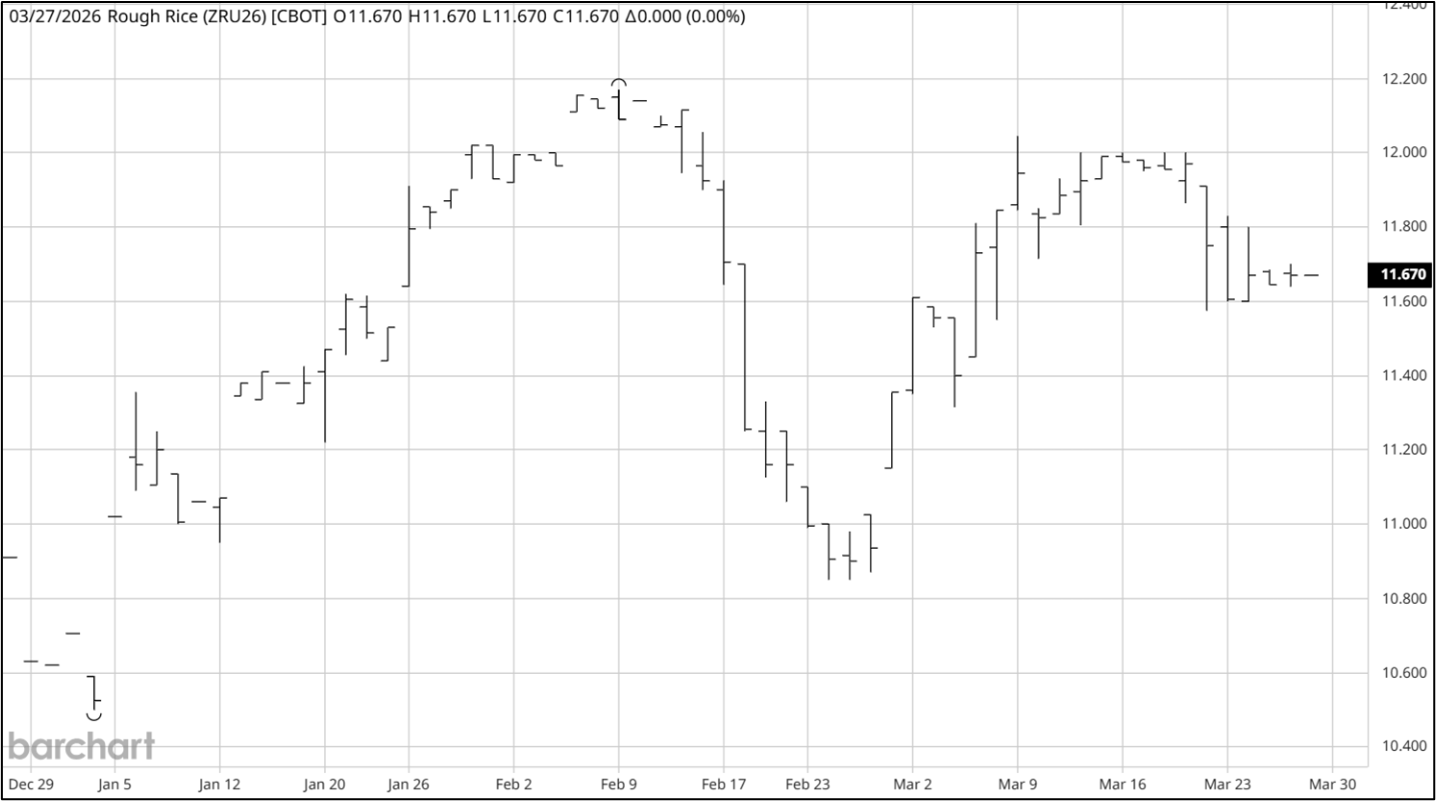
Turning to the technical aspects of the market, we saw a sharp sell-off in rice last Friday (3/20) on strong volume and increasing open interest. This has kept the market on defense. However, the September contract did find support this week at $11.60 and waits for next Tuesday’s Prospective Plantings.
Figure 4. September 2026 Rice Futures, Daily Chart.
Pre-Report U.S. Acreage Estimates:
Private acreage estimates began to circulate this week. For total U.S. rice acreage, industry analysts see 2026 acres in a range of 2.3 to 2.9 million, compared to 2.812 last year. The average trade guess is 2.663 million, which is a modest 149,000 acre or -5.3% decline. The lowest trade guess of 2.3 million acres amounts to a 512,000 acre or -18.2 % drop from last year.
Table 2. USDA 2026 Prospective Plantings, Pre-Report Industry Estimates.
|
(million acres) |
Avg. Estimate |
Range of Estimates |
Last Year |
|---|---|---|---|
|
U.S. Total Rice |
2.663 |
2.300 – 2.900 |
2.812 |
Source: private industry.
These estimates, which do point to lower 2026 rice acres, seem very conservative. It’s possible we see a bullish surprise in next Tuesday’s Prospective Plantings. If not, the February 27th chart gap down at $11.02 ½ to $11.15 could get refilled before the rice market takes a seasonal turn higher in April.
Farmer Bridge Assistance (FBA) Update:
Reminder: April 17, 2026 is the deadline to apply for FBA. More information on the Farmer Bridge Assistance Program can be found at this link: Farmer Bridge Assistance (FBA) Program
As of March 22nd, USDA had disbursed almost $305 million in FBA payments to Arkansas producers. Rice payments make up nearly $150 million (49%) of the total payments since enrollment opened February 23rd. The FBA payment rate for rice is $132.89 per planted acre.
Use the Arkansas Rice Advisor Internet App!
The Arkansas Rice Advisor site https://riceadvisor.uada.edu functions like an app on your mobile device. There you can readily access the DD50 program, rice seeding rate calculator, drill calibration, fertilizer and N rate calculators, publications, and more.
Additional Information
Arkansas Rice Updates are published periodically to provide timely information and recommendations for rice production in Arkansas. If you would like to be added to this email list, please send your request to rice@uada.edu.
This information will also be posted to the Arkansas Row Crops blog (http://www.arkansas-crops.com/) where additional information from Extension specialists can be found.
More information on rice production, including access to all publications and reports, can be found at http://www.uaex.uada.edu/rice.
Acknowledgements
We sincerely appreciate the support for this publication provided by the rice farmers of Arkansas and administered by the Arkansas Rice Research and Promotion Board.
The authors greatly appreciate the feedback and contributions of all growers, county agents, consultants, and rice industry stakeholders.
Specialist |
Area |
Phone Number |
|
|---|---|---|---|
|
Jarrod Hardke |
Rice Extension Agronomist |
501-772-1714 |
|
|
Tom Barber |
Extension Weed Scientist |
501-944-0549 |
|
|
Nick Bateman |
Extension Entomologist |
870-456-8486 |
|
|
Ralph Mazzanti |
Rice Verification Coordinator |
870-659-5507 |
|
|
Trent Roberts |
Extension Soil Fertility |
479-935-6546 |
|
|
Bob Scott |
Extension Weed Scientist |
501-837-0273 |
|
|
Scott Stiles |
Extension Ag Economics |
501-258-8455 |