Arkansas Rice Update 3-20-26
Arkansas Rice Update 2026-02
March 20, 2026
Jarrod Hardke, Scott Stiles, Nick Bateman, Ben Thrash, & Bob Scott
“I’ve had choices, since the day that I was born.”

Load the Wagon
It seems folks are raring to get started. I guess it’s like the saying on the TV show Yellowstone “may as well do it fast, there’s less time for things to go wrong.”
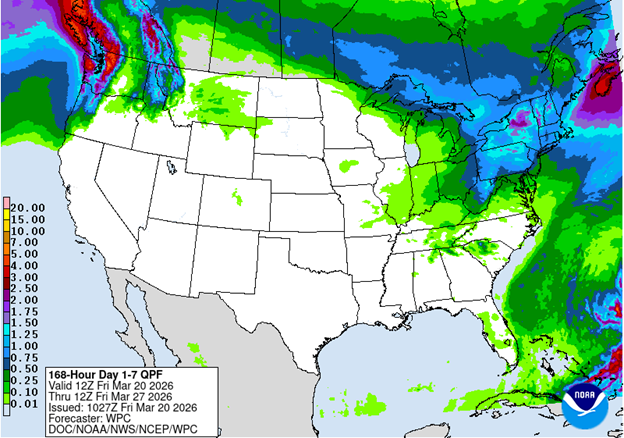
Planting has officially begun in the state, with drills rolling on March 19 in multiple areas of the state. The extended forecast appears wide open for progress with little to no rainfall chances. The temperatures may be a little of a rollercoaster, but not unusual for late March.
With planting getting started and no rain in sight, some conversations have centered around residual herbicide applications. Burndown applications need to happen at planting for existing weed pressure, but applying residuals is trickier. I’m typically a strong proponent of getting planted, levees up, and residual down. With no rain, meaning no chemical activation, we’re unlikely at the moment to get much out of residuals. Waiting until closer to a rain chance may help us get the most out of the cost of our residual herbicides. The current 10+ days of no rain forecast leaves little chemical left for activation if it goes out now, so choose wisely on your herbicide expense. And if we end up flushing to get a stand, be sure to put the herbicide out in front of the flush.
Courier Section 18 Update
Arkansas (and other states) has received a Section 18 emergency exemption for the use of Courier insecticide to control rice delphacid. We’ll share more information on the label, rates, etc. further along in the season.
Keenali Section 18 Update
The public comment period has closed for the proposed Section 18 for Keenali for the 2026 use season. We are now waiting on a final decision from the EPA and will keep you informed as soon as we know more. Thank you for those who took the time to write a comment!
Read on below for more on the Rice Management Guide, weed management survey, plant-back intervals, insecticide seed treatments, and markets.
Let us know if we can help.
Fig. 1. NOAA 7-day precipitation forecast.
Rice Management Guide Now Available
The 2026 Rice Management Guide publication is made possible by the growers of Arkansas through the Arkansas Rice Check-Off administered by the Arkansas Rice Research and Promotion Board and support from the University of Arkansas Division of Agriculture. It contains the most requested production recommendations for rice in a single, easy-to-reference PDF. It is now available for download, and printed copies will soon be available at local county Extension offices.
Rice Weed Management Survey
The weed science program is asking for your help to identify key areas of research need and current practices in rice weed control. Your opinion is important to us and will help direct where we spend Rice Check-Off funds. Your support is greatly appreciated.
The below link and QR code will take you to the rice weed management survey. The survey will take approximately 10-15 minutes to complete.
https://uaex.co1.qualtrics.com/jfe/form/SV_3aqPEHhXNm5WEyG
Fig. 2. Rice Grower Survey.

Herbicide Plant-Back Restrictions
Jarrod Hardke and Bob Scott
As we gear up for planting, some fields have been sprayed with burndown applications recently. A few notable plant-back intervals to rice for our burndown herbicides are included in Table 1. For additional information see MP519 Row Crop Plant-Back Intervals for Common Herbicides.
Table 1. Notable burn-down herbicides with plant-back intervals to rice.
|
Herbicide |
Plant-Back Interval for Rice |
|---|---|
|
2,4-D1 |
21 days |
|
Dicamba2 |
22 days |
|
Elevore |
14 days |
|
Goal |
10 months |
|
Leadoff |
10 months |
|
Metribuzin |
12 months |
|
Python |
6 months |
|
Reviton |
90 days |
|
Select Max |
30 days |
|
Valor / Afforia |
30 days |
|
Zidua SC (3.25 oz) |
12 months |
1 Following 1 in. of rainfall.
2 Plant-back days are rate dependent, days presented are for lowest labeled rate.
Always read and follow label directions.
Benefits of Insecticide Seed Treatments in Rice
Nick Bateman and Ben Thrash
There have been numerous calls over the past week or so around insecticide seed treatments and if we can cut them out to save a few dollars. With current prices everyone is looking for areas to save money, but seed treatments shouldn’t be one of them. Insecticide seed treatments, particularly neonicotinoid seed treatments (CruiserMaxx and NipsIt Inside) not only provide insect protection but many other benefits such as seedling vigor and reduction of plant injury from herbicide drift.
CruiserMaxx and NipsIt are the only consistent control option we have for grape colaspis. It seems over the past several years we have forgotten how damaging grape colaspis can be due to the number of acres that are treated with one of these two neonics. If you are in a soybean/rice rotation, grape colaspis is always a major threat, especially on lighter soils. Folks have asked about increasing seeding rate to overcome grape colaspis damage, but this isn’t an efficient economic option.
Let’s not forget about rice water weevil either. This is the number one pest of flooded rice we deal with. While grape colaspis is typically relegated to lighter soil textures, rice water weevils are not. Neonics can be highly effective on rice water weevils; however, it is dependent on how many days are between planting and flood. The longer this time window gets, the less control we get. The diamide seed treatments Dermacor and Fortenza have a much longer residual and perform very well on rice water weevil.
Over the past 8 years we have talked a lot about combinations of insecticide seed treatments and the benefits of combining different seed treatments for control of grape colaspis and rice water weevil. We have been comparing combinations of a neonicotinoid seed treatment with a diamide seed treatment. With combinations of one of the neonics and one of the diamide seed treatments we consistently see an increase in control of rice water weevil, better yields, and increased net returns compared to a neonic or diamide alone (Table 2). We have seen some increased control when combining CruiserMaxx and NipsIt, but it is less consistent than combinations including a diamide seed treatment.
Another question we have been asked a lot recently is: Do I need this combination on every acre? The short answer is no, but it’s dependent on multiple factors. Planting date and soil texture are the two biggest factors in making this decision.
For rice planted in April, that is more likely to sit in the ground longer and take longer to get to flood, the addition of one of the diamide seed treatments will help tremendously with rice water weevil control. In this planting window there is a much higher likelihood of the neonic seed treatments running out of gas before the flood is applied, which will lead to reduced control for rice water weevil. For rice planted in May, a neonic seed treatment will typically suffice. At this point, rice is usually coming out of the ground quickly and we can manage to get to flood within the 28-35 day window that the neonics last.
Soil texture is another major factor to consider when making seed treatment choices. Soil texture will dictate whether or not grape colaspis will be a concern. Grape colaspis do not occur in heavy clay soil, which is typical rice ground in large portions of Northeast and Southeast Arkansas. In these areas a diamide seed treatment for April plantings, or neonic seed treatment for May plantings should suffice. Grape colaspis is very likely to be found in our finer, loamier soils throughout the Grand Prairie and White River regions, so regardless of planting date we have to have one of the neonic seed treatments on our seed to protect it.
The addition of a diamide seed treatment provides other benefits than just rice water weevil control. This chemistry is excellent on caterpillar pests. We have observed control of fall armyworm 80 days after planting with both diamides. This could have been highly beneficial for a lot of folks last year. We have also observed decreased feeding from rice billbug and increased yields in row rice when combinations of insecticide treatments are used. We are seeing an uptick in rice billbug pressure as we continue to maintain a large row rice footprint in the state. We would suggest if you are planting row rice to add a diamide to your seed.
The bottom line is we need seed treatments in rice to stay profitable, and while it may cost more money, combinations of insecticide seed treatments will pay for themselves in early planted in rice. We can still see benefits in later planted rice from the combinations, but in most cases they are not needed. Production prices are extremely high right now, so we need to be mindful of how we spend our money and be sure to put these combinations of insecticide seed treatments where they belong. At a minimum this year a neonic seed treatment needs to be used. If we want to protect every bushel possible from soil insects a combination of both a neonic and diamide is recommended.
Table 2. Rice water weevil control, yield benefits, and net returns with insecticide seed treatments in rice, 2018-2024.
|
Insecticide Seed Treatment |
RWW† Control |
Yield‡ |
Net Returns§ |
|---|---|---|---|
|
Fungicide Only |
30.7 a |
182.9 e |
910.1 d |
|
CruiserMaxx Rice |
15.4 b |
200.6 bcd |
1001.9 abc |
|
NipsIt Inside |
13.7 bc |
197.7 d |
993.6 bc |
|
Dermacor X-100 |
6.0 d |
203.6 abc |
1017.3 abc |
|
CruiserMaxx Rice + Dermacor X-100 |
5.9 d |
208.5 a |
1031.2 a |
|
NipsIt Inside + Dermacor X-100 |
7.6 d |
205.4 ab |
1020.1 abc |
|
Fortenza |
5.7 d |
202.4 bcd |
1010.7 abc |
|
CruiserMaxx Rice + Fortenza |
6.3 d |
204.5 abc |
1011.0 abc |
|
NipsIt Inside + Fortenza |
5.9 d |
205.5 ab |
1024.0 ab |
|
CruiserMaxx Rice + NipsIt Inside |
9.8 cd |
199.8 cd |
989.4 c |
|
p-value |
<0.01 |
<0.01 |
<0.01 |
Means followed by the same letter are not significantly different at an alpha level of 0.05
†Rice water weevil/3 cores
‡Bushels/acre
§USD/acre
Market Update
Scott Stiles
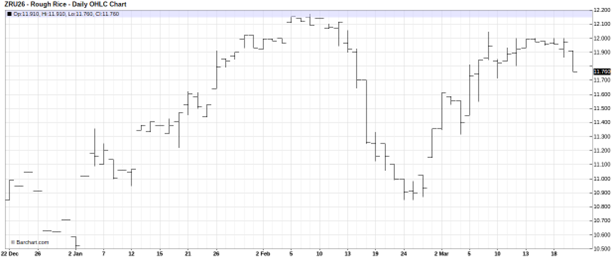
These days you look for good news wherever you can find it. September rice futures have pushed higher over the past month, rallying about $1.15/cwt. from the February lows. That’s about where the good news ends. The rally is running into strong resistance at $12 this week (basis the September contract). In trading early Friday morning, we were seeing that resistance hold with the market pulling back about 27 cents.
Figure 3. September 2026 Rice Futures, Daily Chart.
In Monday’s Crop Progress, Louisiana was the only state showing up with rice planted. They are off to the races according to NASS with 45% planted v. 16% last year and 16% on average. Some planting is getting underway this week in Arkansas.
In Thursday’s Export Sales, USDA reported net sales of 34,246 tons of long-grain rough rice and 11,500 tons of milled rice in the week ending March 12th. Honduras, Mexico, and Guatemala were the top rough rice buyers for the week. Rough rice shipments of 31,695 tons were the highest since last November. In total, cumulative ‘25/’26 long-grain sales remain about 28% behind this time last year. This is making USDA’s 54 million cwt. export target look more difficult to achieve, especially with South American rice still $80 to $100/ton below the U.S.
Crop Margins
Looking forward, the rice market appears more optimistic for the ‘26/’27 balance sheet as new crop futures are trying to work higher. Unfortunately, sharp increases in key inputs are more than offsetting the past month’s strength in rice futures. This is keeping the acreage debate alive.
Since the Iran war began, projected 2026 operating margins for all crops have shifted. How much will the recent increases in Urea and diesel prices affect rice budgets? Since March 1, the average retail price of Urea has increased about 30% and diesel prices have now increased more than 60%.
Each week, we survey input dealers around the state for fertilizer prices. Since early March, we’ve seen little movement in potash and phosphate prices. However, the most significant price changes have occurred in Urea. The figure below includes a weekly average of Urea and farm diesel prices in eastern Arkansas.
Fig. 4. Arkansas Weekly Average Urea and Farm Diesel Prices.
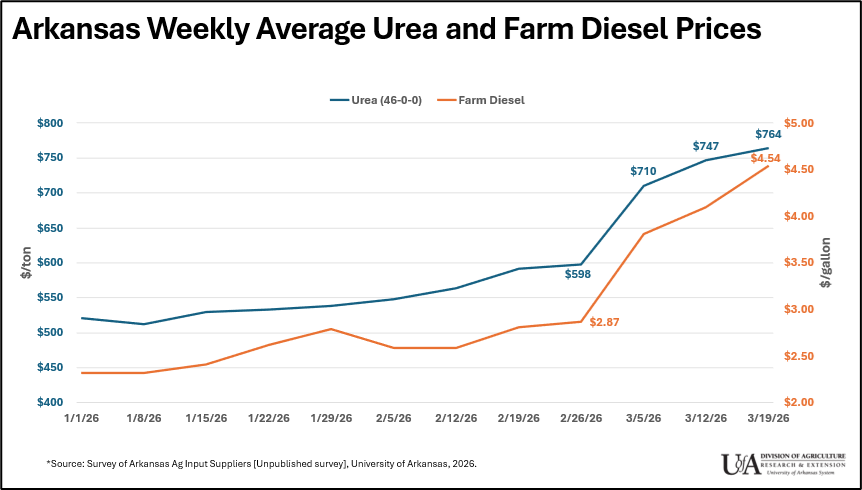
Based on input use estimates in the University’s crop budgets, the recent surge in fuel and fertilizer prices would increase rice production costs by about $97 per acre compared to a month ago. As mentioned earlier, rice prices have also improved with new crop rice bids up about 26 cents per bushel or about 5% since the end of February. Assuming a 200-bushel rice yield, the past month’s price gains equate to about $52 per acre—falling short of covering the increases in fertilizer and fuel prices.
Whether fuel and fertilizer prices continue to increase or pull back depends largely on how soon the supply disruptions in the Middle East are alleviated. For now, we have a problem. This week, farm organizations across the country, US Rice Producers Association and USA Rice included, sent a letter to the Trump administration proposing a new round of assistance for ag producers as part of a defense supplemental request for funding the war with Iran. Link: Letter to President Donald Trump. Farm groups noted that as planting began, “the closure of the Strait of Hormuz sent fuel and fertilizer prices skyrocketing” – further straining the farm economy.
The letter doesn’t specify how much additional money farmers need, but lawmakers have already been discussing $15 billion in new farm aid to supplement the $12 billion Farmer Bridge Assistance Program that USDA funded through its Commodity Credit Corporation spending authority.
Farmer Bridge Assistance (FBA) Update:
As of March 14th, USDA had disbursed almost $292 million in FBA payments to Arkansas producers. Rice payments made up nearly $144 million (49%) of the total payments since enrollment opened February 23rd. More information on the Farmer Bridge Assistance Program can be found at this link: Farmer Bridge Assistance (FBA) Program.
Use the Arkansas Rice Advisor Internet App!
The Arkansas Rice Advisor site https://riceadvisor.uada.edu functions like an app on your mobile device. There you can readily access the DD50 program, rice seeding rate calculator, drill calibration, fertilizer and N rate calculators, publications, and more.
Additional Information
Arkansas Rice Updates are published periodically to provide timely information and recommendations for rice production in Arkansas. If you would like to be added to this email list, please send your request to rice@uada.edu.
This information will also be posted to the Arkansas Row Crops blog (http://www.arkansas-crops.com/) where additional information from Extension specialists can be found.
More information on rice production, including access to all publications and reports, can be found at http://www.uaex.uada.edu/rice.
Acknowledgements
We sincerely appreciate the support for this publication provided by the rice farmers of Arkansas and administered by the Arkansas Rice Research and Promotion Board.
The authors greatly appreciate the feedback and contributions of all growers, county agents, consultants, and rice industry stakeholders.
Specialist |
Area |
Phone Number |
|
|---|---|---|---|
|
Jarrod Hardke |
Rice Extension Agronomist |
501-772-1714 |
|
|
Tom Barber |
Extension Weed Scientist |
501-944-0549 |
|
|
Nick Bateman |
Extension Entomologist |
870-456-8486 |
|
|
Ralph Mazzanti |
Rice Verification Coordinator |
870-659-5507 |
|
|
Trent Roberts |
Extension Soil Fertility |
479-935-6546 |
|
|
Bob Scott |
Extension Weed Scientist |
501-837-0273 |
|
|
Scott Stiles |
Extension Ag Economics |
501-258-8455 |