Arkansas Rice Update 3-13-26
Arkansas Rice Update 2026-01
March 13, 2026
Jarrod Hardke, Scott Stiles, & Trent Roberts
“Good times, bad times, you know I've had my share.”

Sinking Feeling
Death, taxes, and lower rice acres. These things are certain, but the details matter.
Focusing on the lower rice acres, there are a lot of numbers being tossed out there, and frankly it’s hard to argue with anyone’s estimate. The wide range of individual, farm-based decisions make this a whirlwind to forecast.
In December, and even into the first part of this year, it seemed like we could circle 1 million acres for Arkansas. How the months leading up to planting, and planting weather, worked out would see whether we got to at least 1 million or landed just under. Events over the past few weeks have skewered that idea. The last time Arkansas planted fewer than 1 million acres was 1983 (PIK year) when we planted 925,000 acres.
It is beginning to look like we may not hit that number – and I’m now looking toward 900,000 total acres. Of that, 120,000-150,000 acres will be medium-grain, so only 750,000 acres of long-grain. Unfortunately, this is the kind of correction we need given our oversupply situation.
The Arkansas situation is enough of a wild guess, but the same can be said for other states. Generally speaking, everyone will be down, it just continues to be a question of how much. It’s possible that we see the lowest U.S. total planted rice acres since 1972.
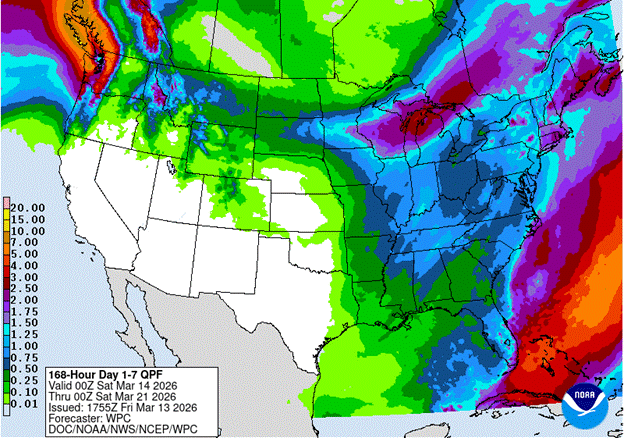
The upcoming forecast still has some rain mixed in, but a warmer weather picture by the end of next week could be ready to kickstart the year into next weekend. We’ll see what the extended forecast holds at that point and have a clearer picture on when planting will take off.
Let us know if we can help.
Fig. 1. NOAA 7-day precipitation forecast.
Tetflupyrolimet Comment Period Closes March 16
The Environmental Protection Agency (EPA) currently has a 15-day comment period open for Tetflupyrolimet (Keenali) Section 18 emergency use for herbicide-resistant barnyardgrass control in rice. If you believe this is a critical need for barnyardgrass control in Arkansas, please take the time to make a comment. The following link will take you to the EPA website: https://www.federalregister.gov/documents/2026/02/27/2026-03939/tetflupyrolimet-receipt-of-applications-for-emergency-exemption-solicitation-of-public-comment.
A few items to note about the submission that differ from what is published on the website:
- The notice reflects the original acreage request, but Arkansas’ revised application limits the request to 50,000 acres.
- The notice states two applications at 8.6 fl oz which is incorrect. The request should allow for two applications at 4.3 fl oz/A on a silt loam soil, or a single application of 8.6 fl oz/A on heavy soil, no acre should receive more than the seasonal max use limit of 8.6 fl oz/A. The gallons listed in the notice correspond correctly to two applications at 4.3 fl oz/A or a single application of 8.6 fl oz/A on the original acreage request.
- The notice lists Missouri as an applicant but they have withdrawn their Section 18 request and are not part of the current submission.
When it comes to fertilizer, something is ALWAYS better than nothing.
Trent Roberts
Bad to Worse? Just when we thought things couldn’t get any worse, they did. Current urea futures are trading at levels not seen since 2022 when they reached their peak post COVID-19. Other nutrient inputs such as P and K are also showing some price increases, but not to the same extent as urea. With uncertainty in the fertilizer markets, even with current prices it can be difficult to carve out enough money to support a standard fertility program.
For most silt loam soils in Arkansas, rice is going to require ~150-60-90 (N-P2O5-K2O) based on soil test results. Although every field is different and some may require more or less fertilizer, this is a standard “baseline” that will optimize yield on most silt loam soils. Preplant P, K, and potentially Zn can be significant input costs for rice producers, but much like other input costs you cannot afford not to apply them when you consider all of the other input costs such as seed, herbicide, labor, irrigation, etc. In this week’s article we will focus on preplant P and K management.
Phosphorus
Phosphorus is one of the hardest nutrients to manage in a production system and its availability in the soil is strongly influenced by soil pH. As a general rule of thumb, lower pH soils (<6.5) will require less P-fertilizer than higher pH soils (>6.5) with similar soil test P levels. Please keep this in mind when looking at cutting back on P-fertilizer – high pH soils require greater P-fertilizer inputs. High pH soils are not the best areas to make drastic cuts to P-fertilizer.
For fields with soil test P <17 ppm, keep in mind that a 180 bu/acre rice crop will remove about 55 lb P2O5/acre and a 220 bu/acre rice crop will remove about 66 lb P2O5/acre. If you consider just replacing what you are removing that requires around 50-70 lb P2O5/acre and you will need this P fertilizer to maximize yield potential. If you are one of the lucky few that has soil test P >17 you might be able to get by without any P-fertilizer at all but remember crop removal and that you will have to pay the piper at some point. The best time to apply P-fertilizer is as close to planting as possible up until flooding. Once the permanent flood is applied, the ability of rice to fully recover from P-deficiency diminishes.
Potassium
Most non-clay soil in Arkansas will require some level of K-fertilizer in order to maximize yield. Potassium availability is not influenced by soil pH and soil test K is a great predictor of K-fertilizer needs. Potassium deficiency is much easier to correct in-season, and we can recover full yield potential with applications as late as the early boot growth stage. Therefore, consider starting with the Economic Potash Rate Calculator (PRC- https://agribusiness.uark.edu/decision-support-software.php) that combines soil test K level, rice grain price, and fertilizer cost to predict the most economical potash rate. This is a great baseline starting point knowing that if conditions improve (rice value increases or fertilizer costs decrease) you will have ample opportunity to add more if needed. Additionally, advances in tissue testing post-flood can help producers identify areas where potash may be deficient and aid in making management decisions.
“I’ll take $5 on pump 3.” We’ve all been in tight spots when it comes to having extra money to spend. Under current conditions we might not be able to fill the tank, but every little bit helps when it comes to plant nutrition. ¼ tank is better than an empty tank.
Zinc Seed Treatments
Jarrod Hardke
There are plenty of zinc (Zn) seed treatment options out there for rice, but they’re not all equal. If you’re planting rice seed this year that doesn’t come pre-treated and you pick what you want on it, know what you’re getting with Zn seed treatments.
We recommend 0.25 to 0.5 lb Zn per hundredweight (cwt / 100 lbs) of rice. There has been a shift in recent years to using Zn seed treatment products that have better flowability and are therefore easier to run through seed treating equipment. There’s just one problem – often this increased flowability is because it contains less Zn. Meaning it may be easier to put on, but you’re getting less Zn out of it. These products that are more flowable are usually EDTA (chelated) forms – which past research has shown can provide the same benefits as Zn Oxide formulations in supplying Zn nutrition to the rice, BUT Zn EDTA forms can cause shortened roots and shoots meaning greater chance of stand failure.
So, a Zn EDTA formulation that is 11.43 lb/gal weight and 6% Zn will only provide 0.05 lb Zn/cwt at a 10 oz/cwt rate. A Zn Oxide formulation that is 12.35 lb/gal weight and 32.5% Zn will provide 0.31 lb Zn/cwt at a 10 oz/cwt rate. A Zn Oxide formulation that is 13.94 lb/gal weight and 36% Zn will provide 0.39 lb Zn/cwt at a 10 oz/cwt rate.
Understanding the source/rate combination effect on the actual Zn applied to the seed is very important to ensure you are getting an adequate amount of Zn to aid the rice crop.
Market Update
Scott Stiles
Changes in USDA’s March WASDE were minimal across all crops. For long-grain, offsetting changes were made to the 2025/26 balance sheet with a 2 million cwt. reduction in imports and a 2 million cwt. reduction in exports. USDA noted imports from Thailand were trailing last year’s record volume. A reduction in exports was justified as rough rice sales to Mexico and other key markets in Central America are well below last year. With exports now projected at 54 million cwt., this equates to an 11% drop from a year ago. Unless sales pick up momentum, a further reduction in exports may be warranted as weekly sales in the final week of February were roughly 30% behind the 2024/25 sales pace. Long-grain ending stocks were unchanged at 36.6 million cwt. The long-grain season-average farm price (SAFP) was unchanged at $10.50 per cwt. ($4.73/bu.).
Table 1. U.S. Long-Grain Supply and Demand.
|
U.S. Long-Grain Supply and Demand |
2025/26 |
monthly change |
||
|---|---|---|---|---|
|
unit: million cwt. |
2024/25 |
February |
March |
|
|
Beginning Stocks |
19.3 |
37.30 |
37.30 |
0.0 |
|
Production |
172 |
153.3 |
153.3 |
0.0 |
|
Imports |
42.7 |
41.0 |
39.0 |
(2.0) |
|
Total Supply |
234 |
231.6 |
229.6 |
(2.0) |
|
Domestic Use |
135.8 |
139 |
139 |
0.0 |
|
Exports |
60.8 |
56 |
54 |
(2.0) |
|
Total Use |
196.6 |
195.0 |
193.0 |
(2.0) |
|
Carry-Over |
37.3 |
36.6 |
36.6 |
0.0 |
|
stocks-use % |
19.0% |
18.8% |
19.0% |
|
|
Avg. Producer Price ($/cwt.) |
$ 14.00 |
$ 10.50 |
$ 10.50 |
$ - |
|
Avg. Producer Price ($/bu.) |
$ 6.30 |
$ 4.73 |
$ 4.73 |
$ - |
|
PLC Reference Price ($/bu.) |
$ 6.30 |
$ 7.61 |
$ 7.61 |
$ - |
|
Proj. PLC Payment Rate ($/bu.) |
$ - |
$ 2.89 |
$ 2.89 |
$ - |
Source: USDA, WASDE, March 2026.
The only change this month to the U.S. medium-grain balance sheet was the 2025/26 SAFP for the Southern states. It increased $0.40 per cwt to $14.20 ($6.39/bu.).
The March outlook for 2025 PLC payment rates is $2.89 per bushel for long-grain and $1.22 per bushel for Southern medium-grain.
Table 2. U.S. Medium-Grain Supply and Demand.
|
U.S. Medium-Grain Supply and Demand |
2025/26 |
|||
|---|---|---|---|---|
|
unit: million cwt. |
2024/25 |
February |
March |
m/m |
|
change |
||||
|
Beginning Stocks |
18.9 |
13.7 |
13.7 |
0.0 |
|
Production |
50.6 |
53.4 |
53.4 |
0.0 |
|
Imports |
6.6 |
6.7 |
6.7 |
0.0 |
|
Total Supply |
74.9 |
73.9 |
73.9 |
0.0 |
|
Domestic Use |
31.5 |
32 |
32 |
0.0 |
|
Exports |
29.7 |
31 |
31 |
0.0 |
|
Total Use |
61.2 |
63.0 |
63.0 |
0.0 |
|
Carry-Over |
13.7 |
10.9 |
10.9 |
0.0 |
|
stocks-use % |
22.4% |
17.3% |
17.3% |
0.0% |
|
Avg. Producer Price ($/cwt.) |
$ 15.00 |
$ 13.80 |
$ 14.20 |
$ 0.40 |
|
Avg. Producer Price ($/bu.) |
$ 6.75 |
$ 6.21 |
$ 6.39 |
$ 0.18 |
|
PLC Reference Price ($/bu.) |
$ 6.30 |
$ 7.61 |
$ 7.61 |
$ - |
|
Proj. PLC Payment Rate ($/bu.) |
$ - |
$ 1.40 |
$ 1.22 |
$ (0.18) |
Source: USDA, WASDE, March 2026.
The March 2026 WASDE Report can be found at this link: March 2026 WASDE Report
Reminder:
USDA FSA is processing applications for the Farmer Bridge Assistance (FBA) Program. Producers have until April 17, 2026, to submit their completed application. The payment rate for rice is $132.89 per planted acre. More details and information are available at this link: Farmer Bridge Assistance (FBA) Program.
The next big report from USDA will be the March 31 Prospective Plantings. It will be released at 11:00 a.m. Central and could certainly deliver some historic, market-moving news. Many in the rice industry believe we’ll revisit some acreage landmarks from the 1980’s. The last time total rice acreage in Arkansas went below 1 million was in 1983 (925,000). New crop rice futures made a brief return to $12/cwt on Monday. But, the sharp increase in diesel and Urea this month is offsetting the recent strength in the September rice contract. Plus, soybeans are gaining a lot of appeal with lower production costs and new crop bids above $11 per bushel. As input costs and commodity prices change, review your planting and marketing decisions. Our 2026 crop budgets can be found here: Crop Enterprise Budget | Arkansas crop budget resources.
Use the Arkansas Rice Advisor Internet App!
The Arkansas Rice Advisor site https://riceadvisor.uada.edu functions like an app on your mobile device. There you can readily access the DD50 program, rice seeding rate calculator, drill calibration, fertilizer and N rate calculators, publications, and more.
Additional Information
Arkansas Rice Updates are published periodically to provide timely information and recommendations for rice production in Arkansas. If you would like to be added to this email list, please send your request to rice@uada.edu.
This information will also be posted to the Arkansas Row Crops blog (http://www.arkansas-crops.com/) where additional information from Extension specialists can be found.
More information on rice production, including access to all publications and reports, can be found at http://www.uaex.uada.edu/rice.
Acknowledgements
We sincerely appreciate the support for this publication provided by the rice farmers of Arkansas and administered by the Arkansas Rice Research and Promotion Board.
The authors greatly appreciate the feedback and contributions of all growers, county agents, consultants, and rice industry stakeholders.
Specialist |
Area |
Phone Number |
|
|---|---|---|---|
|
Jarrod Hardke |
Rice Extension Agronomist |
501-772-1714 |
|
|
Tom Barber |
Extension Weed Scientist |
501-944-0549 |
|
|
Nick Bateman |
Extension Entomologist |
870-456-8486 |
|
|
Ralph Mazzanti |
Rice Verification Coordinator |
870-659-5507 |
|
|
Trent Roberts |
Extension Soil Fertility |
479-935-6546 |
|
|
Bob Scott |
Extension Weed Scientist |
501-837-0273 |
|
|
Scott Stiles |
Extension Ag Economics |
501-258-8455 |