General Nitrogen Management in Cotton
Nitrogen (N) management in cotton is one of the more nuanced decisions that a producer will make. The indeterminate growth habit of cotton (plant will exhibit overlapping vegetative and reproductive growth) makes N management challenging and can have significant impacts not only on yield, but profitability as well. Nitrogen is an essential plant element required for proteins and essential metabolic processes, and is often limiting in Arkansas production systems, meaning that without proper application rates and timings, cotton yield can be significantly reduced. Additionally, excess N applications to cotton can lead to excessive or “rank” growth, requiring additional plant growth regulators to curb or slow plant growth. Cotton is certainly a crop where excess vegetative growth does not translate to increased yield and oftentimes will result in significant yield reductions when excessive growth is not managed properly.
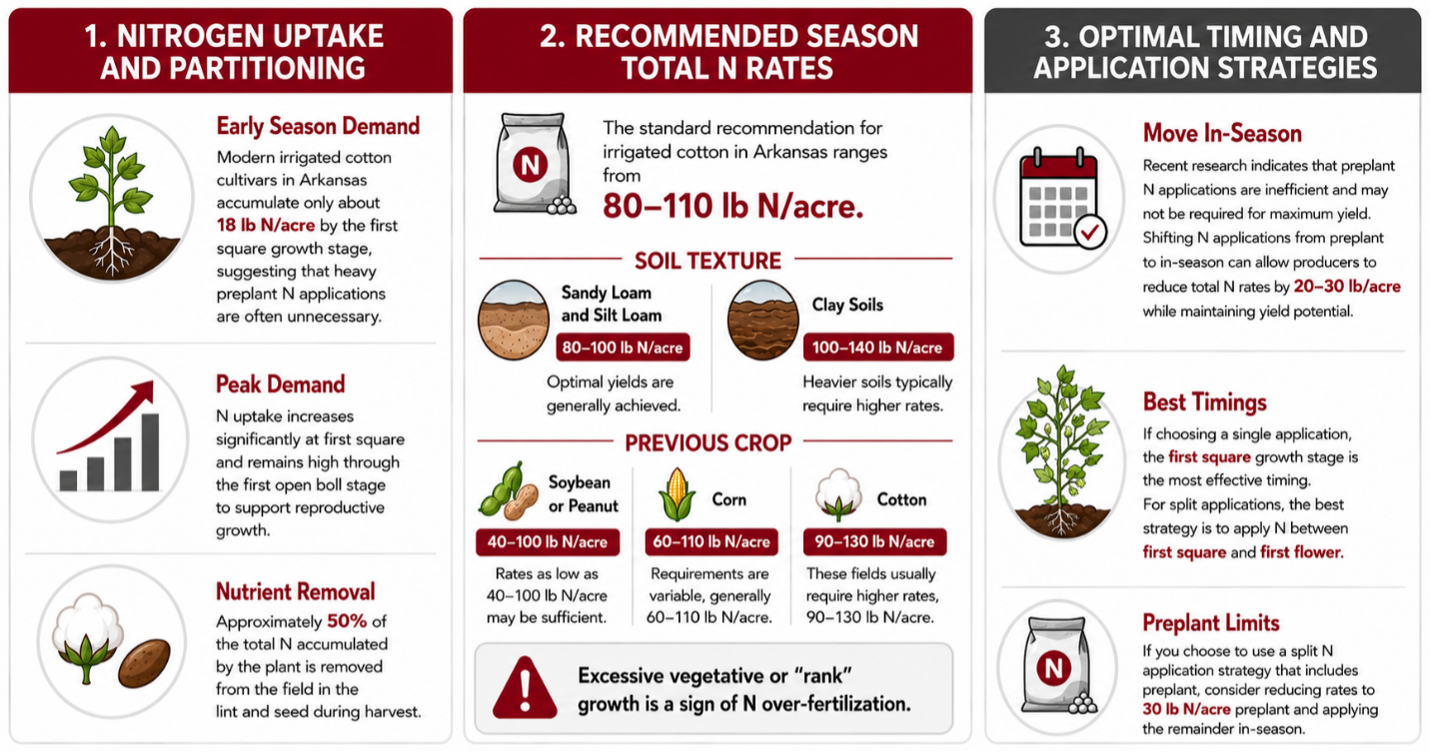
Figure 1 highlights the N uptake and partitioning among plant tissues of modern irrigated cotton cultivars produced in Arkansas. At the first square growth stage, the cotton plant has only accumulated ~18 lb N/acre, highlighting the fact that preplant N is not as critical as once thought. Additionally, at the first square growth stage, N uptake significantly increases and continues through 1st open boll, emphasizing the high N demand during reproductive growth.
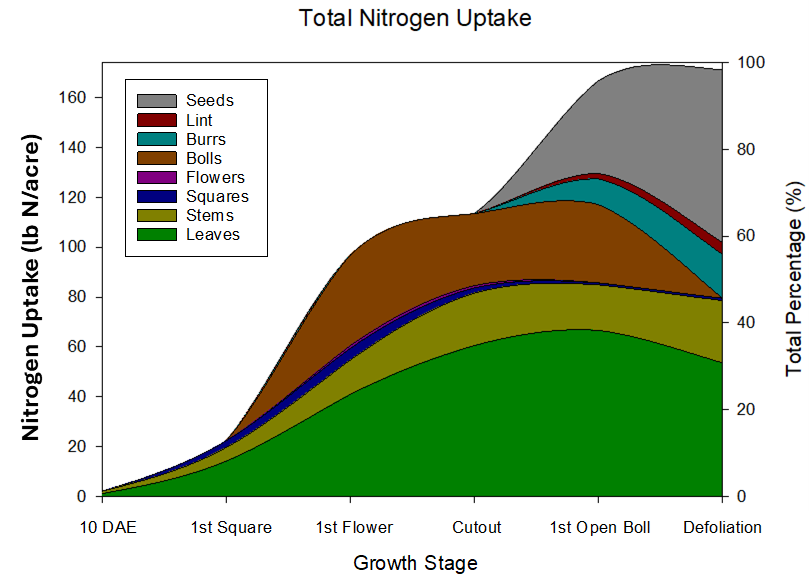
Figure 1. Total nitrogen accumulation and partitioning of irrigated cotton in Arkansas.
Previous N recommendations in cotton have focused on split applications between preplant and in-season timings. Although N management in cotton has been heavily researched, the constantly evolving trait technology and maturities that are now produced require additional research to refine current N recommendations. Roughly 50% of the N that is accumulated by the cotton plant is removed in the lint and seed at harvest, so both the rate and timing of N application is critical.
Season Total Nitrogen Rates
Currently recommended season total N rates for irrigated cotton in Arkansas range from 80-110 lb N/acre and is strongly linked to soil texture and previous crop. Some considerations for season total N rates in cotton:
Soil Texture:
- Sandy Loam and Silt Loam Soils- generally, season total N rates for cotton produced on these lighter textured soils are on the lower end of the suggested range with rates from 80-100 lb N/acre producing optimal yields.
- Clay Soils: generally, season total N rates for cotton produced on heavier textured soils are on the higher end of the suggested range with rates from 100-140 lb N/acre producing optimal yields.
Previous Crop:
- Soybean and Peanut- generally, season total N rates for cotton produced following these crops on silt loam and sandy loam soils are on the lower end of the suggested range with rates from 40-100 lb N/acre producing optimal yields. Recent research on cotton response to N following peanut and soybean have suggested that N rates as low as 40 lb N/acre are adequate to produce maximal yield.
- Corn- generally, season total N rates for cotton produced following corn on silt loam and sandy loam soils are somewhat variable and impacted by the fertilization program in the previous corn crop and environmental conditions. Recent research on cotton response to N following corn has suggested that N rates as low as 60 lb N/acre are adequate to produce maximal yield, but in other situations, rates as high as 110 lb N/acre were needed.
- Cotton- generally, season total N rates of cotton produced following cotton on silt loam and sandy loam soils require slightly higher N rates. Recent research on cotton response to N following cotton has suggested that N rates between 90-130 lb N/A are required to maximize yield.
Nitrogen Application Timing
Historically, preplant N in cotton has been emphasized with as much as 50% of the season total N rate applied preplant. However, recent research across the US Cotton Belt indicates that preplant N applications in cotton are very inefficient and, in some cases, not required to produce maximal yield. A multi-state trial which included several sites in AR compared a split application strategy to single in-season N applications applied at first square. The results of the AR sites suggested that a single in-season application of N applied at the first square growth stage was adequate and, in many cases, resulted in the highest overall yield.
Preplant N Applications- these applications often result in low N use efficiency and may not be required to maximize yield in irrigated cotton production systems. If you choose to use a split N application strategy that includes preplant, consider reducing rates to 30 lb N/acre preplant and applying the remainder in-season.
In-season N Applications- these applications are utilized more efficiently by the cotton crop and increases in efficiency can often lead to either increases in yield with the same total N rate or they can lead to similar yields with reduced N rates. As shown in Figure 1, the critical growth stage where N uptake increases rapidly is the first square growth stage. For any in-season applications, it is critical to have a portion of the N applied near this growth stage. If you are considering multiple in-season applications, the best timing is a split between first square and first flower.
Final Thoughts
There are a multitude of ways to successfully manage N in cotton. However, slight changes can have significant impacts on both yield and profitability. The two primary N sources for cotton are urea and UAN which are both equally reliable sources for N applications to cotton. When using urea for in-season, surface broadcast applications consider using NBPT-treated urea and/or incorporate with rainfall or irrigation to maximize efficiency. If you currently have a heavy preplant N application in cotton, consider moving a portion or all your preplant N in-season. By doing this, you can often cut 20-30 lb N/acre from your season total rate and maintain yield potential. For fields that historically are very rank and require several applications of a plant growth regulator: this is a sign of over-fertilization with N, and these are candidate fields where N can be reduced and still maintain yield. Lastly, in-season N applications can maximize yield with no preplant N. In-season applications of N should be applied at first square or split between first square and first flower to maximize cotton yield.
As always, feel free to reach out with questions regarding optimal N management in cotton.
Research funding support was provided by Cotton Incorporated and Fertilizer Tonnage Fees administered by the Arkansas Soil Test Review Board. The work was also supported by the U.S. Department of Agriculture National Institute of Food and Agriculture, Hatch Project 2934.